
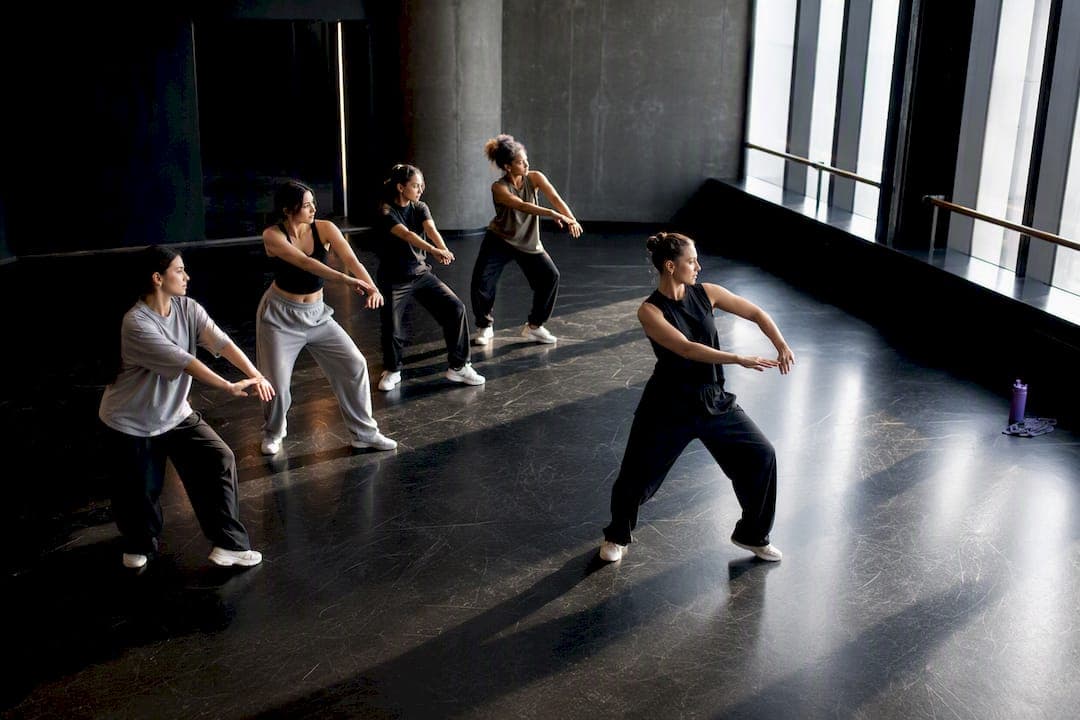
Engagement in dance class means three things at once: students moving and participating (behavioral), students feeling connected and enjoying themselves (emotional), and students genuinely thinking through choreography and technique (cognitive). The research points to three levers that move all three at once: a teacher who builds rapport before pushing corrections, a class structure that satisfies autonomy, competence, and relatedness, and a physical layout that maximizes active practice time over passive demonstration. Everything below unpacks the evidence behind those three levers, then turns them into moves you can use this week.
TL;DR:
- Building rapport before providing corrections helps students accept feedback and maintain engagement throughout the class.
- Incorporating student choice, culturally relevant material, and rotation of partners increases emotional and behavioral participation.
- Structuring class time to maximize active movement during routine and practice segments boosts physical engagement and mood.
- Monitoring participation, mood, and attendance trends allows instructors to assess engagement without overloading their workload.
- Focusing on class sequencing and adjusting the time spent on standing versus moving significantly impacts overall physical engagement levels.
Table of Contents
- The Research Foundations Behind Dance Student Engagement
- What Recent Studies Reveal About Dance Classrooms
- Classroom Strategies That Build Real Participation
- The Teacher's Role in Sustained Engagement
- Structuring Class Time to Maximize Movement and Mood
- How to Track Engagement Without Overloading Your Week
- Making Dance Classes Culturally Meaningful and Inclusive
- Where Studio Operations Support the Pedagogy
- Why Most Engagement Advice Misses the Structural Piece
- Sources
The Research Foundations Behind Dance Student Engagement
The Fredricks framework splits engagement into three parts: behavioral (showing up, trying, participating), emotional (enjoyment, belonging, interest), and cognitive (self-monitoring, problem-solving, applying feedback). A student can be behaviorally present, moving through every combination, yet checked out emotionally or cognitively. Strong programs address all three simultaneously rather than assuming attendance equals engagement.
Self-Determination Theory explains why. Long-term motivation depends on satisfying three psychological needs:
- Autonomy — students feel ownership over choices, even small ones like picking an arm variation
- Competence — students experience visible progress and mastery, not just repetition
- Relatedness — students feel connected to peers and instructor, not isolated in a room of strangers
There's also a mood mechanism worth knowing. A repeated-measures study tracking 4,059 dance sessions found students reported significantly better mood after class than before, with 85.8% of sessions showing maintained or improved mood (session-level effect size, Cohen's d = 0.27). That's a real, repeatable signal, though individual traits predict mood swings better than any single program feature.
What Recent Studies Reveal About Dance Classrooms
Most engagement advice in dance education is anecdotal. A handful of recent studies give you numbers to actually work from.
- An experimental study with 24 youth dancers found that a teacher engagement condition raised student engagement directly, but sequencing mattered: care established early let later corrective feedback land as challenge rather than criticism.
- DanceSport research found passion has a strong direct effect on engagement (path coefficient 0.725), and partnership quality partially mediates that effect (indirect effect 0.137, total 0.862). Translation: who you pair with matters almost as much as how much a student loves dancing.
- A 2015 observational study found routine and practice segments produced 44.2% MVPA (moderate to vigorous physical activity) versus 34.7% during technique segments, meaning class structure itself drives physical engagement.
None of these studies is enormous. The DanceSport sample and the 24-dancer experiment are modest, so treat the effect sizes as directional signals, not universal laws. Still, three separate research lines point the same direction: sequencing, partnership, and structure all move the needle.
Classroom Strategies That Build Real Participation
Engagement rises when students feel some control over what they're doing. Try these, sorted from foundational to advanced:
- Offer choice within structure. Let students pick the final eight counts of a combination, choose the accent in a phrase, or vote on which song plays for warmup. Small autonomy wins compound.
- Scaffold mastery visibly. Break combinations into achievable chunks and give immediate, specific feedback ("your spot is sharper now, land your chin faster next time") rather than generic praise.
- Rotate partners and small groups deliberately. Since partnership quality partially explains engagement gains in DanceSport, don't let the same two students default-pair every week. Rotation builds relatedness across the whole class, not just within one friendship.
- Bring in culturally relevant material. Interest-based, culturally sustaining pedagogies produce measurably greater engagement than pure drill work. A 14-week hip-hop program for adolescent girls, for example, improved motor competence and enjoyment simultaneously. You can find accessible entry points for hip-hop specific programming in resources like this beginner's guide to hip-hop dance and street style.
- Differentiate by age. For early-childhood classes, use imaginative play (animal walks, story-based combinations). For middle schoolers, lean on peer collaboration and short choreography challenges. For teens, give real creative authority: let them choreograph an eight-count and teach it to the class.
Pro Tip: Rotate "student choreographer of the week" starting in upper-elementary classes. It costs nothing, satisfies autonomy directly, and gives you a built-in warmup activity every week.
The Teacher's Role in Sustained Engagement
Teacher behavior is the single most controllable engagement variable in the room, and sequencing is the part most instructors skip.
Start every class with a short rapport ritual: a name check-in, a quick "how's your week" round, or a consistent greeting routine. Students who feel seen tolerate correction better later. Feedback should follow a growth template: name the specific improvement, then give one concrete next step ("your extension opened up, now try keeping your shoulders level through the turn").
The sequencing rule matters most: establish warmth and connection before delivering intense corrective feedback. Research on teacher engagement in dance found that care-first sequencing lets students reframe later low-engagement moments as productive challenge rather than rejection.
Run a quick self-audit weekly:
- Did I greet every student individually?
- Did my feedback include a specific next step?
- Did I rotate who I called on or partnered?
- Did I give at least one autonomy choice this class?
- Did I check in on mood or energy before drilling technique?
Structuring Class Time to Maximize Movement and Mood
Technique segments involve more standing and watching; routine and practice segments involve more moving. Since routine work generates more MVPA than technique drilling, convert passive demonstration time into active repetition wherever you can. Have students mark combinations in small groups while you circulate, instead of everyone watching one demonstration.
- Beginner template (45 min): 10 min warmup, 15 min technique with peer practice pairs, 20 min routine/combination work.
- Teen/intermediate template (60 min): 10 min warmup, 20 min technique with immediate application drills, 30 min choreography and run-throughs.
Pace corrections across the class rather than stacking them at the end, protecting mood and avoiding late-class burnout.
How to Track Engagement Without Overloading Your Week
You don't need a research lab to measure engagement. Three low-burden indicators work: observed participation, a one-item mood check, and attendance trends over time.
| Indicator | Tool | Frequency |
|---|---|---|
| Behavioral participation | 4-item checklist (joined warmup, attempted full combination, offered input, helped a peer) | Every class |
| Emotional state | Single emoji or 1-5 scale mood prompt, pre/post class | Weekly |
| Retention signal | Attendance rate over rolling 4-week window | Monthly |
Aggregate at the class level rather than obsessing over individual sessions. Because individual traits predict mood swings more than program features do, a single low-mood day means little; a downward trend over weeks means something. If you're tracking repeated measures, tell parents and students plainly that you're collecting brief feedback to improve classes, not evaluating individuals.
Making Dance Classes Culturally Meaningful and Inclusive
Interest-based, culturally sustaining teaching consistently beats drill-only formats on engagement outcomes. The mechanism is straightforward: students invest more in material that reflects their identity or lets them shape the narrative.
- Rotate genres and cultural traditions across the semester instead of defaulting to one style all year.
- Build in student storytelling: ask dancers to bring a movement idea from their own background into a combination.
- Use community choreography projects where the whole class contributes phrases, rather than one instructor-authored routine.
- Rotate leadership roles (who leads warmup, who demonstrates) so visibility doesn't concentrate on the same few students.
- Collect anonymous feedback periodically to catch inclusion gaps you might miss from the front of the room.
Where Studio Operations Support the Pedagogy
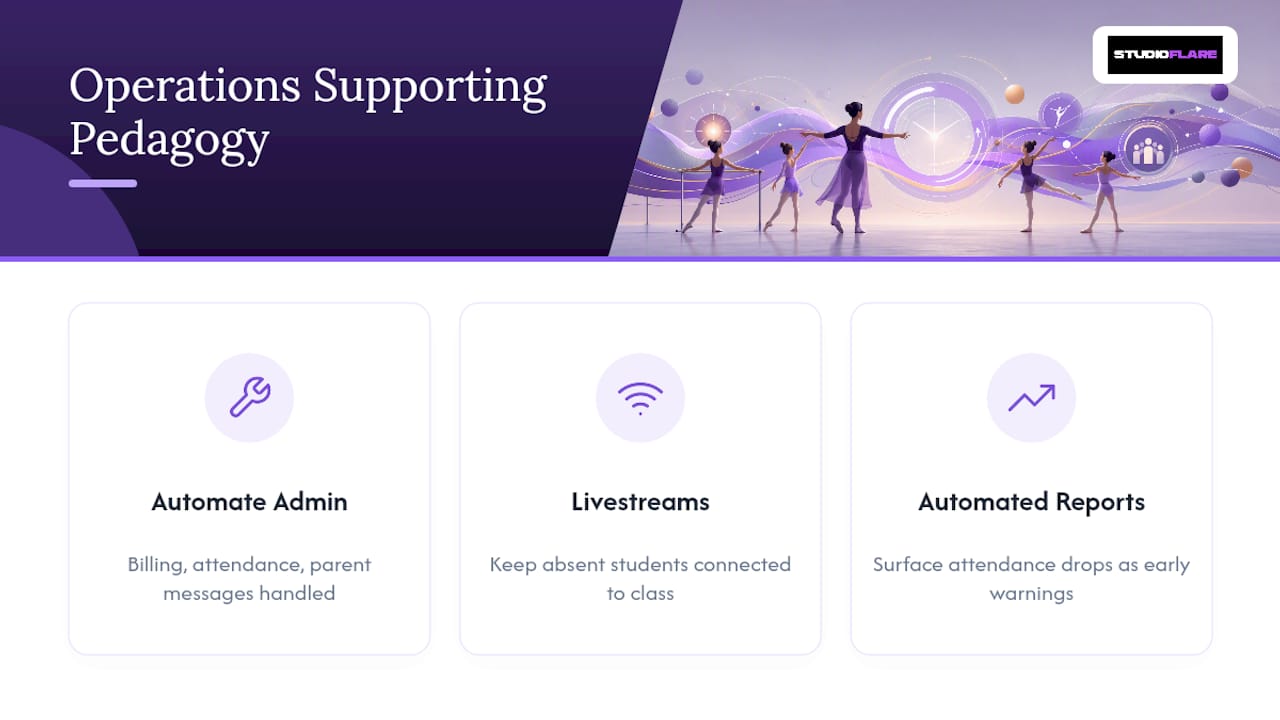
None of the strategies above work if you're spending class-prep time chasing tuition payments or texting parents about schedule changes. Attendance tracking, billing, and parent communication are exactly the kind of repetitive administrative work that a platform for managing studio operations can absorb, freeing instructor attention for the relationship-building and feedback work that actually drives engagement.
Livestream tools extend inclusion to students who miss class due to illness or travel, letting them stay connected to the group instead of falling behind, a use case covered in this guide to livestreaming dance classes. Automated attendance reports also surface early warning signs, a sudden drop in a specific student's attendance often precedes a mood or engagement problem, well before it shows up in a conversation. Studios juggling spreadsheets for attendance tracking often find the manual process itself gets in the way of noticing these patterns early.
Why Most Engagement Advice Misses the Structural Piece
Most engagement advice in dance education focuses entirely on teacher warmth, and that focus isn't wrong, the research on care-first sequencing backs it up. But it's incomplete. The class-structure data is the piece conventional advice skips almost entirely: how you divide time between technique and routine work changes physical engagement by roughly ten percentage points of MVPA, independent of how warm or skilled the teacher is.
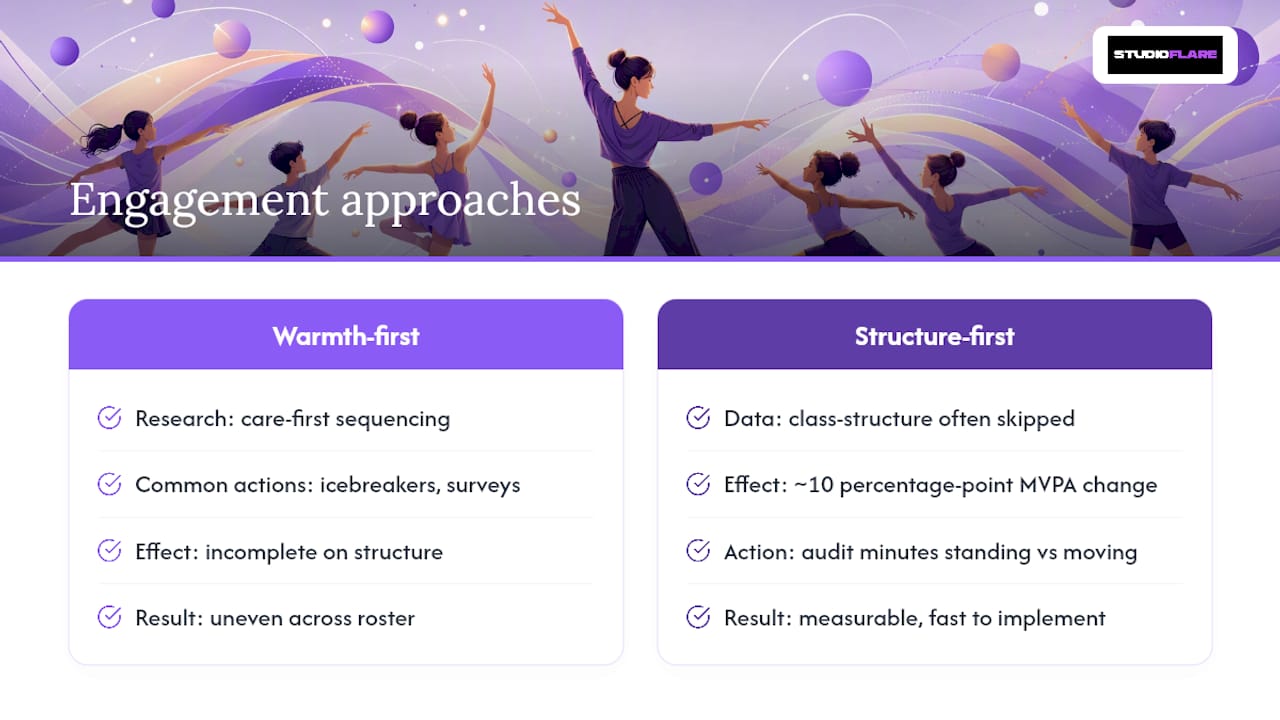
If you can only change one thing this term, don't start with a new icebreaker or a mood survey. Start by auditing your own class time budget: how many minutes go to students standing and watching versus students actually moving. That single structural fix is measurable, fast to implement, and backed by data most studios never look at.
The deeper judgment this research supports is that engagement isn't a personality trait some teachers have and others don't. It's a designable outcome, built from sequencing, structure, and small autonomy choices repeated consistently. Educators who treat it that way, as a design problem rather than a charisma problem, get more consistent results across their whole roster, not just with the students who were already motivated.
— StudioFlare Team
Sources
For deeper study, the teacher engagement thesis covers sequencing experiments in detail. The mood repeated-measures study offers the largest session-level dataset on emotional engagement. The class structure and MVPA study remains the clearest source on physical activity by class segment.
- Self-Determination Theory and exercise adherence (PMC article)
- Mood changes of children and adolescents in dance classes: a prospective repeated-measures study (Frontiers, 2026)
- The impact of teacher engagement on student engagement in dance education (honors thesis, 2024)