

Use a signed liability waiver with assumption-of-risk, release, and medical authorization clauses, and collect it digitally before a student's first class. Require a parent or guardian signature for anyone under 18, and keep timestamped records tied to each signer. Download a working template, adapt the fields to your studio, then have it reviewed by a local attorney and backed by real insurance coverage.
TL;DR:
- A signed digital waiver should include assumption-of-risk, liability release, and medical authorization clauses, with separate signatures for different activities or events.
- Vague or overly broad language in the waiver can be invalid, especially if it attempts to release a studio from gross negligence or intentional harm.
- All participants under 18 must have a parent or guardian sign the waiver, with signatures renewed annually for ongoing participation.
- Digital collection methods must verify signer intent, store timestamped records, and prevent editing to remain enforceable.
- A waiver alone does not replace adequate insurance coverage, which should include general liability, accident, and professional liability policies.
Table of Contents
- What Is a Dance Studio Liability Waiver, and Why Does It Matter?
- Get Your Template: Where to Download and How to Adapt It
- What Does a Dance Studio Waiver Typically Cover?
- What a Waiver Can't Do: Limits and Enforceability Risks
- Who Needs to Sign, and When Do You Need a Separate Waiver?
- How Do Liability Waivers and Insurance Work Together?
- Digital Waiver Collection: Capture, Storage, and Audit Trails
- Customizing Your Waiver: When to Call an Attorney
- Keeping Your Waiver Current as Laws and Programs Change
- StudioFlare Perspective: Operationalizing Waivers Inside Studio Management
- Studioflare: One Platform for Waivers, Registration, and Payments
- Sources
What Is a Dance Studio Liability Waiver, and Why Does It Matter?
A dance studio liability waiver is a signed document where a student, or a parent on a minor's behalf, acknowledges the physical risks of dance and agrees not to sue the studio for ordinary injuries that happen during normal instruction. Legally, it does two things: it establishes assumption of risk (the signer knew injury was possible and chose to participate anyway), and it creates a release of liability (the signer gives up the right to sue for injuries covered by the waiver's terms).
The risk isn't hypothetical. An estimated 23,291 children in the U.S. receive emergency medical treatment annually for dance-related injuries, from ankle sprains to stress fractures from repetitive turns and jumps. A waiver won't prevent those injuries, but it gives your studio a documented record that families understood what they were signing up for.
A well-drafted waiver also functions as a plain-language communication tool. It tells parents what to expect: the physical intensity, the photo policy, the emergency procedures. Standard elements include:
- Identification of the studio and the participant
- Assumption of risk language specific to dance
- Release and indemnification clauses
- Medical treatment authorization
- Photo or media release
- Signature block with date and guardian information for minors
Get Your Template: Where to Download and How to Adapt It
Most studios shouldn't draft a waiver from scratch. Start with a proven dance class waiver form and edit it to match your operation, rather than writing clauses cold. StudioFlare's studio management platform includes digital forms built for this exact purpose, so you're not stitching together a PDF and a separate e-signature app.
Once you have a base template, edit these fields immediately:
- Your studio's exact legal business name (matching your insurance policy and business registration)
- Effective dates and season or session information
- Class types covered (ballet, hip hop, acro, tumbling, aerial, etc., since higher-risk disciplines may need added language)
- Photo and media release scope (recital footage, social posts, marketing use)
- Emergency contact and medical information fields
Don't treat one enrollment waiver as universal coverage for everything your studio does. Competitions, out-of-town trips, and workshops with guest instructors carry different risk profiles than a weekly tap class, and courts tend to look skeptically at a waiver stretched to cover activities it never mentioned.
Pro Tip: Keep your enrollment waiver and your event waivers as separate documents with separate signature dates. If a dispute ever arises, you want a clean paper trail showing the signer specifically agreed to the activity in question, not a blanket form signed months earlier for something else.

What Does a Dance Studio Waiver Typically Cover?
A waiver for dance students is really a set of distinct clauses stacked together, and each one does different legal work. The essential clauses identified in dance injury risk coverage include:
- Identification of parties. Names the studio, the participant, and (for minors) the parent or guardian signing on their behalf.
- Assumption of risk. States plainly that dance involves falls, strains, collisions, and overuse injuries, and that the signer accepts those risks by enrolling.
- Release and indemnification. The signer agrees not to sue for ordinary negligence and, in many versions, agrees to cover the studio's legal costs if a claim is brought anyway. Courts read indemnification clauses narrowly, so overreaching language here often backfires.
- Medical authorization. Permits staff to seek emergency medical treatment for a minor when a parent can't be reached immediately.
- Media and photo release. Grants the studio rights to use recital or class photos and video for marketing, with an opt-out box if your studio offers one.
- Governing law and severability. Names which state's law applies and confirms that if one clause is struck down, the rest of the waiver still stands.
Real published examples make the phrasing concrete. Hunter Dance Center's liability waiver and photo release is a good reference for how a working studio actually structures these clauses side by side on one form.
What a Waiver Can't Do: Limits and Enforceability Risks
A waiver is not a legal shield against everything. Courts across most states won't enforce a release for gross negligence or intentional harm, meaning if a studio ignores a known safety hazard or an instructor acts recklessly, the waiver likely won't protect you. That distinction shapes how the document should be worded.
A few limits every studio owner needs to understand:
- Minors cannot legally sign away their own rights. A parent or guardian must sign, and even then, some states restrict how much a guardian can waive on a child's behalf.
- Enforceability rules vary meaningfully by state, and a few states are notably strict about pre-injury releases involving children.
- Vague or overly broad language ("waives all claims of any kind") can get an entire clause thrown out, where narrower, specific language survives.
- A waiver signed once at enrollment may not automatically extend to a new season, a new activity, or a new instructor without a renewal signature.
This is exactly where a template stops being enough on its own, and why local counsel review matters before you rely on any waiver in a real dispute.
Who Needs to Sign, and When Do You Need a Separate Waiver?
The baseline rule is simple: every enrolled participant signs a waiver before their first class, no exceptions, no verbal agreements. That covers routine instruction, but it doesn't automatically cover everything else your studio does during the year.
Separate event-specific waivers make sense for:
- Off-site recitals or performances at outside venues
- Competition travel, especially overnight trips
- Workshops with guest instructors or unfamiliar choreography
- Higher-risk formats like aerial silks, acro, or partner lifts
For returning students, build waiver renewal into your seasonal registration flow rather than assuming last year's signature still applies. A short annual re-sign, even for the same family, keeps your records current and closes the gap that comes up when a studio tries to rely on a two-year-old signature.
How Do Liability Waivers and Insurance Work Together?
A waiver and an insurance policy solve different problems, and mixing them up is one of the more common mistakes studio owners make. A waiver discourages lawsuits and documents informed consent; it does not pay medical bills, legal defense costs, or a settlement. Waivers and professional liability insurance are meant to work together as layered protection, not as substitutes for each other.
Coverage worth carrying alongside your waiver program:
- General liability insurance, covering slip-and-fall or property damage claims
- Participant accident coverage, which pays medical costs regardless of fault
- Professional liability (errors and omissions), protecting against claims of improper instruction
A signed waiver also strengthens your position when a claim does arise. Underwriters and defense attorneys both view a documented, consistently collected waiver program as evidence the studio takes risk seriously, which can matter at renewal time and during a claims investigation.
Digital Waiver Collection: Capture, Storage, and Audit Trails
Paper waivers get lost, water damaged, or filed in the wrong folder right when you need them most. Digital dance waivers solve that, but only if collected correctly. Electronic signatures on liability waivers are enforceable under the ESIGN Act and UETA when the system properly captures signer intent, consent to sign electronically, verified identity, and a retrievable record.
In practice, that means your online dance waiver workflow should include:
- An emailed signing link sent automatically at enrollment, before the first class
- QR codes posted at check-in for walk-ins or trial students
- Tablet or kiosk signing at the front desk for families without smartphones
- A confirmation record showing exactly what was signed and when
Store these audit details for every signature: timestamp, IP address, the guardian's identity and relationship to the minor, and a locked PDF copy of the exact version signed. Digital dance studio waivers with cloud storage remove the folder-hunting entirely.
Pro Tip: Never edit a waiver template and reuse the same file name. Save each version with a date and a version number, so if a claim surfaces two years from now, you can prove exactly which wording the family agreed to at the time.
Customizing Your Waiver: When to Call an Attorney
Editing dates and class names is safe. Rewriting the liability language yourself is where studios get into trouble. Broad, sweeping indemnification language, or an assumption-of-risk clause that tries to cover gross negligence, tends to get struck down entirely rather than narrowed by a court, which leaves you with less protection than a modest, well-scoped clause would have.
Watch for these red flags before you self-edit:
- Language that tries to waive liability for "any and all" claims without limitation
- Indemnification clauses that make parents responsible for costs beyond what's reasonable for a dance class
- Missing or vague governing-law language when your studio operates across state lines or hosts out-of-state competitors
Bring in a state-licensed attorney when you're adding competition travel, aerial or contact-heavy disciplines, guest instructor arrangements, or anything involving international students. A single review session, often billed as a flat consultation, is far cheaper than defending a poorly worded release form in court.
Keeping Your Waiver Current as Laws and Programs Change
A waiver isn't a document you write once and forget. State law around liability releases shifts, your class offerings expand, and the activities your studio runs this year may look nothing like what you ran three years ago. Treat your waiver like any other compliance document that needs a recurring checkup, not a one-time project.
Set a review cadence, at minimum annually, and re-review sooner any time you add a new activity category (aerial rigs, off-site competitions, a new age group). Track your attorney review date directly on the form or in your records, so you have a clear paper trail showing proactive risk management if a claim ever surfaces.
A few practical triggers that should prompt an immediate waiver review, not just an annual one:
- A change in state law affecting minors and liability releases
- A new type of class or equipment introduced (poles, aerial silks, trampolines)
- An incident or near-miss that reveals a gap in your current wording
- Expansion into a new state or a second studio location with different governing law
Keep old versions archived rather than deleted. If a dispute involves a student who enrolled two seasons ago, you need to produce the exact wording they agreed to, not your current version. Pair that archive with your signed records so each waiver version maps cleanly to the families who signed it. Studios that treat this as routine maintenance, the same way they'd renew an insurance policy, rarely get caught flat-footed when a real question comes up.
StudioFlare Perspective: Operationalizing Waivers Inside Studio Management
Most studios don't lose waiver disputes over bad clauses. They lose them because the signed form never existed in the first place, buried in a filing cabinet or never collected from a trial student who "just wanted to watch one class."
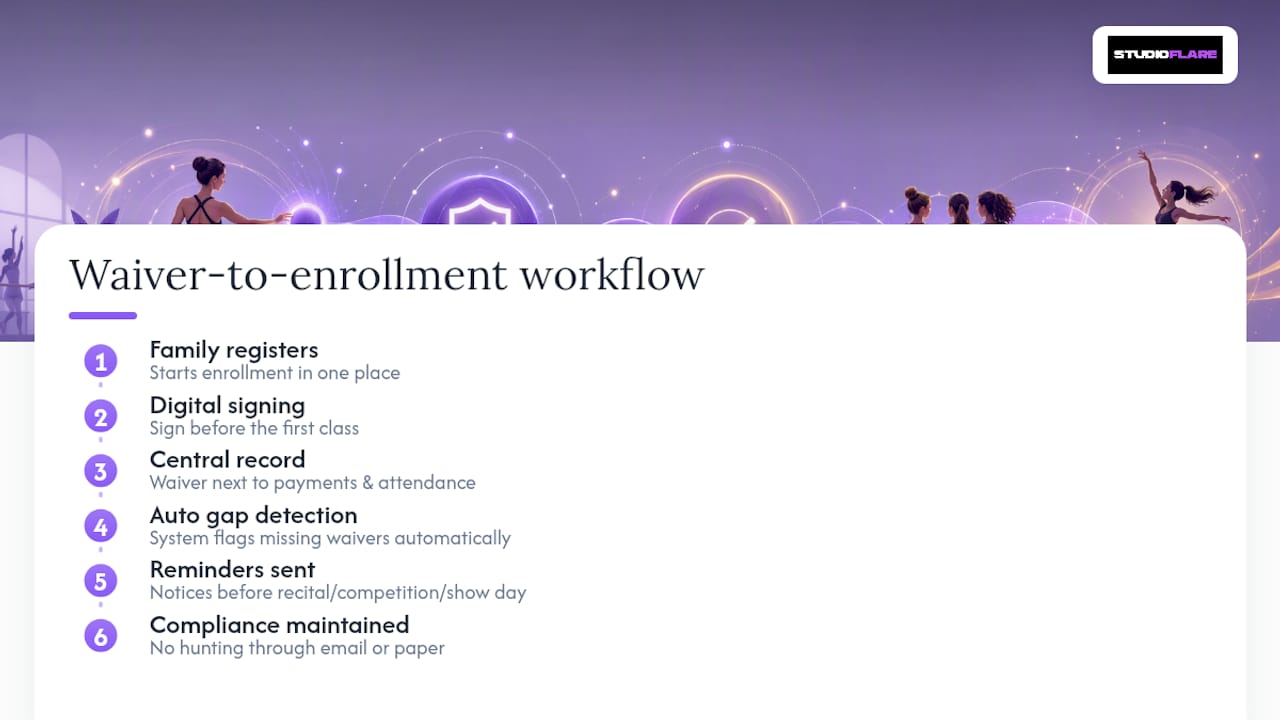
That's an operations problem, not a legal one, and it's why StudioFlare builds digital forms directly into registration and payment workflows instead of treating waivers as a separate task. A student can't complete enrollment without signing, reminders go out automatically to families who haven't, and every signed record lives in one searchable place instead of scattered across email threads and paper folders. Fewer missing waivers at recital time, one branded signing experience, and one source of truth when you need to pull a record fast.
— StudioFlare Team
Studioflare: One Platform for Waivers, Registration, and Payments
Studioflare replaces the paper folder and the separate e-signature tool with one system that ties your waivers directly to enrollment. When a family registers, they sign digitally before the first class, and that signed record sits next to their payment history and attendance, so you're never hunting through email for proof someone actually agreed to your terms.

That matters most during the moments other software treats as an afterthought: recital week, a last-minute trial class, a competition roster due in 48 hours. Instead of chasing down paper forms or manually checking who's signed, Studioflare flags gaps automatically and sends reminders before it becomes your problem on show day. Combine that with automated billing and attendance tracking already built into the same studio management platform, and waiver compliance stops being a separate chore you have to remember.
If you're still juggling spreadsheets, paper forms, and a separate signing app, set up your studio on StudioFlare and see what your enrollment and waiver process looks like when it's actually one workflow instead of three.
This article is general information, not a substitute for advice from a qualified lawyer. Consult a qualified legal professional about your own circumstances before acting on anything here.
Sources
- PubMed: dance-related injuries statistics (2013–2024 aggregate reporting)
- LERM: conference coverage on dance-related injuries and risk clauses
- Nationwide Children's Hospital: increase in dance-related injuries and discussion of layered protections
- Hunter Dance Center — Liability waiver and photo release (PDF)