
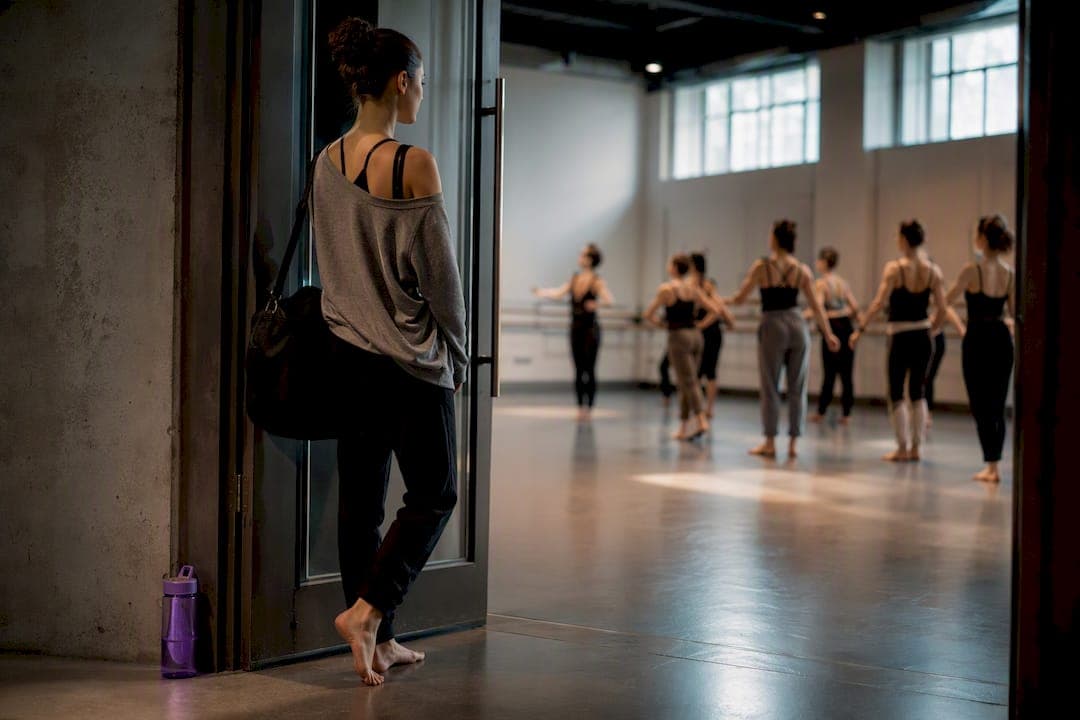
A drop-in dance class is a single session you attend without enrolling in a full term, typically paid for on the spot or through a class pass. Before you show up, check the studio's booking requirement and arrival window. Most studios expect you to register online or arrive early enough to sign a waiver and pay, with pricing typically as a flat single-class fee or a punch on an existing pass.
TL;DR:
- Most studios require online registration or early arrival to secure a drop-in spot, with late arrivals often restricted after ten minutes for safety reasons.
- Make-up classes are typically only offered for illness, injury, or emergencies, and must usually be used within 30 to 60 days, with clear documentation.
- Drop-in fees are higher per session than passes or memberships, which become more cost-effective for frequent attendance, especially over six months.
- Strict policies like 30-day cancellation notice, freeze options, and bounced-payment penalties are common, so reviewing each studio's detailed rules is essential.
- Studios increasingly automate registration, billing, attendance, and livestreaming via systems like Studioflare, streamlining policies and reducing manual errors.
Table of Contents
- How to Register and Pay for a Drop-In Class
- Attendance, Late Arrival, and Make-Up Class Rules
- Passes, Pricing, and How Memberships Differ From Single Drop-Ins
- Common Studio Policy Examples and What They Mean
- How Studios Manage Drop-Ins Behind the Scenes
- Do You Need Dance Experience Before Trying a Drop-In Class?
- What Etiquette Looks Like in a Drop-In Class
- What to Wear to a Drop-In Dance Class
- Drop-In Classes vs. Regular Enrollment: Trade-Offs to Know
- Practical Takeaway: Pick the Right Drop-In Option for Your Goals
- Studioflare: A Better Way for Studios to Handle Drop-Ins
- Sources
- FAQ
How to Register and Pay for a Drop-In Class
Booking a drop-in class usually follows the same basic sequence, whether you're signing up from your couch the night before or walking through the studio door ten minutes early.
- Check the schedule online. Most studios post class times and availability on their website or booking app.
- Register in advance when possible. Some studios, like Keystone Dance Co., require an online form filled out before class, and walk-ins get placed on a waitlist instead of guaranteed entry.
- Sign the waiver. First-timers almost always need to complete a liability waiver, either digitally beforehand or on paper at check-in.
- Pay your way in. Options typically include a card on file, a one-time card swipe at the front desk, an existing class pass, or membership credits.
- Arrive early. Arriving about ten minutes before class start is generally recommended. Some studios waitlist anyone who registers or arrives later than that.
Bring a form of ID if it's your first visit, and have proof of your pass ready if you're not paying by card. Studios juggling drop-ins alongside enrolled students often lean on tools like automated payment collection to keep checkout fast during busy class changeovers.
Attendance, Late Arrival, and Make-Up Class Rules
Lateness rules exist for a reason beyond politeness. Warming up late or missing choreography instructions midway through can be a real safety issue, especially in classes with turns, lifts, or fast group formations. That's why a ten-minute cutoff is common: The Dance School LA states that students arriving ten minutes or later may be asked to sit out entirely.
Make-up policies tend to follow a similar logic. Studios rarely hand out make-up credit for a skipped class just because you changed your mind. What usually qualifies:
- Illness or injury, often with advance notice given to the front desk
- A documented emergency rather than a same-day cancellation
- A make-up used within a set time limit, commonly 30 to 60 days
No-shows on a paid drop-in class are typically non-refundable. If you're on a recurring membership and don't cancel in time, some studios charge the class anyway since the seat was reserved and someone else may have been turned away for it.
Pro Tip: Text or email the front desk as soon as you know you'll miss class, not after. Studios that require "prior notice" for make-up eligibility often interpret that literally, and a message sent an hour before class counts very differently than one sent the next day.
If you need a make-up, ask directly what documentation the studio wants. Some accept a simple text message; others want a note tied to your account before they'll release a credit.
Passes, Pricing, and How Memberships Differ From Single Drop-Ins
A single drop-in class usually costs more per session than any bundled option, which makes sense: you're paying for flexibility with zero commitment. Studios price around that trade-off in a few consistent ways.
- Single drop-in fee: the most expensive per class, no expiration, no commitment.
- Multi-class passes: MPWR Dance sells 14 drop-ins for $210 or seven for $120, both valid for six months and both non-transferable and non-refundable.
- Memberships: flat monthly pricing for a set number of classes or unlimited attendance, often with a pause option for travel.
- Enrollment credit: some studios, including Raino Dance, apply your drop-in fee toward tuition if you enroll in that same class within a week.
If you attend once a month, stick with single drop-ins. If you're averaging two or more classes a week, a pass or membership almost always wins on cost per class, just watch the validity window so you don't lose unused credits when the six months run out.
Common Studio Policy Examples and What They Mean
Policy pages read like fine print until you actually need them, which is exactly when the wording starts to matter. A few clauses show up again and again.
- 30-day drop notice. The Dance School LA requires written notice a full month before you stop a recurring enrollment, plus a processing fee for changes or cancellations.
- Freeze options. Pausing your spot for travel or injury is often allowed, sometimes for a small monthly holding fee instead of full tuition.
- Bounced-payment penalties. A failed card charge can trigger a late fee on top of the original tuition.
When you're scanning a studio's policy page, jump straight to the sections labeled "cancellation," "refunds," or "attendance." That's where the real terms live. MPWR Dance's drop-in pass terms run barely a paragraph, and the entire non-refundable, six-month validity rule is in it.
Red flags worth watching for: refund language that's vague instead of specific, make-up rules that never mention a time limit, or administrative fees that only appear after you've already signed up.
How Studios Manage Drop-Ins Behind the Scenes
Waitlists exist because class capacity is a real constraint, not just a formality. When registration closes ten minutes before start time, the studio is protecting instructor bandwidth and floor space, not being difficult.
- Grace periods for late registration typically run five to ten minutes before the studio shifts you to a waitlist.
- Livestream drop-ins usually use time-limited access links, so the stream opens shortly before class and closes shortly after.
- Attendance tracked at check-in, rather than guessed at after the fact, cuts down on billing disputes over no-shows.
- Automated billing tied to attendance records means fewer arguments about who actually showed up and who owes what.
Platforms like Studioflare bundle registration, attendance tracking, livestreaming, waivers, and billing into one system, which is part of why more studios are moving away from spreadsheets and group texts for exactly this kind of policy enforcement.
Do You Need Dance Experience Before Trying a Drop-In Class?
Most drop-in classes list a level right in the schedule: beginner, intermediate, advanced, or "all levels." That label is worth taking seriously before you book. A beginner hip-hop or contemporary class assumes zero background and moves at a teaching pace, while an intermediate ballet or advanced jazz class often assumes you already know terminology, can pick up combinations quickly, and won't need basic technique explained.
"All levels" classes are the safest bet if you're unsure, since instructors typically modify combinations on the fly for different skill bands in the same room. Genre matters here more than raw experience. Someone with years of ballet training can still walk into an intermediate hip-hop class and feel lost, because the vocabulary and movement quality don't transfer directly.
If a studio doesn't list a level, call or message before you book instead of guessing. Front desk staff will usually tell you honestly whether a class runs fast for newcomers. It also helps to ask what a typical class structure looks like: some intermediate classes spend half the session on drilling technique, which is far more approachable for a first timer than a class that jumps straight into full combinations across the floor.
One rule of thumb that holds up across most genres: if you can follow choreography by watching once or twice and don't need every step broken down individually, you're probably ready for that level.
What Etiquette Looks Like in a Drop-In Class
Walking into a room full of regulars as a one-time visitor comes with a few unwritten rules, and following them makes the class better for everyone, including you.
Arrive with enough time to find a spot on the floor without disrupting warmup, and default to the back or side rows unless the instructor directs you elsewhere. Regulars often have unofficial "usual spots," and taking one without knowing it can create friction before class even starts. Keep phones off and put away, not just silenced, since even a glance at a screen during choreography breakdown throws off your own timing and can distract dancers around you.
Talking during instruction is one of the fastest ways to stand out for the wrong reason. Save questions for a natural pause, or ask the instructor directly after class if something didn't click. If you don't know the choreography yet and the room is moving fast, it's fine to mark movements smaller or step to the side during a run through rather than forcing your way through steps you haven't learned.
Thanks to the instructor on your way out. It's a small habit, but it's standard in most studio cultures and it's noticed when it's skipped.
What to Wear to a Drop-In Dance Class
Footwear and attire expectations depend heavily on genre, and showing up in the wrong gear can genuinely limit what you're able to do in class.
Ballet classes almost always require ballet shoes and fitted clothing so the instructor can see your alignment. Jazz and contemporary classes typically call for jazz shoes or bare feet, with fitted or semi-fitted clothing that won't restrict movement. Hip-hop classes are the most forgiving on attire: sneakers with good grip and comfortable, unrestrictive clothes are standard. Tap requires tap shoes, full stop, since the class doesn't function without them.

Avoid loose jewelry, baggy clothing that obscures your lines, and street shoes with heavy tread in a studio that has a sprung or hardwood floor, since some studios explicitly prohibit outdoor shoes to protect flooring. If you're unsure what a specific class requires, check the studio's website or call ahead. Most list attire expectations directly on the class description, and showing up unprepared is one of the most common first-timer mistakes.
Drop-In Classes vs. Regular Enrollment: Trade-Offs to Know
Drop-ins exist for flexibility, and that flexibility is real: no long-term commitment, no term-long tuition, and no penalty if your schedule changes week to week. That makes them ideal for travelers, casual dancers, or anyone testing a new studio or genre before committing.
The trade-off shows up in continuity and cost. Raino Dance restricts drop-ins entirely for some short-term programs, and drop-in students are often barred from performing in year-end showcases since choreography builds over the full term. Regular enrollment also tends to be cheaper per class once you're attending consistently, and it usually comes with priority registration when popular class times fill up.
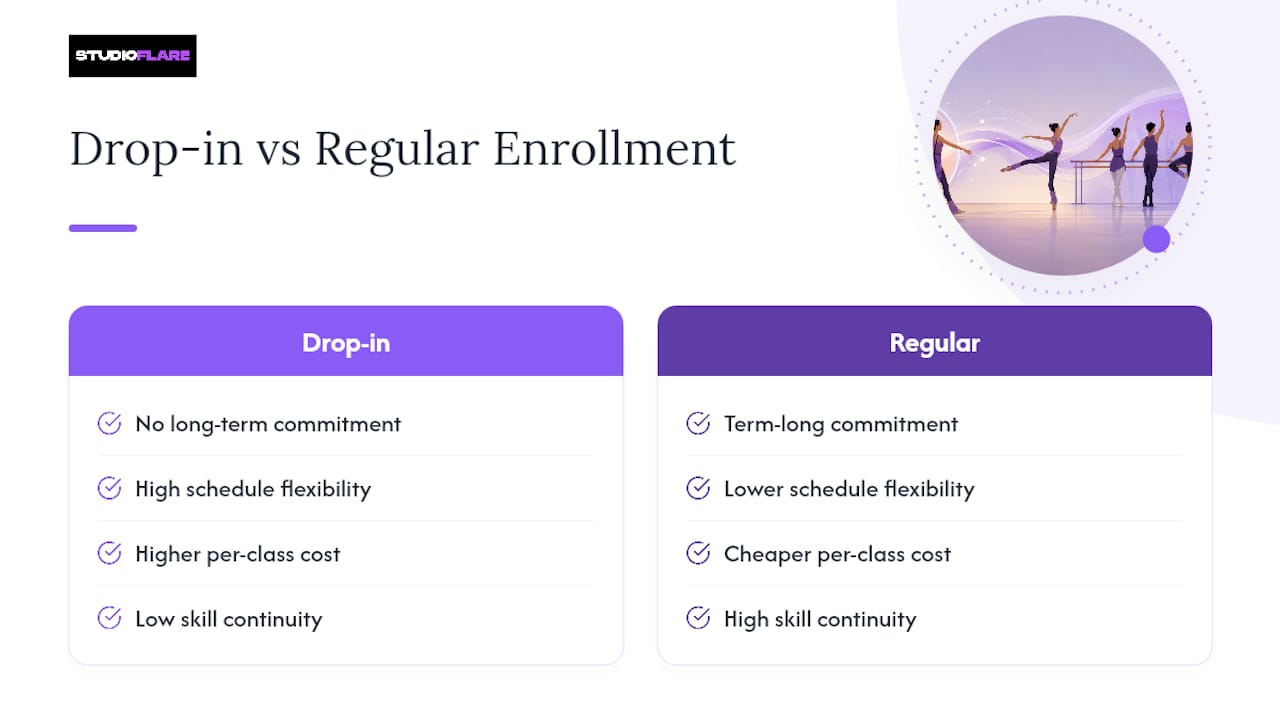
If your goal is steady skill progression, especially in technique-heavy genres like ballet, regular enrollment builds foundational strength that a once-a-month drop-in simply can't replicate. If your goal is variety, flexibility, or just staying active without a schedule commitment, drop-ins are the better fit; just go in knowing you'll be paying a premium per class for that freedom.
Practical Takeaway: Pick the Right Drop-In Option for Your Goals
Single drop-ins make sense if you're traveling, testing a new studio, or attending less than once a week. Once you're going more often, a pass or membership almost always costs less per class, so run the math before you keep paying full price out of habit.
Prioritize studios that spell out their waitlist and make-up rules clearly rather than burying them in vague language, and check whether virtual access exists for weeks you can't make it in person. If regular attendance is the plan, look specifically for credit or rollover protections so a busy month doesn't mean losing money you already spent.
— StudioFlare Team
Studioflare: A Better Way for Studios to Handle Drop-Ins
Every policy detail covered above, the waitlist cutoffs, the make-up documentation, the pass validity windows, exists because studios are juggling registration, billing, and attendance manually or across scattered tools. Studioflare replaces that patchwork with one system built specifically for dance studios, not generic fitness centers, combining online registration, automated tuition billing through Stripe, built-in livestreaming with access control, digital waivers, and attendance tracking in a single dashboard.

That matters directly for the policies students run into. A studio using Studioflare can enforce a waitlist cutoff automatically, tie livestream links to paid registration, and settle no-show disputes with a real check-in record instead of a guess. Pricing runs $29 a month on the Starter plan or $49 a month on Pro, plus $1 per active student, with no setup fee and no contract locking you in. If you run a studio and want to see how it handles drop-in traffic without the spreadsheet chaos, create your studio account and try it against your current system.
Sources
- Drop-in & Pop-Up Classes — KEYSTONE DANCE CO.
- Policies | The Dance School LA
- Policies & Pricing — Raino Dance
FAQ
What Is a Drop-In Class in Dance?
A drop-in class is a single dance session you can attend without enrolling in a full session or term. You typically pay a one-time fee or use an existing class pass, and most studios still require basic registration or a signed waiver before you join.
What Are the Rules in a Dance Class?
Rules vary by studio, but the common ones cover arrival time, attire, and behavior during instruction. Most studios enforce a lateness cutoff around ten minutes, as seen at The Dance School LA, and expect students to stay off their phones and follow the instructor's pacing without talking over combinations.
What Does "Drop-In Class" Mean?
It means attending a single class as a one-time visitor rather than committing to a full term of weekly sessions. The term applies whether you're paying per class, using a punch from a multi-class pass, or drawing down membership credits.
Can I Write Off Dance Classes on My Taxes?
Dance classes are generally not tax deductible if they're for personal enjoyment or general fitness. Deductibility depends heavily on your specific situation, such as classes required for a job or a documented medical treatment, so check with a tax professional rather than assuming either way.