

The fastest way to stop losing subscription revenue to failed payments is an automated, segmented retry-and-dunning flow that pairs smart retries with timely, targeted customer outreach. Three things need to be in place this month: decline classification (soft vs hard), a retry schedule tied to a hosted update-payment flow and communication that starts within 24 hours of the failure, not a week later.
Get those three right before touching anything more complex.
- Classify every decline as soft or hard before you decide how to respond.
- Build a retry schedule with a low-friction update-payment link attached to every message.
- Start outreach soon after the failure and escalate tone across the sequence.
Quick metric to watch first: recovered MRR divided by total failed-charge attempts. If that ratio is not visible on a dashboard right now, that is the first gap to close, ahead of any tooling decision.
Key Takeaways
Automated, segmented retry-and-dunning flows recover more failed subscription revenue than any single tool or manual follow-up process alone.
| Point | Details |
|---|---|
| Segment before retrying | Classify every decline as soft or hard, since each requires a different recovery action. |
| Start outreach within 24 hours | Delayed communication lets recoverable soft declines slide into involuntary churn. |
| Build a hosted update-payment page | A direct, low-friction update link improves conversion more than a generic failure notice. |
| Track recovery rate weekly | Divide recovered dollars by failed attempts to measure whether your sequence is actually working. |
| Studios can bundle billing and reminders | StudioFlare combines Stripe billing, automated reminders, and hosted update pages in one platform built for dance studios. |
Table of Contents
- What Is Failed Payment Recovery and Why Does It Matter?
- What Causes Failed Payments, and How Do You Classify Them?
- How Do You Build a Recovery Flow That Actually Works?
- Which Automation Tools Handle Failed Payment Recovery?
- What Metrics Should You Track and Test?
- What Mistakes Quietly Drain Recoverable Revenue?
- What Should Payment Ops Teams Prioritize First?
- An Integrated Option for Dance Studio Billing
- Frequently Asked Questions
- Sources
What Is Failed Payment Recovery and Why Does It Matter?
A failed payment happens when a scheduled subscription charge cannot be authorized or captured. The card gets declined, the bank flags it, or the processor times out before the transaction clears. Card data can also be stale between authorization and capture, especially on annual plans where a card has expired since the last successful charge.
Left alone, these failures don't stay flat. Involuntary churn compounds every billing cycle, since each unresolved decline removes a paying account without any cancellation decision from the customer. Stripe's guidance on failed payment recovery notes that starting dunning communications within 24 hours and segmenting declines into soft versus hard categories measurably improves recovery outcomes.
For a subscription business, this isn't a rounding error. They just silently stopped paying.
What Causes Failed Payments, and How Do You Classify Them?
Most declines trace back to a short list of causes: expired or replaced cards, insufficient funds, issuer fraud or velocity flags, processor timeouts, and simple data mismatches like a wrong billing zip code.
The critical operational move is separating these into two buckets:
- Soft declines are transient. Insufficient funds, a temporary bank hold, or a network timeout often resolve on their own within days.
- Hard declines require customer action. An expired card, a closed account, or a fraud block will not fix itself no matter how many times you retry it.
Stripe recommends applying different actions to each class rather than running one blanket retry policy across every failure. Retrying a hard decline five times wastes processor calls and can trigger additional fraud scrutiny. Prompting a customer to update their card for a soft decline creates unnecessary friction for something that might resolve itself in 48 hours.
Pro Tip: Pull the decline code on every failed transaction and build a simple lookup table mapping codes to actions. Decline-code management turns retry logic from a guessing game into a rules engine, and it's the single easiest automation win most teams skip.
How Do You Build a Recovery Flow That Actually Works?
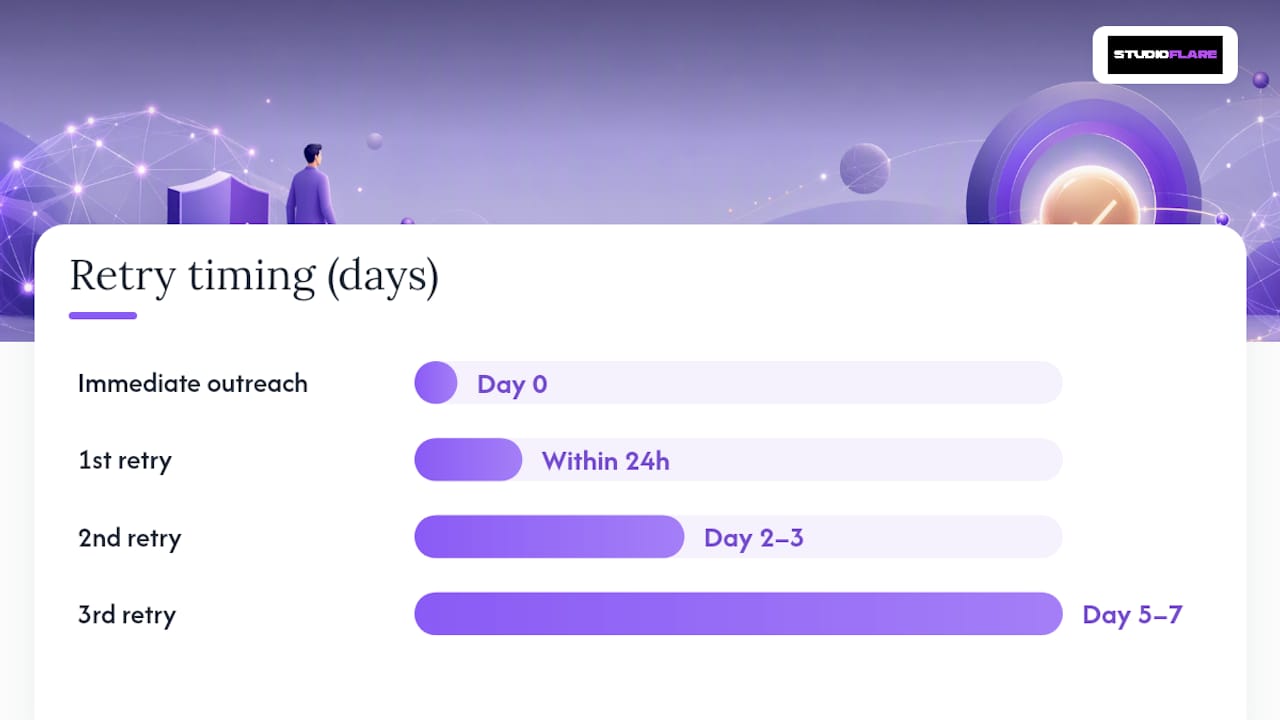
Before any retry fires, run three checks: confirm the card updater has synced the latest card data, verify the account isn't already flagged for cancellation, and log the decline code so you know which bucket you're in. Skipping this step means retrying charges that were never going to succeed.
From there, the flow follows a simple structure:
- First failure (day 0): Automatic retry within hours for soft declines. Send a low-key email: "We had trouble processing your payment. No action needed yet, we'll try again shortly."
- Second failure (day 2 to 3): Retry again, escalate the message. Include a direct link to a hosted update-payment page. "Your payment still hasn't gone through. Update your card in under a minute."
- Third failure (day 5 to 7): Final automated retry plus SMS or in-app prompt if available. Message tone shifts to urgency: "Your subscription will pause in 3 days unless we can process payment."
- Hard decline at any point: Skip retries entirely. Go straight to direct outreach asking the customer to update their payment method.
Timely, short reminders tied to a clear update link consistently improve update-payment conversion for subscription and membership businesses, more than generic "your payment failed" notices sent without a clear next action.
| Attempt | Timing | Decline type | Action |
|---|---|---|---|
| 1st retry | Within 24 hours | Soft | Automatic retry, soft-tone email |
| 2nd retry | Day 2 to 3 | Soft | Retry + hosted update-payment link |
| 3rd retry | Day 5 to 7 | Soft | Final retry + SMS/in-app prompt |
| Immediate outreach | Day 0 | Hard | Skip retries, request card update directly |
Every recovery message needs to state clearly what happened, what the customer needs to do, and by when, without implying a debt collection notice. Keep language factual and specific to the subscription itself.
One compliance note worth baking into every template: avoid language that implies debt collection or legal consequence, since these are recurring service charges, not delinquent accounts, and the tone of your messaging should reflect that distinction.
Which Automation Tools Handle Failed Payment Recovery?
Four broad categories cover most of the market, and picking one depends on engineering bandwidth and monthly transaction volume more than on brand preference.
- Orchestration and smart-retry platforms (like Butter) route failed transactions through retry logic and sometimes across alternate processors. Highest control, highest integration effort.
- Billing platforms with built-in dunning (like Chargebee or Paddle) bundle subscription billing with retry schedules and templated communication out of the box. Lower setup effort, less granular control over routing.
- Payment processors with native retry tools (like Stripe Billing) offer smart retries and card-updater services directly inside the payment stack you likely already use.
- Homegrown scripts built on processor APIs give full flexibility but require ongoing engineering maintenance as decline codes and card networks change.
Orchestration, meaning routing a retry through a secondary processor or route, becomes worth the added complexity once a business sees declines clustered around network routing or bank relationship issues rather than customer-side problems. Below a few thousand transactions a month, that complexity rarely pays for itself.
For dance studios specifically, a platform like StudioFlare that bundles Stripe billing with automated reminders and hosted update pages removes most of the integration work smaller studios can't staff for.

Pro Tip: Don't add orchestration before you've fixed your retry timing and messaging. Teams jump to complex routing to solve a problem that a better dunning sequence would have fixed for free.
What Metrics Should You Track and Test?
Five numbers matter more than any dashboard vanity metric: recovery rate (recovered dollars divided by failed attempts), involuntary churn rate, net MRR retained, update-payment conversion rate, and time-to-recovery from first failure to resolution.
Calculate recovered MRR using a fixed attribution window, typically 14 to 30 days from the initial failure, so a payment that resolves on its own weeks later doesn't get falsely credited to your retry sequence.
- Test retry timing (24 hours vs 48 hours for the first attempt).
- Test messaging tone (soft reminder vs urgency-forward copy).
- Test a hosted update page against an in-app prompt for conversion.
Pro Tip: Run each test for at least one full billing cycle, and don't call a winner until you have at least a few hundred failed transactions in each variant. Subscription cohorts are small and noisy; a two-week test on 40 declines will lie to you.
What Mistakes Quietly Drain Recoverable Revenue?
The recurring pattern: one retry schedule for every decline type, generic emails sent days too late, no hosted update page, decline codes ignored entirely, and zero A/B testing on any of it.
Run this in a single afternoon: confirm the card updater is active, verify the retry schedule is actually firing, click through the update-payment page yourself, check that decline codes are being logged, and make sure templates exist for every stage of the sequence.
Pro Tip: Any account with three or more consecutive hard declines and no customer response should get flagged for manual review, not another automated email. That's usually a dead card or a customer who's already decided to leave.
What Should Payment Ops Teams Prioritize First?
Classify declines and get a low-friction update-payment flow live before investing in orchestration or complex routing. Once volume climbs and single-processor retries plateau, that's the signal to evaluate smart-retry platforms or multi-processor routing.
An Integrated Option for Dance Studio Billing
Dance studios running payment recovery through spreadsheets and manual follow-up texts lose the exact revenue this playbook is built to save. StudioFlare bundles automated Stripe billing, timed payment reminders, and a hosted update-payment page into the same platform where you already manage registrations and attendance, so studios don't need to stitch together three separate tools to run a proper dunning sequence.

If your studio is still running billing through a legacy system or a patchwork of spreadsheets and texts, StudioFlare's dance studio management platform replaces that setup with automated retries and reminders built in from day one. Studios switching from older tools can see how the transition works on the Mindbody alternative page, or go straight to creating a studio account to see the billing flow in action.
Frequently Asked Questions
What is the fastest way to reduce failed payments in a subscription business? Segment declines into soft and hard categories, then apply an automated retry schedule with escalating messages for soft declines and direct outreach for hard ones. This single change usually recovers more revenue than any other adjustment.
How many times should you retry a failed payment? Three attempts spread across roughly a week works well for soft declines: one within 24 hours, a second at day 2 or 3, and a final attempt around day 5 to 7. Hard declines should skip retries and go straight to customer outreach.
What's the difference between a soft decline and a hard decline? A soft decline is temporary, often caused by insufficient funds or a processing timeout, and frequently resolves on its own. A hard decline, like an expired card or a fraud block, requires the customer to take action before the payment can succeed.
Do failed payment recovery tools actually increase revenue? Recovery flows built around timely communication and hosted update pages consistently lift update-payment conversion for subscription and membership businesses, though the exact uplift depends on your baseline decline rate and current messaging.
How does StudioFlare help with failed payment recovery for dance studios? StudioFlare integrates Stripe billing with automated reminders and hosted update pages, so studios get a working recovery flow without building one from separate tools.
This article is general information, not a substitute for advice from a qualified financial advisor. Consult a qualified financial professional about your own circumstances before acting on anything here.
Sources
- Failed payment recovery 101 (Stripe resources)
- Retries (Stripe orchestration docs)
- Decline-code management (JPMorgan merchant services)