

A family tuition cap is a billing policy that limits what a household pays for regular class tuition to a fixed maximum, no matter how many kids are enrolled. It solves two problems at once: it simplifies billing for you, and it takes the sticker shock out of enrolling a third or fourth child. The rest comes down to picking the right model, protecting your margin, and writing the policy so nobody argues about it later.
TL;DR:
- Setting a family cap requires careful calculation to ensure it does not reduce revenue below your profit margins.
- Excluded fees such as costumes, competition dues, and private lessons should be clearly defined and kept outside the cap to prevent disputes.
- Automating billing with management software helps enforce the cap accurately and reduces errors across multiple households.
- Launch the cap at the start of a season or semester with transparent communication to prevent billing disagreements.
- Monitoring revenue per family and churn rates during the first season is essential to verify the cap's impact on margins and retention.
Table of Contents
- How a Family Tuition Cap Works: Models and Exclusions
- Weighing the Upside Against the Real Risk
- Setting the Cap Amount: A Design Checklist With Real Numbers
- Setting Up Automated Billing So the Cap Runs Itself
- Writing the Policy So Parents Don't Push Back
- Tracking Whether the Cap Is Actually Working
- What Studios That Test This Actually Learn
- Automate Your Family Cap With StudioFlare
- Sources
How a Family Tuition Cap Works: Models and Exclusions
Most studios build their cap around one of three structures. A monthly family cap sets a flat ceiling on what a household pays each billing cycle, regardless of enrollment count. A seasonal family cap applies the same logic but locks in the number for the full season, which works well if you bill in installments rather than monthly. A per-student cap with a family ceiling charges normally per dancer until the household total hits a set number, then stops adding charges beyond that point.
Caps almost always stack awkwardly with sibling discounts, so most studios pick one or the other rather than running both. A hard cap typically replaces a sibling discount entirely, since it already delivers the savings a discount would.
Fees the cap does not touch usually include:
- Registration fees
- Costumes and recital admission
- Competition team or company dues
- Private lesson bookings
Center Stage Dance's posted pricing is a clean real-world example: a Family Max Tuition Plan at a fixed monthly amount, with performance and annual fees carved out separately.
Weighing the Upside Against the Real Risk
The upside is straightforward. A family cap turns a confusing, per-child invoice into one predictable number, which is a real selling point when you're recruiting multi-child households. Families with two or three dancers stop doing math in their heads before signing the third kid up for tap, and your front desk stops fielding "wait, why is this so much" calls every August.
The risk is just as real. A flat cap can quietly erode revenue if you set it without running the numbers first, and every excluded fee you don't clearly define becomes a future dispute. Costume charges, competition dues, and makeup fees all need to sit outside the cap in writing, or you'll be refunding money you didn't budget to lose.
- Benefit: simpler, more predictable billing for multi-child families
- Benefit: a genuine differentiator when families comparison shop studios
- Risk: revenue leakage if the cap sits below your real per-family average
- Risk: bookkeeping confusion when excluded fees aren't itemized separately
Pro Tip: Run your cap idea past your actual numbers before you announce it. Dance Teacher's guidance on discount economics is blunt about this: discounts and caps that ignore profit margin can turn a marketing win into a quiet loss.
Setting the Cap Amount: A Design Checklist With Real Numbers
Picking a number without doing the math is how caps eat into margin. Work through these steps in order.
- Calculate your average tuition per student. Say your studio averages $140 per student per month across all class types.
- Figure out what a typical three-child family currently pays. At $140 each, that's $420 a month before any discount.
- Model your cap against that baseline. A cap set at the example family max tuition plan amount saves that family a significant amount each month, a discount that should be checked against your margin, not just what sounds generous. Check that percentage against your margin, not just against what sounds generous.
- Cross-check against margin guidance. Dance Teacher's reporting on studio discounting suggests most studios can safely absorb 5% to 10% off gross tuition without hurting the bottom line. A cap that discounts a three-child family by 23% only works if your per-student margin has room for it.
- Decide what's included and what stacks. Lock in that the cap covers only weekly group classes, and state plainly whether it can combine with any other discount (usually it should not).
- Set proration rules for mid-season enrollment. If a family adds a second dancer in week six of a twelve-week session, decide whether the cap applies from that billing cycle forward or gets prorated for the remaining weeks. Most studios apply it starting the next full billing cycle to keep the math simple.
- Pick an effective date and stick to it. Launch caps at the start of a season or semester, never mid-cycle, so nobody is comparing two different invoices for the same month.
Setting Up Automated Billing So the Cap Runs Itself
Manual math on family caps is where mistakes happen. Somebody forgets to zero out the third child's invoice, a card declines and nobody notices until the family owes two months at once, or a refund gets issued against the wrong account. The fix is building the cap into your billing cadence instead of your front desk's memory.
Decide first whether you're billing monthly or in seasonal installments. Kerry's Dance Center's published policies show a common seasonal approach, splitting tuition across nine and a half to eleven payments rather than a flat monthly number, which changes how your cap math applies each cycle.
Inside your studio management software, you'll generally need to:
- Link all dancers in a household to a single family account
- Flag which fee categories sit outside the cap
- Set autopay and card-on-file rules so declined payments don't quietly break the cap logic
- Build a refund policy for families who drop a child mid-cap-period
Platforms built specifically for dance studios, including StudioFlare, now treat family-level billing as a standard feature rather than a workaround, which matters once you're managing dozens of capped households instead of three.
Writing the Policy So Parents Don't Push Back
The cap only works if families understand it before they hit checkout, not after their first confusing invoice. Put the actual number and its exclusions on your registration page and inside the parent portal, not buried in a PDF nobody opens.
A workable policy paragraph reads something like this:
Three questions come up constantly, so answer them before parents ask:
- Does the cap include costumes? No, costume and recital fees bill separately.
- What if I add a third child mid-season? The cap applies starting the next full billing cycle.
- Can I combine this with a sibling discount? No, the cap already reflects the household savings.
Clarity here does double duty. It heads off billing disputes, and it borrows a lesson from outside the dance world too. Trailmark's piece on hidden fee disclosure makes the same point for school-related purchases: parents forgive a cost, but they don't forgive being surprised by one.
Tracking Whether the Cap Is Actually Working
Set a measurement plan before you launch, not six months after. Three numbers matter most: average revenue per family (ARPF), churn rate by household, and how much you're actually collecting in excluded fees like costumes and competition dues.
- Pull ARPF and churn baselines before the cap goes live
- Recheck both numbers at the 90 day mark
- Set a decision threshold in advance, such as reviewing the cap if ARPF drops more than 5%
- Do a full review at season's end regardless of how the 90 day check looked
If you're nervous about rolling this out studio-wide, run it as a cohort test first. Cap tuition for new multi-child enrollments only, leave existing families on standard billing, and compare ARPF and retention between the two groups for a full season before deciding to expand it.
What Studios That Test This Actually Learn
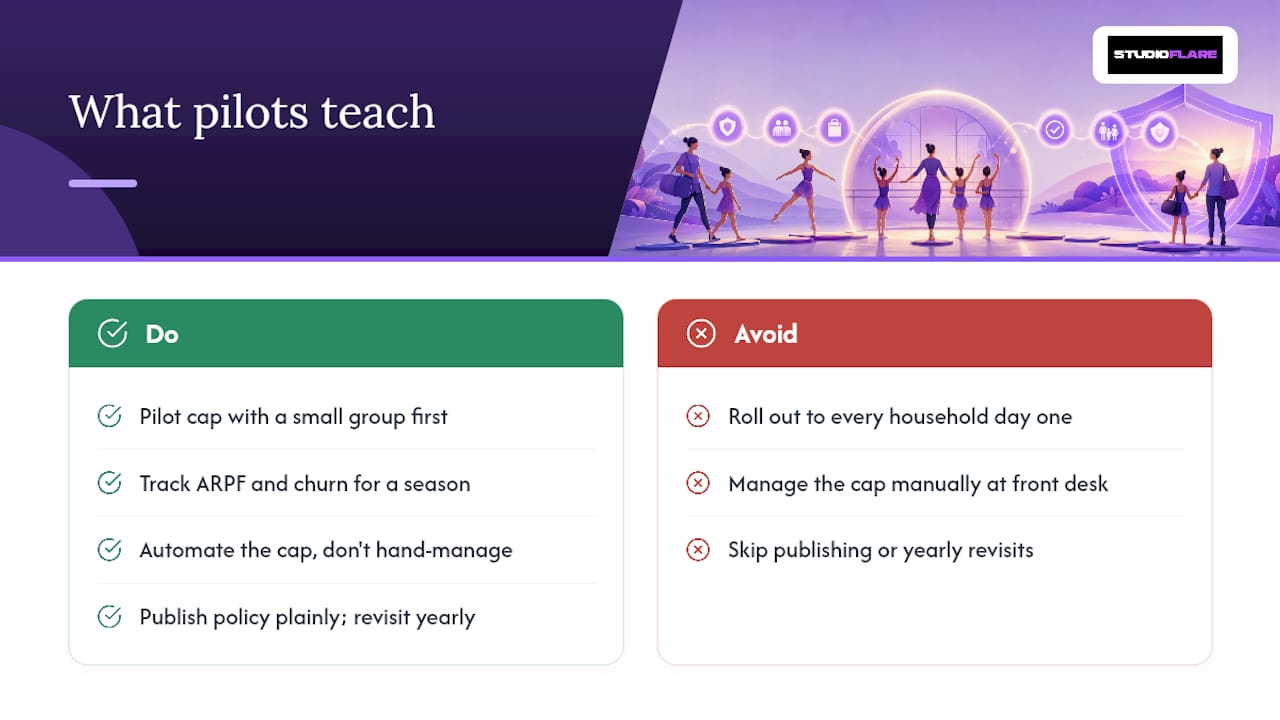
Studios that pilot a family cap with a small group first, rather than rolling it out to every household on day one, catch margin problems before they become studio-wide losses. Tracking ARPF and churn on that pilot group for a full season tells you more than any spreadsheet projection.
The studios we talk to who automate the cap instead of managing it by hand consistently report fewer billing corrections and fewer awkward front-desk conversations. Publish the policy in plain language, and revisit the number every year as your average tuition shifts.
— StudioFlare Team
Automate Your Family Cap With StudioFlare
Building a family cap on paper is the easy part. Enforcing it correctly across dozens of households, every billing cycle, without a staff member manually zeroing out invoices, is where most studios actually struggle. Certain studio management platforms handle that math automatically, applying your cap rules, exclusions, and proration through automated billing so the same policy runs identically for every family, every month.

Setting it up looks like this: link siblings to one family account, define which fees sit outside the cap, and let the platform apply the ceiling automatically at each billing cycle. From there, reporting tools can track your ARPF and enrollment mix so you can see whether the cap is helping or quietly cutting into margin, without pulling numbers by hand from a spreadsheet. Studios moving off legacy systems can compare the setup directly on the Mindbody alternative page. If you're ready to test a family cap on your own roster, you can create your studio account and set it up in an afternoon.
Sources
For studios drafting their own language, Center Stage Dance's posted family tuition cap and Kerry's Dance Center's published billing policies are worth reading in full. Dance Teacher's guidance on discount economics and on sibling discount policy covers the margin math in more depth than most studios budget time for. StudioFlare's blog also covers related billing and attendance topics for studios refining their own policies.
- PRICING | Center Stage Dance
- Kerry’s Dance Center Policies 2025-26
- Are You Offering Discounts the Right Way? - Dance Teacher