

The fastest way to increase registration conversion for dance classes is fixing five things in order: the trial-class experience, checkout friction, follow-up automation, your Google Business Profile schedule, and your offer structure. Studios that tighten trial follow-up and personalization report conversion jumping from roughly 35 to 40 percent up to 55 to 65 percent. The rest of this guide breaks down exactly how, in order of effort.
TL;DR:
- Updating your Google Business Profile with current schedules and responding to reviews can increase inquiries by 25 to 35 percent.
- Building a five-day, automated follow-up sequence focused on objections like cost and skill level can double enrollment conversion rates.
- Simplifying the registration process with minimal upfront questions and clear next steps reduces abandonment and improves trial-to-enroll rates.
- Using a platform with one-click registration, automated billing, and integrated messaging saves staff time and accelerates the sales funnel.
- Addressing broken links and outdated schedules through a quick audit can resolve most registration issues before investing in additional marketing.
Table of Contents
- Quick Wins to Boost Dance Enrollment This Month
- Map the Parent Journey and Simplify Registration
- Design a Trial Class That Converts
- Automated Follow-Up Sequences That Actually Convert
- Use Google Business Profile to Convert Local Searches
- Pricing and Offers That Raise Conversion
- Measure What Matters: KPIs and Quick Experiments
- How StudioFlare Removes Friction from Registration
- The System Beats the Hack
- Automate Registration, Billing, and Follow-Up With StudioFlare
- Sources
- FAQ
Quick Wins to Boost Dance Enrollment This Month
Not every fix deserves the same urgency. Some take an afternoon. Others need a season to pay off. Sorting your effort by speed keeps you from burning a week on a rebrand when a broken link is the real problem.
- Run a link check sprint (2 to 3 hours, no software needed). Click every registration button on your site and socials. A stupid-easy enrollment audit catches outdated timetables and dead forms before you spend a dollar on ads.
- Add your live class schedule to Google Business Profile (1 hour, free). This alone can add 15 to 20 extra inquiries a month.
- Turn on SMS reminders for trial bookings (requires a texting tool). Parents open texts far more reliably than email.
- Rewrite your registration confirmation email to include a next step, not just a receipt (30 minutes).
- Build a three-email, five-day trial follow-up sequence (half a day, one time only). This is the highest-leverage item on the list and the one most studios skip.
Staff time covers items one, three, and four. Item two needs a Google account. Item five is where a platform with built-in automation saves the most hours.
Map the Parent Journey and Simplify Registration
Every enrolled family moves through four stages: discovery, interest, trial, and enrollment. Each stage needs a different call to action, and mismatching them is where most studios lose people.
- Discovery (Google search, Instagram, word of mouth): the CTA is "see this week's schedule," not "enroll now." Nobody commits before they know if Tuesday at 5:00 PM works.
- Interest (they've viewed your schedule or class page): the CTA becomes "book a free trial class."
- Trial (they showed up): the CTA is "register before your spot opens to the waitlist."
- Enrollment (they registered): the CTA shifts to "add a sibling" or "join the fall session."
Lead capture works best when it asks for almost nothing up front. A phone number and a child's age get someone into your funnel; a ten-field form does not. Studios that spell out the exact steps of registration, create account, pick a class, checkout, see fewer abandoned sign-ups because nobody is guessing what happens next.
Pro Tip: Once a month, walk through your own registration flow on a phone, starting from a cold Google search. If you hesitate anywhere, a parent will bounce there too.
Design a Trial Class That Converts
A trial class is not a favor you're doing a family. It's a 45 minute sales conversation, and treating it that way changes what happens before, during, and after.
- Before class: send a short text with the teacher's name, what to wear, and where to park. A personalized welcome note beats a generic confirmation every time.
- During class: have the teacher introduce themselves to the parent directly, not just the kid. Hand over a one-page "next steps" sheet with a QR code straight to checkout, so nobody has to remember a URL later.
- After class: don't rely on one thank-you email. Run a five-day sequence with three short videos that answer the questions parents don't ask out loud: is my child behind, will they fit in socially, and what does this actually cost long-term. These unspoken objections are usually why a family "thinks about it" and disappears.
Automated Follow-Up Sequences That Actually Convert
Generic "still thinking about enrolling?" messages underperform sequences built around specific objections. A targeted three-to-five step follow-up that names cost, fit, and skill level typically doubles conversion versus a vague nudge.
- Immediately after the trial: a thank-you text with a direct registration link.
- Day 2: a short video addressing "is this the right level for my child."
- Day 3: a cost breakdown, including any sibling pricing, sent by email.
- Day 4: a text asking if they have questions, sent by a real staff member, not a bot.
- Day 5: a final email with a deadline, like a spot-reservation cutoff.
SMS wins for anything time-sensitive; email carries the longer explanations. If a family hasn't responded by day 4, that's the point to pick up the phone.
Pro Tip: Build these as templates with merge fields for the child's name and class time. It reads as personal without eating an hour of staff time per family.
Use Google Business Profile to Convert Local Searches
Someone searching "ballet classes near me" at 9:00 PM is closer to registering than someone scrolling Instagram. Your Google Business Profile is often the first thing they see, and an outdated one costs you the click.
- Publish your current class schedule, not last season's, directly on the profile.
- List open spots by age group where the platform allows it. Visible availability shortens the decision.
- Update monthly: new session dates, holiday closures, and any waitlisted classes.
- Respond to every review within a week. It's a small trust signal that shows up right next to your schedule.
Studios that keep schedules current see 25 to 35 percent more clicks, and those leads convert at a higher rate simply because intent is already high.
Pricing and Offers That Raise Conversion
Your price structure decides whether a trial family enrolls one kid for one session or brings the whole household back every year.
- Waive the registration fee for early sign-ups only, with a real deadline. Reasons to register early include locking in a preferred time slot before it fills.
- Build a sibling discount ladder: 10% off a second child, 20% off a third. It raises household lifetime value without discounting your best-selling classes.
- Treat summer intensives as a funnel, not a standalone product. Studios that build rollover offers into summer convert 60 to 75 percent of summer-only students into year-round enrollment.
- Test one offer at a time. Run the sibling ladder for a month before layering in a registration-fee waiver, or you won't know which one moved the number.
Measure What Matters: KPIs and Quick Experiments
You can't fix what you don't track, and most studios only track total enrollment, which hides where the real drop-off happens.
- Trial-to-enroll rate: trials that convert into paid registration. This is your headline number, and the 15 to 25 percentage-point lift from a strong follow-up sequence is the benchmark to chase.
- Lead-to-trial rate: inquiries that actually show up for a class.
- Average time to enroll: days between trial and paid registration. Anything past a week usually means your follow-up sequence has a gap.
- Track these weekly in a simple spreadsheet or dashboard for 30 to 60 days before and after a change, so you're comparing real cohorts, not guessing.
Trial-to-enroll conversion is the one number that tells you, faster than anything else, whether your funnel is actually working.
How StudioFlare Removes Friction from Registration
Most of the tactics above depend on speed: fast checkout, fast follow-up, fast schedule updates. That's exactly where a dedicated platform earns its cost instead of adding another login to manage.
- One-click registration and checkout, so parents aren't rebuilding an account every session.
- Automated Stripe billing, with receipts and payment reminders sent without a staff member touching a keyboard.
- A parent portal that handles waivers, schedules, and messages in one place instead of scattered texts.
- Built-in automation that can run the day 2 through day 5 follow-up cadence described above without a separate email tool.
A platform like this pays off fastest for larger studios where manual follow-up starts slipping. A single-instructor studio with 30 students might get by on templates and a shared calendar a little longer.
The System Beats the Hack
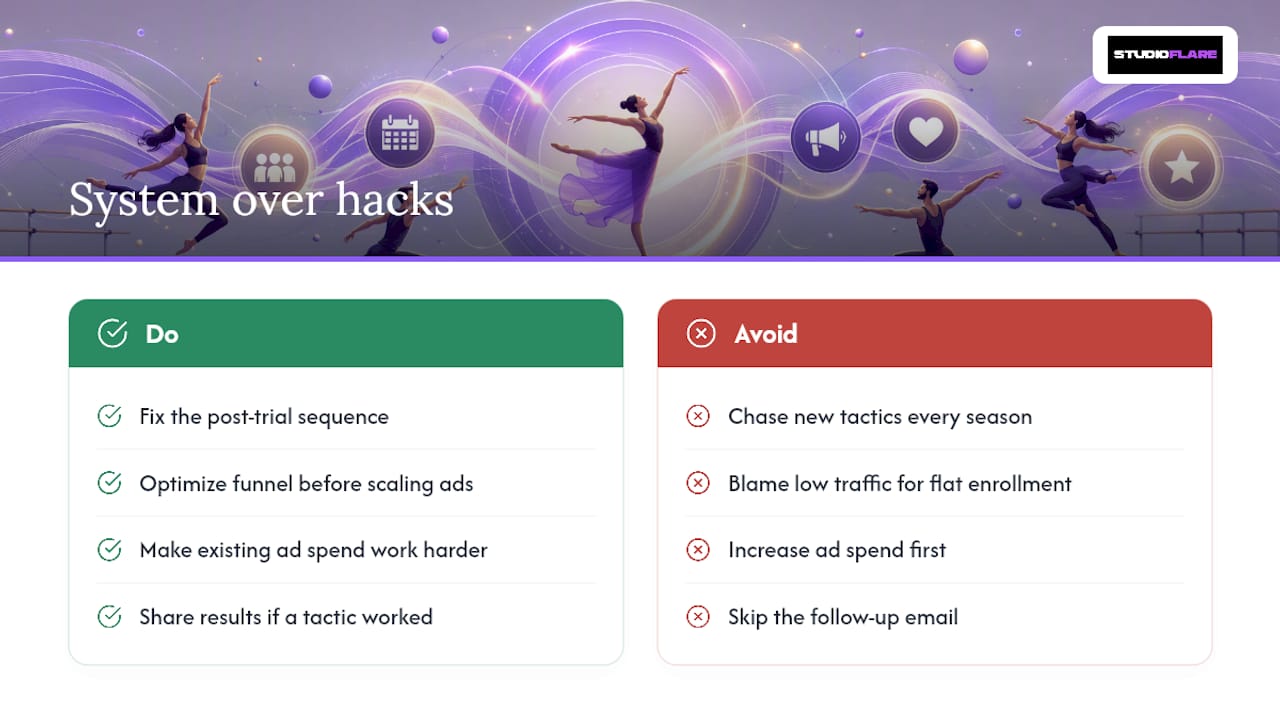
Most studios chase a new marketing tactic every season and wonder why enrollment stays flat. The real gap usually isn't traffic. It's what happens between the trial class and the "still deciding" email that never gets sent. Fix the sequence before you increase ad spend. A better funnel makes every dollar you already spend on marketing work harder, and it's the cheapest lever available to most studios right now.
If you've tried one of these tactics and seen the numbers move, we'd like to hear about it.
— StudioFlare Team
Automate Registration, Billing, and Follow-Up With StudioFlare
StudioFlare replaces the spreadsheet-and-group-text approach most studios outgrow around their second location or their two-hundredth family. Where a generic form tool or email platform handles one piece of the funnel, this platform runs registration, automated billing, messaging, and follow-up automation from a single dashboard designed specifically for dance studios.

That means the five-day objection-answering sequence described above, the sibling discount ladder, and the automated payment reminders all live in one system instead of three disconnected tools. The AI assistant answers routine parent questions about classes and payments instantly, freeing staff to focus on the trial-class experience itself rather than chasing down receipts. If your current setup, whether that's Jackrabbit or iClassPro, is missing the automation piece, compare it against a Mindbody alternative built for dance and see the registration flow yourself. You can create your studio account and test the checkout and follow-up sequence with your next trial class this week.
Sources
- 3 Easy Ways to Boost Dance Studio Enrollment and Retention | Dance Studio Owner
- Marketing Ideas for Dance Studios | Softscotch
- Making Enrolment 'Stupid-Easy' For Your Dance Studio In 2026 | Dance Principals United
- Registration Troubleshooting - Harlem School of Arts
FAQ
How Do You Increase Dance Studio Enrollment?
Focus on trial-class personalization, a short automated follow-up sequence, and a current schedule on Google Business Profile; studios combining these three report conversion rising from around 35 to 40 percent to 55 to 65 percent.
Why Do Dancers Count "5, 6, 7, 8"?
Dancers use an eight-count phrase because most music breaks into eight-beat phrases, and starting the count a few beats early gives the whole group time to prepare and start moving together on beat one.
Why Do Dance Studios Charge a Registration Fee?
Registration fees typically cover administrative costs like insurance, systems, and costume ordering, and studios often waive or discount them for early sign-ups to encourage families to lock in a preferred schedule before spots fill.
How Much Money Can You Make Owning a Dance Studio?
Earnings vary widely by enrollment size, class pricing, and location, and depend heavily on retention and conversion systems rather than marketing spend alone; a studio management platform like StudioFlare can help owners track revenue per student and spot where conversion gaps are costing them enrollment.
What's the Fastest Way to Fix a Leaky Registration Funnel?
Start with a link check sprint to catch broken forms or outdated schedules, since that single fix often resolves lost registrations before any new campaign is needed.