
Makeup class tracking is the simple loop of report the absence, reserve the makeup in your portal, timestamp the student's check-in, and mark the credit used, then repeat for the next missed class. A studio like Some studios automates each step so nothing gets lost between a parent's text message and the front desk whiteboard. Get this loop right and disputes over recital eligibility or tuition mostly disappear.
TL;DR:
- Digital check-in methods like QR codes or kiosks provide high dispute resistance due to precise timestamping, unlike paper or manual logs.
- Setting a strict expiration date between two weeks and 30 days for makeup credits minimizes administrative confusion and parent disputes.
- A clear policy should specify a cap of two to five makeups per season, with explicit rules for expiry, eligibility, and recital attendance, to prevent assumptions.
- Streaming data directly into billing and reports streamlines reconciliation, especially when managing multiple staff and credits across numerous classes.
- Relying on one unified portal with automated alerts ensures credits don't lapse unnoticed, reducing reliance on memory and decreasing dispute triggers.
Table of Contents
- What Is the Step-by-Step Workflow for Tracking a Missed Class?
- What Should a Studio's Makeup Policy Actually Say?
- Which Attendance Capture Method Actually Holds Up in a Dispute?
- How Do You Turn Makeup Credits Into Something You Can Bill Around?
- What Exports Do You Need When a Parent Disputes a Credit?
- When Does Your Studio Outgrow Spreadsheets for Makeup Tracking?
- A Studio Owner's Honest Take on Where Makeup Tracking Breaks Down
- See How Studioflare Handles the Whole Makeup Loop
- Sources
What Is the Step-by-Step Workflow for Tracking a Missed Class?
Every missed class should trigger the same five moves, in the same order, every time. Inconsistency, not bad intentions, is what causes most makeup disputes.
- Absence reported through one channel, before class starts. A text to an instructor's personal phone doesn't count. Requiring reports through the studio portal before class start time is the standard most studios that manage this well have settled on, according to Dance/10 Performing Arts Center's published policies.
- Log it immediately, with an expiry date attached. The missed-date row should get a deadline the moment it's created, not weeks later when someone remembers.
- Require advance reservation for the makeup itself. Walk-ins strain class caps and create scheduling collisions instructors have to untangle later.
- Timestamp the check-in when the student actually shows up. This is the moment the credit gets marked used, not before.
- Close the loop. Notify the family and update whatever report tracks recital eligibility or remaining credits.
- Staff logging absences from memory at the end of the week instead of in real time.
- Front desk allowing a makeup without checking whether the student had an open, unexpired credit to spend.
Pro Tip: Set a recurring weekly reminder to review expiring credits. A credit that quietly lapses unused is a parent complaint waiting to happen, and it's almost always preventable with a five-minute Friday check.
What Should a Studio's Makeup Policy Actually Say?
A vague policy is worse than no policy. Families fill the gaps with their own assumptions, and every assumption is different. Studios should publish four specific answers: how many classes a student may miss, exactly how makeups work and when they expire, what recital attendance requires, and what happens to tuition when a class is skipped, per the framework Attend It AI lays out for dance studio attendance policies.
The practical defaults most studios land on:
- Cap: 2 to 5 makeups per season. Fewer than that frustrates families with genuine scheduling conflicts; more than that turns your class caps into a guessing game.
- Expiry: 2 weeks for fast-moving competition tracks, 30 days for general recreational classes, or simply "end of season" for smaller programs.
- Eligibility: Currently enrolled students only, and only for absences reported through the proper channel unless a studio deliberately chooses to be more lenient.
- Recital language: State plainly that makeups do not roll over into the next season and specify the attendance threshold required to perform.
- Recordkeeping: Tell families what you keep and how they can request their own attendance history.
A short, fixed cap paired with a clearly published expiry date cuts down on administrative back and forth far more than an open-ended "space permitting" promise ever does.
Which Attendance Capture Method Actually Holds Up in a Dispute?
Not every attendance method produces evidence a parent will accept. A paper roll sheet or a front desk notebook is fine for remembering who showed up, but it's a weak record when a parent insists their daughter attended a class three weeks ago and the sheet is missing or illegible. Timestamped digital check-ins, whether through a QR code, a lobby kiosk, or a sign-in link, hold up because they capture the exact minute a student walked in, not a staff member's best guess at closing time.
| Method | Timestamp accuracy | Dispute resistance | Setup effort |
|---|---|---|---|
| Paper roll sheet | None | Low | Minimal |
| Front-desk notebook | Manual, often delayed | Low to moderate | Minimal |
| QR code check-in | Automatic | High | Moderate |
| Lobby kiosk | Automatic | High | Moderate to high |
| Sign-in link (SMS/email) | Automatic | High | Low |
Digital check-in methods carry a timestamp that paper notebooks simply can't produce, which is exactly why they win when a parent disputes attendance. Setting up a kiosk means importing your roster once and mapping it to recurring class lists so staff aren't manually re-entering the same names every week.
Pro Tip: If you're placing a physical kiosk near your studio's entrance, think about where it sits relative to foot traffic and sightlines. A security setup guide built for studio environments covers placement considerations that apply just as well to check-in hardware as to camera systems.
How Do You Turn Makeup Credits Into Something You Can Bill Around?
A makeup credit isn't cash and it isn't a refund. It's a ledger entry: one missed class equals one owed makeup, expiring on a set date, and it should stay separate from whatever tuition line item the family already paid.
- Credits vs. tokens vs. paid substitutes. A credit is earned by a reported absence. A token is a studio-issued bonus, unrelated to any specific miss. A paid substitute is when a family wants an extra class beyond what's owed and pays a one-off fee for it.
- Makeups are not tuition refunds. State that directly in your policy. Tuition pays for enrollment in the program, not for a specific seat count, and a missed class doesn't shrink the bill.
- The ledger entry that matters. Mark the credit "used" only at the moment of a timestamped check-in, never at the moment of reservation. A credit tracked against an actual attendance record beats one tracked against memory or a hopeful sign-up, and it's the check-in that should win if the two ever disagree.
- Paid private makeups. If a family wants a one-on-one session instead of joining another group class, that's usually a separate charge, not a credit redemption, and it should hit the books as its own line item.
What Exports Do You Need When a Parent Disputes a Credit?
Three exports resolve almost every parent conversation without an argument:
- Timestamped attendance log covering the disputed date range, showing exactly who checked in and when.
- Makeup credit ledger with the missed date, scheduled makeup date, attended flag, and expiry column all in one row per credit, so nothing is memory-based.
- Roster snapshot for the specific class in question, confirming who was actually scheduled that day.
When a parent-facing report is generated, one line per date with a clear timestamp is enough. Set an internal standard, such as a 24-hour turnaround, so staff aren't scrambling to reconstruct records under pressure. If a dispute escalates past a front-desk conversation, route it to a single manager who has the exports on hand, and keep attendance records for at least a full season so a summer question about a spring absence doesn't hit a dead end.
When Does Your Studio Outgrow Spreadsheets for Makeup Tracking?
A single-instructor studio with a handful of weekly classes can often run makeups on paper without much friction. That changes fast once you add instructors, recurring credits, and parents who expect a same-day export when they ask about a missed class. Software becomes worth the switch once credits and multiple staff schedules make manual records genuinely hard to keep straight, according to Attend It AI's studio operations research.
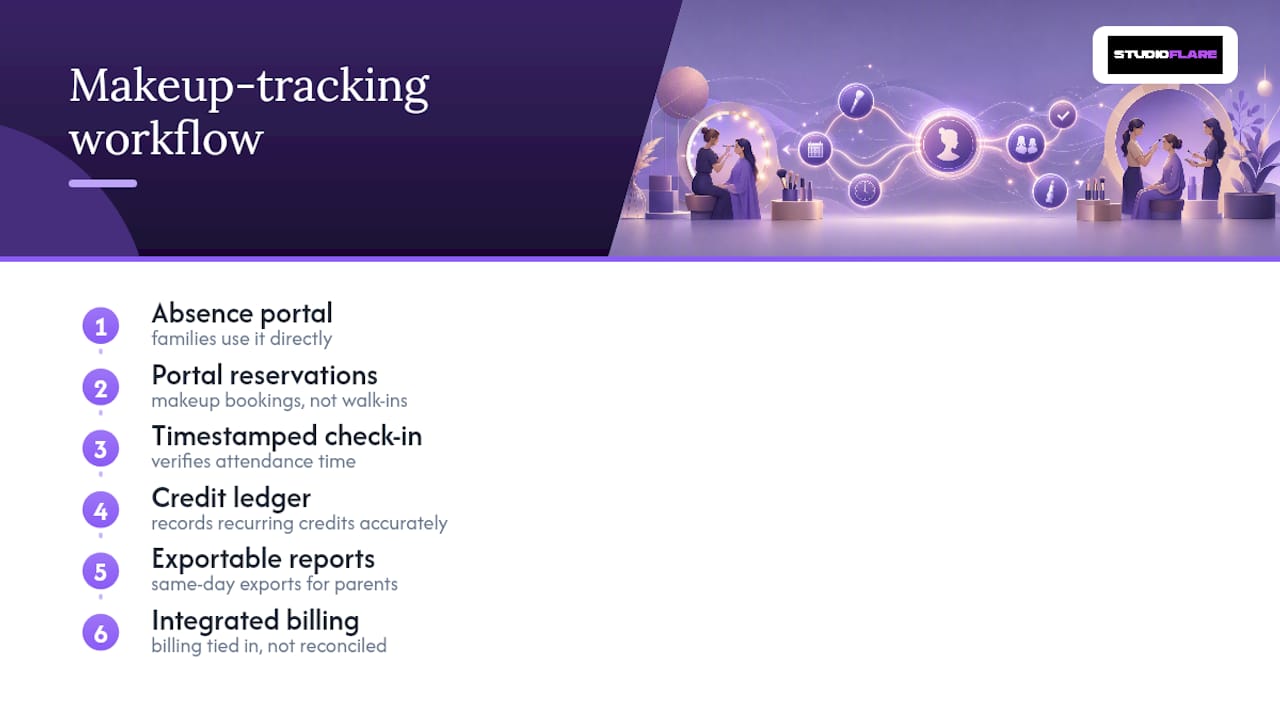
The feature checklist that actually matters at that point: an absence portal families use directly, portal-based makeup reservations instead of walk-ins, timestamped check-in, a real credit ledger, exportable reports, and billing that's actually integrated rather than reconciled by hand. Some studio management platforms build these around automated billing, AI assistants that answer quick staff questions about a student's remaining credits, and livestreaming that gives families a remote option when a makeup slot won't fit their schedule. The company's own attendance operations guide walks through the check-in mechanics in more detail.
A Studio Owner's Honest Take on Where Makeup Tracking Breaks Down
Most makeup problems trace back to one habit: relying on memory, sticky notes, or three different notification channels instead of one. The fix is almost always smaller than owners expect. Pick one reporting channel, require portal reservations, and enforce timestamped check-ins. Compare that against what your front desk does today.
— StudioFlare Team
See How Studioflare Handles the Whole Makeup Loop
Certain studio management platforms replace the group texts and spreadsheet tabs most studios use to track makeups with one connected system: an absence portal families use directly, makeup reservations that respect class caps, timestamped check-in, and a credit ledger that never depends on someone's memory.

Every step maps to less admin time and to records you can hand a parent in seconds instead of digging through a notebook. Attendance data can flow straight into billing processes, so a paid private makeup or a one-off charge may not need a separate invoice process, and AI assistants can answer staff questions about a student's remaining credits without anyone opening a spreadsheet. If your studio is outgrowing paper rolls or fielding the same recital-eligibility questions every season, see how Studioflare compares as a Mindbody alternative or start a free trial and set up your first attendance report this week.
Sources
For policy wording, see Attend It AI's studio attendance guide and Studioflare's attendance setup walkthrough.