

Tuition is due on the 1st, a grace period runs through the 5th, a flat late fee applies after that, and accounts unpaid at 30 days lose their spot. The single biggest fix isn't a stricter rule. It's requiring a card or bank account on file at registration and putting billing on autopilot, so a missed payment policy for dance studios enforces itself instead of falling on your front desk staff. A platform with built-in autobilling can run that process automatically.
TL;DR:
- Most studios set a 5 to 10-day grace period after tuition due date before applying late fees, typically ranging from $15 to $35.
- Implementing autopay and requiring a card or bank account on file at registration greatly reduces missed payments and accounts falling into delinquency.
- A clear, staged communication plan — including reminders, late notices, and final warnings — improves collection rates with consistent messaging.
- Billing automation through studio management platforms streamlines collection, enforces policies, and minimizes staff workload.
- Costumes and recital fees should have separate payment schedules and late-fee rules, with unpaid balances potentially leading to exclusion from performances.
Table of Contents
- What a Missed Payment Policy Dance Studios Can Actually Use Looks Like
- Setting Your Dates and Fees: What Actually Works
- Reminder, Warning, Final Notice: What to Actually Say
- Why Automation Is the Real Fix, Not Just Stricter Rules
- Keeping Your Policy Enforceable Without a Lawyer on Retainer
- What Changes When You Actually Enforce This
- Put This Policy on Autopilot With Studioflare
- Where This Policy Language Comes From
- Sources
- FAQ
What a Missed Payment Policy Dance Studios Can Actually Use Looks Like
Copy the structure below, fill in your own numbers, and paste it into your registration form, enrollment agreement, or confirmation email. This is the core document behind any workable dance class payment rules, and it needs to live somewhere families see it before they hand over a credit card, not after.
[Studio Name] Tuition and Payment Policy
- Tuition is due on the first day of each month and covers that month's classes regardless of attendance.
- We accept payment by credit card, debit card, or ACH bank transfer. A valid card or bank account must be kept on file for all active students.
- Accounts not paid within a few days after the due date enter a grace period with no penalty.
- Accounts unpaid after the grace period incur a $25 late fee or 20% of the balance, whichever is greater.
- Returned payments, declined cards, or failed ACH transfers incur an additional $25 NSF fee and trigger an automatic retry within 3 business days.
- Costume and recital fees follow a separate payment schedule with their own due dates and late-fee terms, detailed in your recital packet.
- Accounts more than 30 days past due may result in suspension from class until the balance is resolved.
- Accounts more than 60 days past due may result in withdrawal and referral to collections.
- Students with unpaid balances at the time of recital may be excluded from performance and costume distribution.
- Questions or payment plan requests go to [contact name/email/phone] before the due date, not after a late fee has posted.
Place this exact language in three spots: the online registration flow, your written enrollment terms, and the confirmation email every family gets after signing up. Redundancy here isn't overkill. It's what makes the policy enforceable when a parent later claims they never saw it.
Setting Your Dates and Fees: What Actually Works
Most studios bill on the 1st and start the late-fee clock somewhere between day 5 and day 11 of the grace window, then move to suspension once an account hits 30 to 60 days past due, according to published studio policy pages. That range isn't arbitrary. A shorter grace period (5 days) works better for studios with tighter cash flow; a longer one (10 to 11 days) fits studios that bill a lot of families paycheck to paycheck.
Fee structure matters just as much as timing. Studios generally pick one of these approaches:
- Flat fee: a fixed $15 to $35 late charge, simple to explain and easy for parents to predict.
- Percentage-based: a fee tied to the balance owed, which scales with tuition tier but can feel punitive on large invoices.
- Combined: a fixed dollar amount or a percentage, whichever is greater, which protects you on both low and high tuition accounts.
Sample studio policies list $15 to $35 late fees alongside $25 NSF charges for returned payments, and that combined structure shows up often enough to count as the market standard. Treat costumes and recital fees as their own line item with their own deadline, not folded into monthly tuition. A family that's current on class fees but behind on a costume balance needs a different notice than one who missed tuition entirely.
Reminder, Warning, Final Notice: What to Actually Say
Collection rates improve when you use the same sequence every time instead of improvising each conversation, and a staged notice cadence with clear scripts reduces both awkwardness and disputes. Here's a four-step version you can adapt today.
- Pre-due reminder (2 days before due date). Subject line: "Tuition Reminder — Due [Date]." Tone: friendly, no mention of fees. "Just a quick heads-up that tuition is due on [date]. Your card on file will be charged automatically, no action needed."
- First late notice (day after grace period ends). Subject line: "Payment Past Due — Action Needed." Tone: matter-of-fact. "Your account is past due and a $25 late fee has been applied. Please update your payment method or contact us by [date] to avoid further action."
- 30-day escalation. Phone call or text preferred over email here. Offer a payment plan explicitly: "We'd like to help you get current. Can we set up a payment plan over the next two months?" Document the agreement in writing, even if it's a two-line email confirming the terms.
- 60-day final notice. Subject line: "Final Notice — Enrollment Suspension." State the consequence plainly: suspension from class, loss of recital spot, or referral to a collections agency. This is also the point to decide whether the student is withdrawn or given one more short window to resolve the balance.
Pro Tip: Send the first late notice by text, not just email. Parents open texts fast, and a short "your account is past due, reply if you need a payment plan" often gets a same-day response that an email buried in an inbox never will.
For staged notice language you can adapt for any collection scenario, an HOA-style collection letter template offers a useful structure for tone and escalation pacing, even outside the HOA context.
Why Automation Is the Real Fix, Not Just Stricter Rules
Requiring a card or ACH authorization on file and switching to automatic monthly billing shifts payment responsibility onto the system instead of your staff, according to studio payment policy examples. That single change does more to reduce missed payments than any fee structure, because it removes the moment where a parent has to remember to log in and pay.
Automation removes the social awkwardness of asking a parent for money in person. The charge just happens, the same way a gym membership or a streaming subscription renews without anyone picking up a phone.
Setting it up correctly takes a short checklist:
- Capture a card or bank account at the moment of registration, before the first class.
- Pick one draft date for all families and stick to it.
- Set an automatic retry schedule for failed charges (2 to 3 attempts over several business days).
- Keep written records of any payment plan agreements, including who approved them and when.
- Decide your NSF/declined-fee amount up front so it's already in the policy, not negotiated case by case.
Automation is increasingly the standard among studios that have moved past spreadsheets and manual invoicing. Some platforms handle this through Stripe-based auto-billing, card capture at registration, and templated notices, which is covered in more detail in a guide to collecting studio payments online.
Keeping Your Policy Enforceable Without a Lawyer on Retainer
A policy only works if it's actually part of what parents agreed to, not a page they skimmed once. Build it into your enrollment paperwork and require a checkbox or signature at registration, not a link buried in a footer.
- Include the full payment policy in your written enrollment agreement and require acceptance before the first charge.
- Put payment plans in writing every time, even informal ones, and keep account notes consistent across every family.
- Apply late fees and suspension rules the same way for every account. Selective enforcement is what turns a fee dispute into a bigger conflict.
- Be explicit about missed classes: most studios offer scheduled make-ups but no refunds or credits, and that stance needs to be stated, not implied.
- If you're dealing with deposits, formal collections, or a family threatening legal action, talk to a local attorney. This article isn't legal advice, and enforceability rules vary by state.
Bookkeeping habits matter here too. Reconciling who's paid, who's on a plan, and who's past due gets easier with basic bookkeeping practices for small business owners applied consistently month over month.
What Changes When You Actually Enforce This
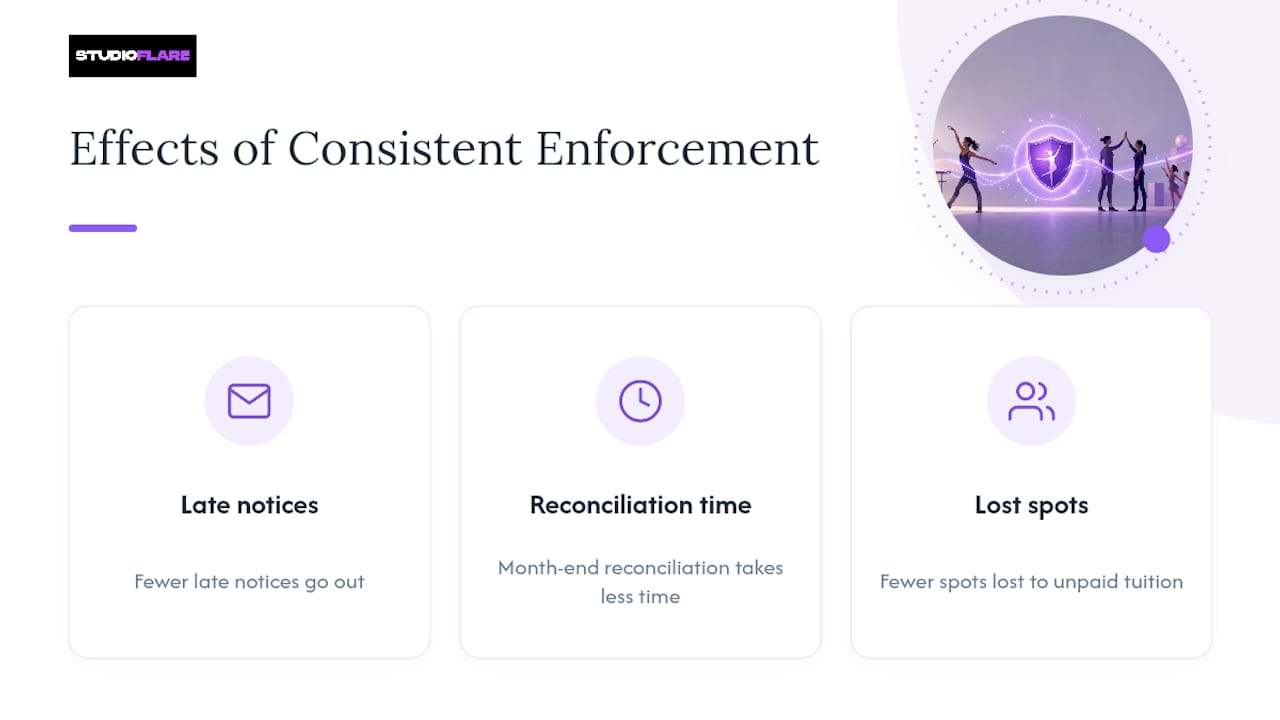
A written, consistently enforced policy does more for a studio's bottom line than any single fee amount. Fewer late notices go out because parents know the deadline before it arrives. Reconciliation at month's end takes less time because accounts aren't scattered across exceptions and one off arrangements. Fewer spots get lost to quietly unpaid tuition that nobody caught until recital season.
The pattern holds across studios that make the switch: consistency, not strictness, is what actually protects revenue and keeps families from feeling singled out.
— StudioFlare Team
Put This Policy on Autopilot With Studioflare
There are studio management platforms that serve as alternatives to manually chasing tuition by text message or spreadsheet, using Stripe-based auto-billing to charge cards or bank accounts on file monthly, retry failed transactions automatically, and apply late fees set by the studio without requiring manual reminders.

Getting your policy live takes a few steps: start a trial, turn on automated billing, import your class roster, and paste your policy wording into the registration flow. Some platforms include a parent portal that gives families a running statement so payment status is clear, and built-in notice templates handle reminder and past due sequences. If you're weighing this against a Jackrabbit Dance setup or an iClassPro plan, the billing automation and AI assistant for common payment questions are worth comparing directly. Ready to see it running on your own roster? Create your studio account and turn on auto-billing this week.
Where This Policy Language Comes From
- InMotion Dancer's payment policy shows real-world card-on-file and auto-billing language.
- N-Step Dance Center's policies illustrate a full grace-period-to-suspension timeline.
- Encore Dance Studio's policies cover make-up class and no-refund stances clearly.
Sources
- Payment policies — InMotion Dancer (example studio policy)
- Policies | N-Step Dance Center
- Ask the experts: Dealing with overdue payments — Dance Teacher
FAQ
Is there a grace period for missed payments?
Most studios build in a grace period of 5 to 10 days after the due date before any late fee applies, based on common studio billing patterns.
How many days late can you pay a bill before facing suspension?
Studios commonly suspend class participation once an account is 30 days past due, with withdrawal or collections referral by 60 days, per the same studio policy pattern.
What should a missed payment notice actually say?
Keep it short and specific: state the amount owed, the fee applied, the deadline to resolve it, and the consequence if it's ignored. A staged notice approach works better than a single vague reminder.
Do dance teachers need liability insurance?
Liability insurance is a separate operational issue from payment policy, and most studios carry general liability coverage regardless of billing setup. It's not something a payment policy resolves, so check with an insurance provider familiar with studio operations directly.
Should costumes and recital fees follow the same late-fee rules as tuition?
No. Costumes and recital balances typically run on a separate schedule with their own deadlines, and unpaid balances at recital time can mean exclusion from the performance, according to sample studio policy documents.