
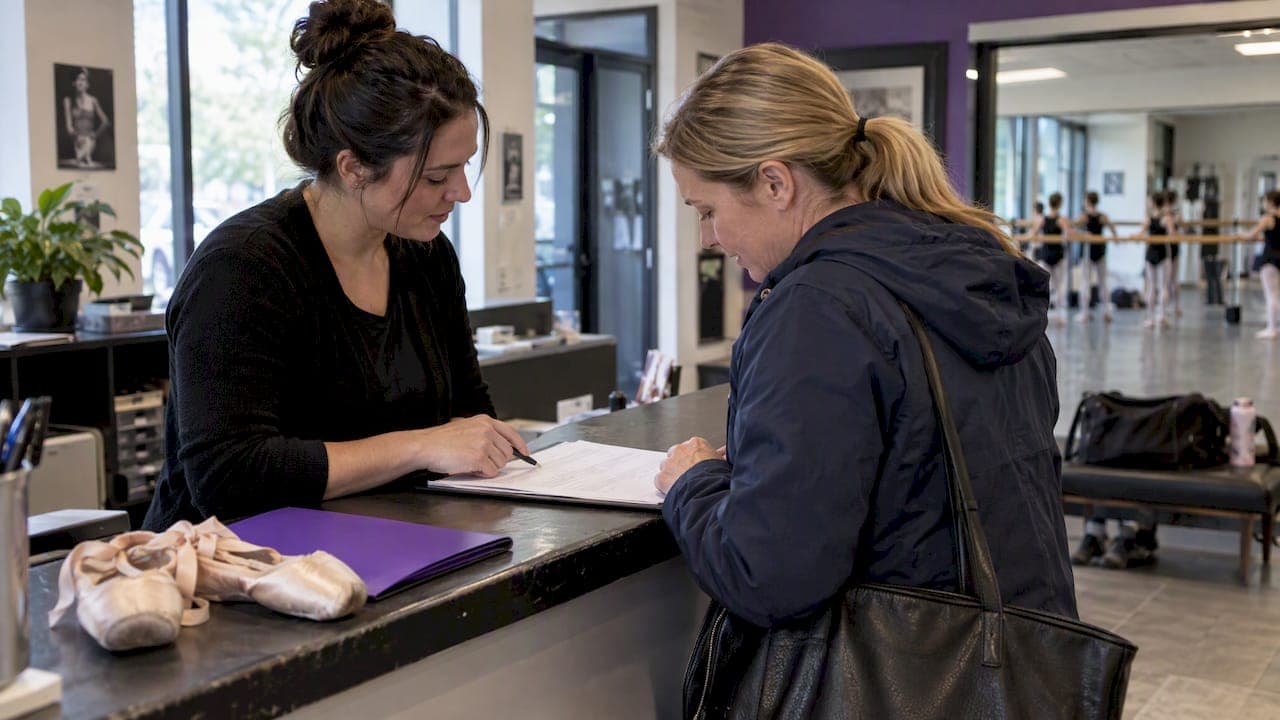
Adopt a written, purpose-specific media consent that separates marketing permission from participation consent, and enforce limited recording windows with clear device rules. Require this consent for every minor before any studio-created or published photo or video, publish a retention and deletion timeline, and give families a simple way to opt out or withdraw consent later.
TL;DR:
- Studios must obtain separate, signed consent for marketing use of minors' photos and videos, clearly specifying the channels and retention periods.
- Recording rules should be location-specific, with designated windows and zones, enforced through signage and staff training.
- When posting online, any media featuring children requires verifiable parental consent, especially when using photos, videos, or audio files.
- Retention periods for routine rehearsal footage should generally be around one year, with longer storage only for marketing assets with explicit consent.
- Licensing for music and choreography must be obtained separately from consent for the dancer's image to avoid copyright violations.
Table of Contents
- Quick checklist for building or auditing your photo and video policy
- How COPPA affects studio media practices and consent for minors
- When FERPA-style rules or school partnerships change your obligations
- Setting recording rules for classes, rehearsals, and performances
- Publishing media, setting retention periods, and handling deletion requests
- Contract clauses and supervision rules for hired or volunteer photographers
- Music and choreography copyright considerations for recital footage
- Copy-ready consent text, registration clauses, and signage
- Step-by-step rollout, staff scripts, and enforcement protocol
- Using a studio management platform to manage media policies
- A simpler way to enforce your media policy
- FAQ
- Sources
Quick checklist for building or auditing your photo and video policy
Before writing a single clause, check your current practice against these minimum defaults.
- Separate marketing consent (website, ads, social media) from participation consent (required to enroll in class).
- List every channel where photos or videos might appear: website, brochures, social platforms, livestream, recital programs.
- Set recording rules by location: classroom, rehearsal, backstage, and performance each need their own boundary.
- Publish a retention timeline and a deletion or withdrawal process families can actually use.
- Put contract terms and supervision rules in place before any outside photographer touches your building.
- Post signage, train staff on enforcement, and log violations so the rule has teeth.
How COPPA affects studio media practices and consent for minors
If your studio posts photos, videos, or livestreams online, the Federal Trade Commission's COPPA guidance treats any photo, video, or audio file containing a child's image or voice as personal information, and operators covered by the rule must get verifiable parental consent before posting that media online, along with a privacy notice covering retention and deletion practices, according to the FTC's COPPA guidance. Whether COPPA applies turns on factors like whether your website or app is directed to children, but the safest posture for a studio is to apply these protections to every student under 13 regardless of how your online presence is classified.
The practical takeaway: treat photos, videos, and audio of any child as sensitive data that needs a documented consent trail, not casual content for a social post, per the same FTC guidance.
- Collect a signed, dated consent form before any studio-created photography, video, livestreaming, or audio recording of a minor.
- Name every channel the media might appear on: website, brochure, social media, livestream, or display.
- Keep marketing consent as a separate checkbox from the consent required to participate in class.
- State in your privacy notice how long you keep media and how a parent can request deletion.
When FERPA-style rules or school partnerships change your obligations
Most private dance studios are not covered by FERPA, since the law applies to educational agencies and institutions that receive certain federal funds, not independent businesses. A photo or video only becomes an "education record" when it directly relates to a specific student and is maintained by a covered educational institution or its agent, according to the Department of Education's FERPA guidance on photos and videos.
- If you partner with a school for a joint recital or showcase, agree in writing on who maintains the recordings.
- Set a redaction workflow for any footage that includes students from the partner school.
- Consult legal counsel before treating any studio-held video as a record covered by school privacy obligations.
Setting recording rules for classes, rehearsals, and performances
Clear, location-based rules beat a blanket "no phones" policy because they tell families exactly what's allowed and where.
- Designate specific recording windows, such as an observation week, a dress rehearsal, or a fixed set of seats during the recital, and name everywhere else as off-limits, including backstage and dressing areas.
- Require tripods only in a designated rear zone, ban flash photography entirely, and prohibit loud audio playback during class or performance.
- In the classroom, require instructor-led permission before anyone records, and ask that phones stay stowed when a teacher requests it.
- Post signage at entrances and in the lobby stating the recording policy in plain language, and train staff to enforce it consistently rather than selectively.
Pro Tip: Put the recording window and off-limits zones on the same sign, so parents never have to guess where the line is.
Publishing media, setting retention periods, and handling deletion requests
Once you have consent, the next question is what you publish, for how long, and how someone can ask you to take it down.
- List permitted uses explicitly (class progress updates, website galleries, recital programs) and require a separate opt-in before anything is used for marketing or commercial promotion.
- Tie retention to actual business need: a year is reasonable for routine rehearsal footage, while promotional assets are kept longer only when a parent has separately consented.
- Offer a simple take-down request process, and be upfront that you can't control reposts once footage leaves your platform through a third party.
- Store media behind access controls rather than open folders, limiting who on staff can view or download files.
Our privacy policy outlines how retention and deletion commitments can be stated clearly for families, which is the kind of language worth mirroring in your own studio's notice.
Contract clauses and supervision rules for hired or volunteer photographers
A hired photographer without a contract is a liability waiting to happen. Cover these basics before anyone brings a camera into your building.
- Spell out permitted uses, ownership or license terms, delivery deadlines, and a deletion obligation if the relationship ends.
- Ban backstage and changing-room access outright, and require a staff escort anywhere students are present.
- Require studio review and sign-off before any image or clip goes public.
- For parent or volunteer photographers, limit them to a supervised window with written expectations handed out in advance.
Music and choreography copyright considerations for recital footage
Getting parental consent to show a dancer's face is only half the picture. Music and choreography carry separate copyright protections, and public-performance licensing is a distinct issue from consent to publish a student's image, according to the U.S. Copyright Office's fair use guidance. Fair use is fact-specific, and the Copyright Office notes it often does not extend to posting a full recital recording publicly, so studios should not assume an educational setting automatically clears the music or choreography for distribution.
- Secure a public-performance license or record from a licensed sound source before publishing recital footage widely.
- Ask choreographers for explicit permission when their original work appears in footage you intend to post.
- Treat music and choreography rights as a separate checklist item from the dancer's own image consent.
Copy-ready consent text, registration clauses, and signage
Paste these starting points into your registration flow, recital program, or lobby signage and adjust to your studio's voice.
Parental consent (registration form): "I give [Studio Name] permission to photograph and video record my child during class and studio events for internal records and progress tracking. I understand this is separate from marketing use, which I may opt into below."
Marketing opt-in (separate checkbox): "I additionally consent to my child's photo or video being used on [Studio Name]'s website, social media, or printed materials."
Retention and withdrawal (privacy page): "We retain class and rehearsal footage for up to one year unless marketing consent extends that period. To request deletion, email [contact] with your child's name and the footage in question."

Signage (lobby and studio doors): "Recording permitted only during designated observation windows. No flash, no tripods outside the rear zone, no backstage recording."
Step-by-step rollout, staff scripts, and enforcement protocol
Rolling out a new policy works best when it rides along with something families already do: registering.
- Build consent checkboxes directly into your registration flow so every enrollment creates a timestamped consent record tied to that student's profile.
- Script front-desk staff to mention the policy at enrollment and send a reminder email before recitals or showcases.
- Set an enforcement ladder for violations: a verbal reminder first, a written warning for a repeat incident, and a logged record of each occurrence.
- Review your policy and consent records on a set schedule, such as once per semester, to catch gaps before they become disputes.
Using a studio management platform to manage media policies
Paperwork is where most media policies quietly fail. When consent lives in a drawer instead of a database, nobody can produce it fast enough when a parent asks. Digital registration ties a signed, timestamped consent record to each student's profile, and integrated livestreaming with access control keeps galleries limited to the families who consented, rather than open to anyone with a link.
— StudioFlare Team
A simpler way to enforce your media policy
We built StudioFlare so consent tracking does not live in a filing cabinet. Digital waivers capture signed, purpose-specific consent at registration, our built-in livestreaming gates class access to authenticated parent accounts, and secure galleries keep media visible only to the families who opted in.

- Digital waivers attach consent directly to each student's profile, searchable the moment a parent asks about it.
- Livestreaming with access control replaces open links with authenticated, parent-only viewing.
- Parent communication tools let you send policy reminders and opt-out instructions without a separate mailing list.
Our Starter plan starts at $29 per month plus $1 per active student, and the Pro plan runs $49 per month, both with no setup fee and no contract. Create your studio and put consent tracking on autopilot today.
This article is general information, not a substitute for advice from a qualified lawyer. Consult a qualified legal professional about your own circumstances before acting on anything here.
FAQ
Do I need written parental consent to post a child's dance recital photo online?
Yes, when the photo is collected or posted through an online service, the FTC's COPPA guidance treats it as personal information requiring verifiable parental consent, per the FTC's COPPA FAQ. Keep marketing consent separate from the consent required simply to enroll in class.
Does FERPA apply to a private dance studio's recordings?
Generally no, since FERPA covers educational agencies and institutions receiving certain federal funds, not independent studios, according to the Department of Education's FERPA guidance. If you partner with a school on a joint event, you may take on added obligations and should clarify record ownership in writing.
Can I post recital footage that includes copyrighted music?
Not automatically. Music and choreography carry separate copyright protections from a dancer's image, and the U.S. Copyright Office's fair use guidance notes that fair use is fact-specific and often does not cover public distribution of recital recordings. Securing a public-performance license or recording from a licensed source is the safer route.
How long should a dance studio keep photos and videos of students?
Tie retention to actual need: routine rehearsal footage for about a year is common, while promotional assets are kept longer only with separate marketing consent. Publish the timeline in your privacy notice so families know what to expect and how to request deletion.
What should a dance studio's photo and video signage say?
Signage should state exactly when recording is allowed, such as a designated observation window, and name off-limits areas like backstage or dressing rooms. It should also note device rules: no flash, tripods restricted to a rear zone, and no loud audio playback.
Sources
- Complying with COPPA: Frequently Asked Questions | Federal Trade Commission
- FAQs on Photos and Videos under FERPA | Protecting Student Privacy