

Private lesson booking is the system that lets a studio schedule one-on-one sessions, take payment upfront or by package, and hand the instructor everything they need to know about the student before the lesson starts. Done right, it cuts admin hours, prevents no-shows, and keeps students coming back because every session feels prepared instead of improvised. StudioFlare and similar studio management platforms build this as a core feature, not an add-on, because private lessons run on details that spreadsheets and group texts routinely lose.
TL;DR:
- Scheduling controls must include instructor availability, buffer times, and options for single or recurring bookings to prevent overlaps and delays.
- Intake forms should be mandatory before checkout, collecting critical student information to improve instructor preparedness and session quality.
- Pricing needs a tiered structure with discounts for packs and premiums for competition prep, aligned with demand spikes during peak seasons.
- Booking policies should enforce consistent cancellation windows and fees, clearly communicated through email confirmations to reduce operational disruptions.
- A unified platform with mobile access, time zone detection, and integrated notifications minimizes friction and automates routine management tasks.
Table of Contents
- Core Features Every Private Lesson Booking Setup Needs
- How to Price Private Lessons and Pay Instructors Fairly
- Booking Policies That Protect Revenue and Instructor Time
- Setting Up Private Lesson Booking: A Practical Checklist
- Handling Personal and Payment Data Securely
- Calendar and Notification Integration That Actually Works
- Mobile Access for Instructors and Parents
- Managing Private Lessons Across Different Time Zones
- Support and Dispute Resolution When Something Goes Wrong
- Why Instructor Preparedness Was Our Starting Point
- Bringing Private Lesson Booking Into StudioFlare
- Sources
Core Features Every Private Lesson Booking Setup Needs
A booking tool that only puts a name on a calendar slot is not doing the job. Private lesson scheduling has more moving parts than group class registration, and each one solves a specific failure mode studios already know too well.
Start with scheduling controls. You need instructor selection tied to real availability, buffer time between sessions so instructors aren't sprinting between studios, and the ability to set up either a single booking or a recurring weekly slot. Client intake matters just as much: a short form capturing age, dance level, goals, and any injury history means the instructor isn't discovering a bad knee mid-combination.
Payment capture has to handle more than a flat fee. Studios need single-session pricing, multi-session packs, and recurring billing that runs through a processor like Stripe without someone manually chasing a card number. Automated reminders and calendar sync cut down on the single biggest revenue leak in private lessons: no-shows. Round it out with package tracking, attendance logging, and a place for instructors to leave notes after each session.
- Instructor selection with availability rules and buffer time
- Intake forms covering age, level, goals, and injury or health notes
- Single, pack, and recurring payment options through automated billing
- Email and SMS reminders synced to the studio calendar
- Package balance tracking and instructor session notes
Custom intake questions do more than look thorough. Roughly 62% of studios using custom booking questions report improved instructor preparedness, because the instructor walks in already knowing what the student needs instead of spending the first ten minutes figuring it out.
Pro Tip: Make the intake form mandatory before checkout, not optional after booking. If it's optional, most parents will skip it, and you'll be back to guessing.
How to Price Private Lessons and Pay Instructors Fairly
Pricing private lessons well means giving parents a reason to buy more sessions at once while making sure instructors get paid for work that happens off the clock. Most studios that run this well settle on a tiered structure rather than a single flat rate.
- Single session: standard rate, no discount, good for trial bookings
- 5-pack: modest per-session discount to encourage a short commitment
- 10-pack: deeper discount, positioned for students training toward a goal
- Competition-prep sessions: priced at a premium above standard rate
That premium isn't arbitrary. Competition season often drives a 40 to 60% spike in demand for private coaching, and studios that respond with a 15 to 25% seasonal premium in the weeks before a major event capture that demand instead of leaving money on the table or overbooking instructors at standard rates.
Instructor pay needs to reflect real time spent, not just time on the floor. If an instructor reviews intake notes and writes post-session documentation, that's work. Building a short prep and documentation allowance into the pay structure, whether as a scheduling buffer or a separate line item, keeps instructor pay honest and reduces the temptation to skip notes altogether.
On billing flow, decide upfront: are packs paid in full at purchase, or does the studio invoice after each session? Upfront payment for packs reduces collection headaches. Recurring billing works better for ongoing weekly arrangements where a family commits long-term rather than buying in blocks.
Booking Policies That Protect Revenue and Instructor Time
Private lessons fall apart operationally when there's no consistent rule for cancellations, and every late cancel becomes a one-off negotiation. Centralizing policy in the booking system, rather than leaving it to whoever answers the phone, is what actually makes a policy stick.
- Set a cancellation and reschedule window, commonly 24 to 48 hours before the session, and enforce it the same way for every family.
- Charge a no-show or late-cancel fee and spell it out in the booking confirmation, not buried in a handbook nobody reads.
- Send a confirmation immediately after booking, then a reminder by email and text roughly 24 hours before the session.
- Collect intake information at the time of booking, not the day of, so instructors have time to actually read it.
Weekly lessons for at least three weeks tend to produce better outcomes than one-off bookings, and session length should scale with the student's age and level, with longer sessions suited to older or more advanced dancers.
Pro Tip: Put your cancellation fee in the booking confirmation email, not just the studio policy page. People read confirmations. They rarely read policy pages.
Centralizing these rules in your booking system, instead of relying on staff memory, is what keeps a no-show fee from becoming a debate every time it's enforced.
Setting Up Private Lesson Booking: A Practical Checklist
Configuring this properly the first time saves you from rebuilding it three months in. Work through setup in this order:
- Create session types and durations for each private lesson format you offer.
- Set instructor availability and buffers so back-to-back bookings don't collide.
- Build your intake questions and mark the essential ones as required.
- Connect your payment processor and configure products for single sessions and packs.
- Create package SKUs with expiration rules and turn on automatic remaining-session tracking.
- Standardize an instructor notes template so prep information reaches the instructor the same way every time.
- Run a full test: book as a parent, confirm the instructor gets notified, verify payment settles, and check the pack balance decrements correctly.
A few things are worth prioritizing over others while you build this out:
- Scheduling, billing, and parent communication should work perfectly before you touch anything else.
- Package and billing tracking prevents the double-booking and payment errors that come from running private lessons through a spreadsheet next to your group class system.
- Instructor notes templates matter more than most studios expect. Standardized intake, homework, and session notes measurably improve lesson outcomes and retention.
Automating substitutions, waitlists, and cancellations this way can save studio administrators 8 to 10 hours a week that used to go into manual scheduling and follow-up texts.
Handling Personal and Payment Data Securely
Private lesson intake forms collect information a lot more sensitive than a class registration: injury history, medical notes, sometimes minors' health details alongside a parent's card number. That combination means the booking system has to treat both personal and payment data with real care, not just a login screen.
Payment information should never touch your studio's own servers directly. Processing through a PCI-compliant provider like Stripe means card details are tokenized and handled by the processor, not stored in your database where a breach would be catastrophic. On the intake side, access to injury notes and health information should be limited to instructors who actually teach that student, not visible to every staff login.
Look for role-based access controls, encrypted data storage, and a documented privacy policy that spells out what's collected and how long it's kept. A platform's privacy policy should tell you exactly this, in plain language, not buried in legal boilerplate. If a vendor can't explain in a sentence how they protect student health data, that's a real gap, not a minor one.
Calendar and Notification Integration That Actually Works
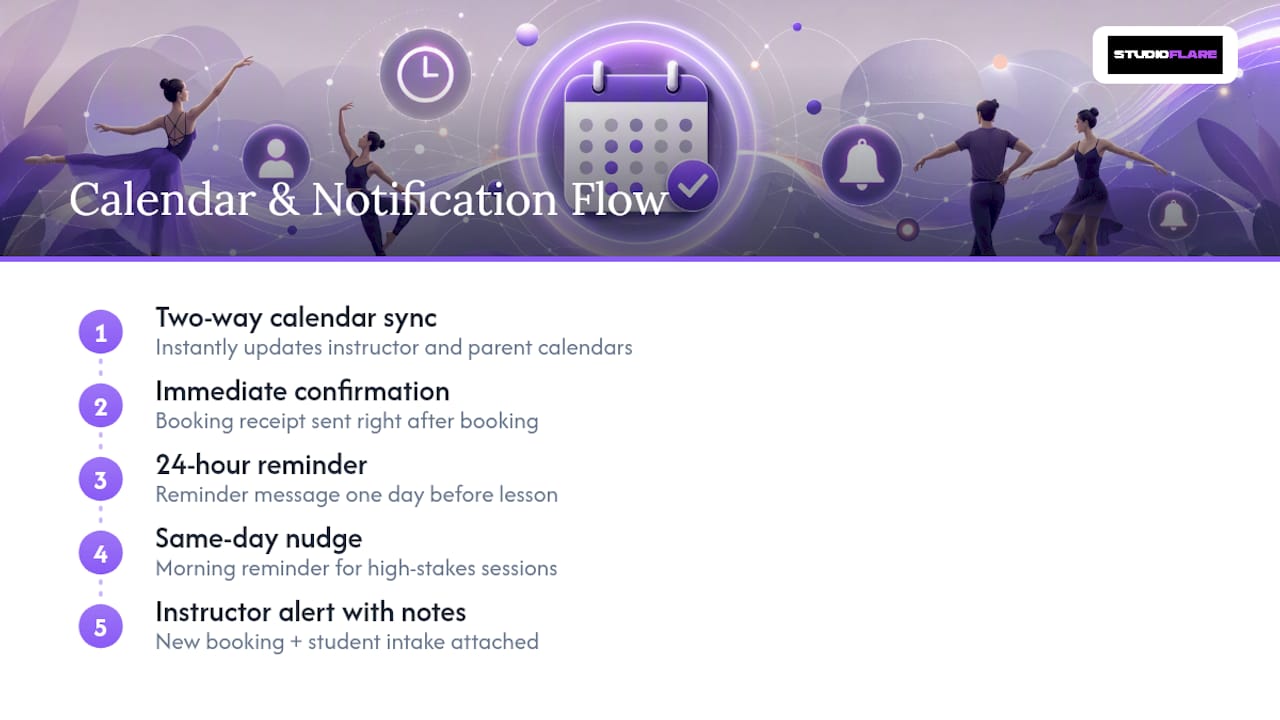
A booking system that lives in its own bubble, disconnected from the calendars instructors and parents already check, creates more friction than it solves. Two-way calendar sync means a booked private lesson shows up automatically on the instructor's phone calendar, and a cancellation on either end updates both sides instantly instead of requiring a follow-up text.
Notification systems need to run on more than one channel. Email confirmations get missed; a text reminder the morning of a lesson gets read. The strongest setups send an immediate booking confirmation, a reminder 24 hours out, and a same-day nudge for higher-stakes sessions like competition prep. Instructors benefit from a parallel notification stream: a new booking alert that includes the student's intake notes attached, so there's no separate step to go dig up that information.
Studios switching from disconnected tools often underestimate how much friction disappears once booking, calendar, and messaging all pull from the same system. StudioFlare's approach to collecting payments online folds notification timing into the same workflow as billing, so a reminder and a payment receipt come from one place instead of three.
Mobile Access for Instructors and Parents
Private lessons get booked and rebooked constantly, often from a phone in a parking lot between school pickup and rehearsal. If your booking system isn't fully usable on mobile, whether that's a native app or a responsive web interface, you're pushing parents back toward calling the front desk, which defeats the entire point of self-serve booking.

Instructors need mobile access just as much as parents do. Checking tomorrow's schedule, reviewing a student's intake notes before walking into the studio, or marking a session complete from a phone all matter more for private lessons than for group classes, because private sessions change instructor to instructor and day to day. A platform that only works well on desktop is asking your staff to do double the work.
Look for an interface that keeps the booking flow to a handful of taps: pick instructor, pick time, confirm payment. Every extra screen is a chance for a parent to give up and call instead.
Managing Private Lessons Across Different Time Zones
Time zones rarely come up until a studio adds virtual private lessons or a family splits time between two locations, and then it becomes an immediate headache. A booking system that displays availability in the studio's local time only creates confusion the moment a parent books from a phone set to a different zone and shows up an hour early or late.
The fix is straightforward on the software side: the system should detect or let the parent select their time zone and display available slots converted automatically, while confirmations and reminders state the time in both zones when there's a mismatch. This matters more than most studios expect once livestreamed private lessons enter the picture, since a remote student joining a session isn't necessarily in the same zone as the studio. StudioFlare's livestreaming setup is worth pairing with clear time zone handling if you're offering private lessons to students who aren't walking through your front door.
Support and Dispute Resolution When Something Goes Wrong
Every studio eventually deals with a payment dispute, a double-booked slot, or a parent who insists they canceled in time when the system shows otherwise. How your booking platform handles that moment matters as much as how it handles the booking itself.
A solid system keeps a timestamped record of every booking, cancellation, reschedule, and payment event, so disputes get resolved by checking a log instead of relying on memory. When a card is disputed through the bank, having Stripe's transaction history and your own booking confirmation on record gives you the documentation to respond quickly rather than losing the chargeback by default.
On the support side, studios should expect responsive help from their software vendor when a payment fails to settle or a sync breaks between calendar and booking. Read the terms of service before committing, specifically the sections on payment processing responsibility and data handling, so you know where the platform's obligations end and yours begin.
Why Instructor Preparedness Was Our Starting Point
We built intake capture and automated delivery to instructors as a first-order feature, not an afterthought, because the data backs it up: studios that hand instructors real information before a lesson report better preparedness and stronger retention. Automating that handoff, along with reminders and billing, is what turns private lessons from a scheduling chore into dependable revenue.
— StudioFlare Team
Bringing Private Lesson Booking Into StudioFlare
StudioFlare handles the entire private lesson workflow in one place: scheduling with instructor availability and buffers, automated billing through Stripe for single sessions and packs, intake forms that route straight to the instructor's dashboard, and built-in livestreaming if you offer remote sessions. The AI assistant answers routine questions about balances and upcoming bookings so your staff isn't fielding the same "how many sessions do I have left" text every week.

If you're currently juggling private lesson bookings across a calendar app, a separate payment link, and a text thread for intake questions, that's exactly the setup this feature replaces. Studios moving from spreadsheet-based tracking or a Mindbody alternative search typically cite the same pain point: no single system connects booking, payment, and instructor prep. Create your studio account and set up your first private lesson session type today to see how the full workflow fits your schedule.
Sources
- AI Dance Studio Software: Scheduling & Automation in 2026
- Private Dance Lesson Pricing: Solo Coaching Rates That Justify the Premium — Zatrovo Blog
- Private Lessons: Guidelines for Working One-on-One