
Set refunds to rare by default: issue pro-rata studio credit tied to the cancellation's effective date, allow cash refunds only inside a short purchase window (typically 24 to 48 hours), and automate the proration math so no staff member does it by hand. Every rule should live inside your studio-management software, not in a PDF nobody reads, with timestamped consent captured at checkout and every refund request logged against the original charge.
TL;DR:
- Refunds should be issued as pro-rata studio credits tied to the cancellation date, with cash refunds restricted to within 24 to 48 hours of purchase.
- Cancellation policies must be tailored to revenue types, with specific cutoff times for drop-ins, private lessons, and memberships to prevent disputes.
- The billing system must enforce effective dates and proration calculations automatically, linking refunds directly to original Stripe charges for clear audit trails.
- Detailed, timestamped records of refund requests, attendance, and consent are essential for resolving chargebacks and defending against disputes.
- Automating these rules within a dedicated studio management platform reduces manual errors, streamlines workflows, and supports consistent policy enforcement.
Table of Contents
- Building Your Dance Studio Cancellation Policy By Product Type
- Configuring Effective Dates, Proration, and Stripe in Your Billing System
- Documenting Consent, Attendance, and Chargeback Evidence
- Refund and Cancellation Language You Can Copy Into Checkout
- Balancing Goodwill Against Cashflow: An Operational Take
- Automating This Policy Inside StudioFlare
- Sources
Building Your Dance Studio Cancellation Policy By Product Type
A single blanket rule fails the moment you apply it to different revenue types. Memberships, class packs, single drop-ins, private lessons, and trials each carry different risk profiles, so your dance studio cancellation policy needs a distinct default for each one.
Start by defining three outcomes clearly, because vague refund terms for dance classes are the single biggest driver of billing disputes. Ambiguous language, not customer hostility, is what turns a routine cancellation into a chargeback, and specific pro-rata wording closes most of that gap.
- Refund: cash back to the original payment method, usually restricted to a short window after purchase.
- Studio credit: account balance applied to future tuition, the default for most mid-cycle cancellations.
- Pro-rata credit: a partial credit calculated from the cancellation's effective date forward.
- No-refund/no-credit: applies to no-shows past the cutoff and to promotional or trial pricing once consumed.
Reasonable cutoffs vary by studio, but workable starting points look like this: drop-ins and single sessions get a cancellation window before forfeiting the class; private lessons need a cancellation window because instructors block dedicated time; membership cancellations typically require 30 days' written notice before the next billing cycle locks in.
Trials deserve their own rule set. If a free or discounted trial auto-converts to a paid membership, send a reminder before the first real charge and require an explicit opt-in checkbox rather than a buried terms link. Auto-billing without clear conversion terms is one of the most common dispute triggers among trial and drop-in customers specifically.
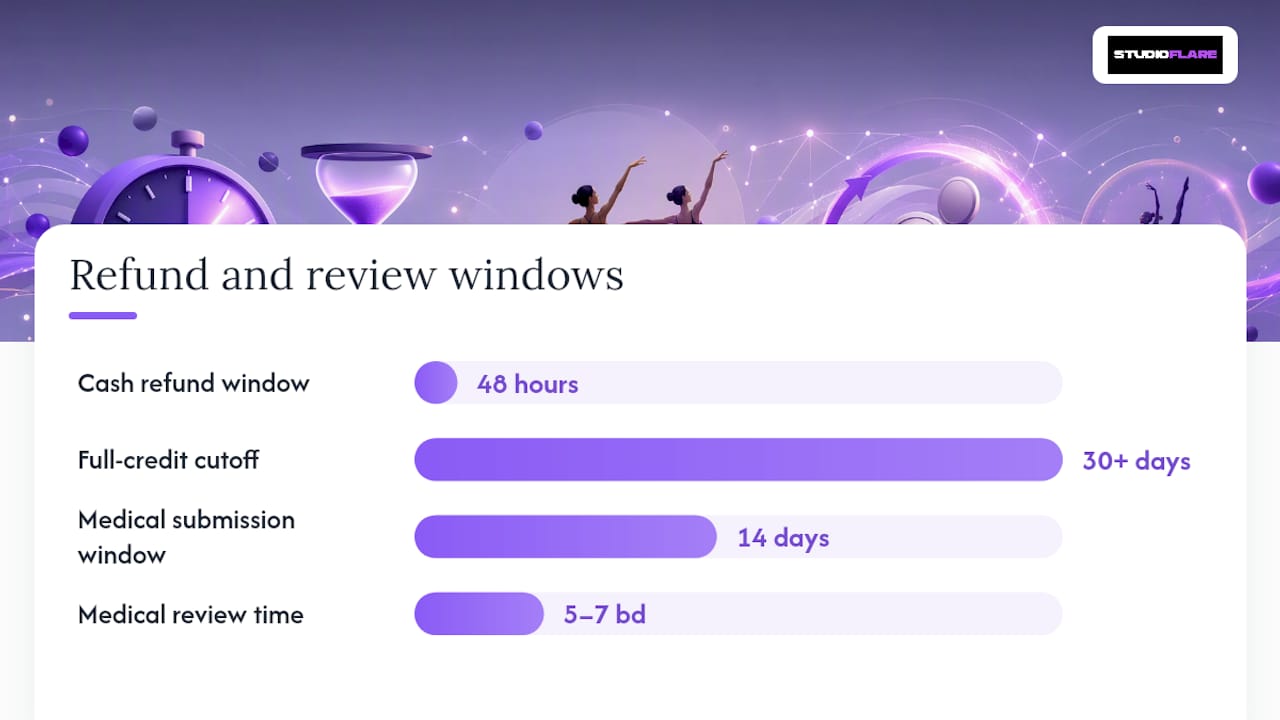
Medical and hardship exceptions should require documentation (a doctor's note, a moving confirmation) submitted within a defined window, with a timely decision issued.
Configuring Effective Dates, Proration, and Stripe in Your Billing System
The policy on paper only works if your studio-management software enforces it the same way every time. That starts with effective-date logic: the system should calculate refunds based on the date the cancellation takes effect, not the date a parent emailed the front desk. Using the ticket date instead of the effective date is exactly the kind of inconsistency that gives a bank dispute reviewer a reason to side against the studio.
Proration itself is simple math once the effective date is locked in as a real field on the enrollment record, not a note in a spreadsheet.
- Class pack example: a 10-class pack at $200 ($20/class), with 4 classes used before cancellation, refunds or credits the remaining 6 classes: $120.
- Monthly membership example: a $150/month membership canceled on day 12 of a 30-day cycle refunds or credits for the 18 unused days: ($150 ÷ 30) × 18 = $90.
- Late-cancel fee example: a $15 flat fee automatically deducted when cancellation falls inside the no-refund window, applied before any remaining credit is calculated.
Every refund should map back to the original Stripe charge rather than issuing a fresh, disconnected transaction. Stripe's charge and refund objects generate webhook records that tie the reversal to the exact original payment, which becomes critical evidence if a parent later disputes the charge with their bank. That same refund to original charge structure also simplifies month end reconciliation, since your books show a clean negative entry against the exact invoice rather than a mystery credit.
Pro Tip: When you issue a Stripe refund, attach internal metadata to it, the invoice ID, a reason code, and the staff member who approved it. That metadata is what turns a one-line refund into a defensible record six months later.
Configure your system to default to credit issuance immediately upon a valid cancellation, and route cash refunds through a manual approval step. That asymmetry keeps cash out the door slower than credit, which protects cash flow without making the policy feel punitive.
Documenting Consent, Attendance, and Chargeback Evidence
Winning a dispute rarely comes down to who was right. It comes down to who has better records. A studio that can produce a timestamped agreement, an attendance log, and a clean payment trail wins chargebacks that a studio relying on memory loses.
Display the refund policy everywhere money changes hands, not just once in a signup form buried on page three. Checkout checkboxes, confirmation emails, and receipts should each restate the core terms, because a bank reviewing a dispute wants to see the customer agreed to the terms at the moment of purchase, not that the terms existed somewhere on your website.
Your refund request log should capture:
- Who requested the refund and their enrollment ID.
- The date and time of the request, plus the cancellation's effective date.
- The stated reason and any supporting documentation.
- The decision, the credit or refund amount issued, and who approved it.
Logging requests and outcomes this consistently creates a paper trail showing the policy was applied the same way for everyone, and that consistency is often what tips a chargeback decision in the studio's favor.
Attendance evidence backs up the whole log. Digital sign-in through your attendance tracking tools, instructor-entered rosters, and livestream attendance reports for virtual classes all establish that a student actually used, or didn't use, the sessions in question. When a chargeback lands, assemble a response packet with four pieces: the policy language shown at checkout, the timestamped consent record, the attendance history, and the payment trail from the original Stripe charge through any refund. Recording refunds as negative revenue against the original invoice also keeps your books and your dispute evidence pointing to the same numbers. Consistent staff training on these steps, covered in more depth on the studio operations blog, matters as much as the software settings themselves.
Refund and Cancellation Language You Can Copy Into Checkout
Vague policy language creates disputes; specific numbers close them. Use these as starting templates, not final legal text, and adapt the specific windows to your own studio's cancellation rules.
Checkout checkbox: "I agree to the studio's cancellation and refund terms: credits are issued for cancellations made 30+ days before the next billing cycle; cash refunds apply only within 48 hours of purchase. Full terms →"
Confirmation email snippet: "Thanks for enrolling in [Class Name]. Your payment of $[amount] was processed on [date]. Per our refund policy, you may cancel until [cutoff date] for a full studio credit. After that date, cancellations receive a pro-rata credit calculated from your effective cancellation date."
A parent cancels a class pack after attending some classes. The unused classes are calculated as studio credit, issued automatically once the cancellation's effective date is confirmed in the system.
Medical exception wording: "Cancellations supported by documented medical or hardship circumstances, submitted within 14 days of the triggering event, will be reviewed within 5 to 7 business days and may qualify for a refund outside the standard window."
Linking this language to your full terms of service rather than rewriting it fresh in every email keeps the wording consistent across every touchpoint.
Balancing Goodwill Against Cashflow: An Operational Take
Every refund is a small negotiation between two things that pull against each other: the goodwill that keeps a family enrolled for another three years, and the cashflow discipline that keeps the studio solvent. Studios that refund too generously train customers to ask for exceptions constantly. Studios that refund too rigidly lose parents who'd have stayed loyal for a decade over a $40 dispute. The pro-rata credit default exists precisely because it splits that difference. It costs the studio nothing in cash today, and it feels fair enough that most parents accept it without escalating.
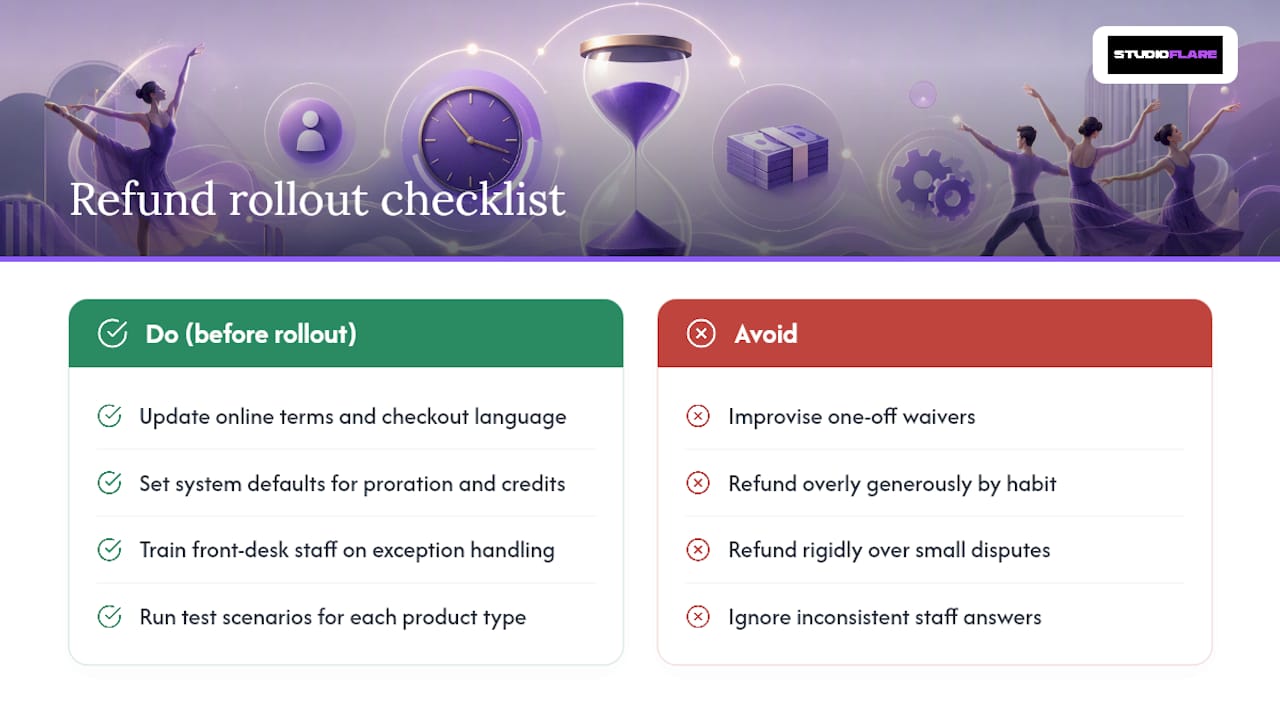
Before rollout, walk through this checklist: update the online terms and checkout language, set system defaults for proration and credit issuance, train front-desk staff on exception handling so nobody improvises a one-off waiver, and run test scenarios for each product type. After launch, track refund rate, chargeback rate, and average processing time monthly. A rising chargeback rate almost always traces back to inconsistent staff answers, not a bad policy.
— StudioFlare Team
Automating This Policy Inside StudioFlare
A comprehensive studio management platform replaces running refund logic across spreadsheets, group texts, and a payment processor's dashboard that don't talk to each other. Every rule described above, effective-date proration, timestamped checkout consent, and refunds mapped to the original charge, runs as a built-in workflow instead of a manual process someone has to remember to do correctly every time.

Billing runs on automated charges tied directly to each student's enrollment record, so a mid-cycle cancellation prorates against the actual effective date rather than the date someone got around to processing it. Digital sign-in and livestream attendance logs generate the evidence a chargeback response needs automatically. An AI assistant can answer a parent's billing question before it ever turns into a dispute. If you're currently piecing this together across a legacy platform, the Mindbody alternative built for this exact workflow is worth a look, or you can create your studio account and see the refund and proration settings configured against your own class schedule.
Sources
- Studio Refund Policy: Language That Prevents Disputes and Passes State Law Scrutiny — Zatrovo Blog
- Reducing Refund Disputes: Payment Tips for Managing Trial Classes and Drop-Ins
- Dance Studio Accounting Tips | Complete Controller
- Best Dance Studio Payment Software (2026)