

Respond inside Stripe before the deadline or you automatically lose the funds, so open the dispute now and note the exact due date. Call or message the parent right away to see if this is a misunderstanding worth resolving directly. While you wait for a reply, pull the signed enrollment terms, the payment receipt, and attendance logs, since those three documents decide most studio disputes.
TL;DR:
- Respond promptly within the first 24 to 72 hours by opening the dispute in Stripe, contacting the parent, and gathering all relevant documentation.
- Strong evidence including signed terms, timestamps, attendance logs, and communication history significantly increases the chances of winning disputes.
- Implement clear checkout policies, send pre-charge reminders, and provide clients access to their payment history to prevent disputes before they start.
- Stripe deducts dispute fees immediately upon filing, and a high dispute rate can trigger account monitoring or restrictions, impacting future payment processing.
- Only fight disputes backed by solid documentation and high potential recovery; avoid wasting staff hours on thin or recurring cases without strong evidence.
Table of Contents
- How Stripe Chargebacks and Inquiries Actually Work
- What to Do in the First 24 to 72 Hours After a Dispute Notice
- The Evidence That Actually Wins Chargeback Disputes for Studios
- Checkout Policies and Staff Habits That Cut Chargebacks Before They Start
- Submitting Evidence Through Stripe: Fees, Timelines, and Outcomes
- How StudioFlare Organizes Your Evidence Before You Need It
- Why Parents File Chargebacks Against Dance Studios in the First Place
- Chargeback Strategies Built for How Dance Studios Actually Operate
- Does a Chargeback Hurt Your Stripe Account Standing?
- When to Fight a Chargeback and When to Let It Go
- Cut Chargeback Risk With Built-In Evidence Tools
- Where to Go for the Official Rules and Deadlines
- Sources
How Stripe Chargebacks and Inquiries Actually Work
Stripe splits payment problems into two stages, and the distinction matters more than most studio owners realize. An inquiry is a soft warning, usually the card issuer asking questions before a cardholder formally disputes the charge. If you respond fast and clearly at this stage, you can often resolve it with no fee and no mark against your account. A full chargeback is different: the card network yanks the funds from your Stripe balance immediately, and Stripe deducts a dispute fee the moment the dispute is filed.
From there, the clock starts. You typically get 7 to 21 days to submit evidence, depending on the card network and reason code. The issuing bank then takes its own sweet time, often 60 to 75 days, to actually rule on your submission. That gap between "you respond" and "you find out" is exactly why documentation has to be ready before the dispute ever lands.
What to Do in the First 24 to 72 Hours After a Dispute Notice
Speed determines whether you win. Here's the order that works:
- Open the dispute in your Stripe Dashboard immediately and record the reason code and the exact submission deadline, not just "soon."
- Contact the parent or guardian directly, calmly and without accusation, and ask if they'd be willing to withdraw the dispute if it's a billing mix-up. Log the date, time, and outcome of that conversation.
- Export your paper trail: the signed registration terms, the transaction receipt, the class or session booking record, attendance or check-in logs, and any email or text thread related to the charge.
- Decide whether to fight or fold, and assign one specific staff member to own the representment packet so it doesn't stall between two people who each assume the other is handling it.
Even if the parent agrees to drop the dispute, Stripe still requires a formal response in the dispute center to close it out. A verbal agreement with a parent doesn't undo the chargeback on its own.
Pro Tip: Set an internal rule that billing questions get a reply within four business hours. Studios that respond that fast to confused parents often stop a chargeback before it's ever filed.
The Evidence That Actually Wins Chargeback Disputes for Studios

Issuers reviewing a dispute don't want a story. They want proof, organized in a way that lets an unfamiliar reviewer verify your side of things in under five minutes. Studios that keep this material on hand consistently outperform ones scrambling after the fact.
The core evidence set looks like this:
- Signed terms at purchase, showing the parent explicitly agreed to your refund policy and to recurring billing if applicable.
- A timestamped transaction receipt or confirmation email, matching the disputed amount exactly.
- Attendance or booking logs, proving the dancer actually showed up to class or that the session was reserved and held for them.
- Communication records, including any emails or texts where a cancellation request was made, ignored, or handled.
- A short cover letter, one paragraph, that lays out the timeline in plain language before the issuer digs into the attachments.
Studio-focused benchmarks suggest that studios with signed terms, confirmations, and attendance records on file win a significantly higher share of disputes than studios that don't. The pattern holds because issuers are, at bottom, just trying to confirm the service was delivered as agreed.
A workable cover letter reads something like: "On [date], [client name] enrolled in [class name] and electronically signed our registration terms, which include a no refund after 7 days policy. The attached receipt confirms the charge of $[amount] on [date]. Attendance logs show the dancer checked in on [dates]. No cancellation request was received prior to this dispute." Attach documents in that same order: cover letter first, signed terms second, receipt third, attendance fourth, communications last.
Checkout Policies and Staff Habits That Cut Chargebacks Before They Start
Most disputes are preventable, and prevention costs almost nothing compared to fighting a chargeback after the fact. Four changes make the biggest dent:
- Put refund, cancellation, and recurring billing terms directly at checkout, and require an acknowledgment checkbox before the parent can complete enrollment.
- Send a reminder email 7 to 10 days before any recurring tuition charge, so nobody is surprised by a line on their bank statement.
- Hold your team to a same-day or next-business-hour response window for billing questions, and empower staff to issue a refund or credit on the spot when it clearly resolves the issue.
- Give clients a portal where they can see their own charge and attendance history, so a confused parent can check the facts themselves instead of calling the bank first.
A written no-show and cancellation policy posted where parents actually read it, not buried in a PDF, closes off one of the most common excuses issuers hear: "I didn't know I'd be charged." Pair that with clear online payment collection practices and most billing confusion never becomes a dispute in the first place.
Submitting Evidence Through Stripe: Fees, Timelines, and Outcomes
The Stripe Dashboard's Disputes tab shows every open case with its reason code, amount, and response deadline front and center. That deadline is not a suggestion.
Here's what actually happens on the money side:
- The disputed amount is pulled from your balance the moment the dispute is filed, and the dispute fee is deducted immediately, separate from whether you win or lose.
- If you win, the disputed amount is returned to your balance, though the dispute fee itself is not always refunded and network fees can still apply depending on the card brand.
- If the dispute is small and your evidence is weak (no signed terms, no attendance proof), accepting it can cost less in staff time than fighting it.
- If you have strong documentation, a thorough evidence package is almost always worth submitting, since a clear paper trail tends to move the outcome in your favor.
Stripe also offers Smart Disputes and dispute deflection tools that help automate parts of the evidence submission and flag disputes worth fighting.
| Dispute stage | What happens | Typical timeframe |
|---|---|---|
| Inquiry received | No funds pulled yet; respond to possibly avoid a formal dispute | Immediate response recommended |
| Dispute filed | Funds withheld, dispute fee charged | Same day |
| Evidence submission window | You upload your representment packet in Stripe | 7 to 21 days |
| Issuer review | Bank evaluates evidence and decides | 60 to 75 days |
How StudioFlare Organizes Your Evidence Before You Need It
The studios that win disputes aren't scrambling to find a signature from six weeks ago. They already have it. StudioFlare automates the collection of signed terms and receipts at the moment of checkout, so that documentation exists before a dispute is ever filed, not after.
Attendance and booking logs sync automatically inside the platform, giving you timestamped proof that a class was attended or a private lesson was booked and held. When a dispute does land, you can pull a complete attendance record in seconds instead of digging through a spreadsheet or a group text thread from three months ago. StudioFlare's AI assistant can also flag which transactions are in dispute and surface a recommended next step, whether that's issuing a quick refund or assembling the evidence bundle.
Why Parents File Chargebacks Against Dance Studios in the First Place
Most studio chargebacks aren't fraud. They're friction. Understanding the actual pattern helps you respond with the right tone instead of treating every dispute as an attack.
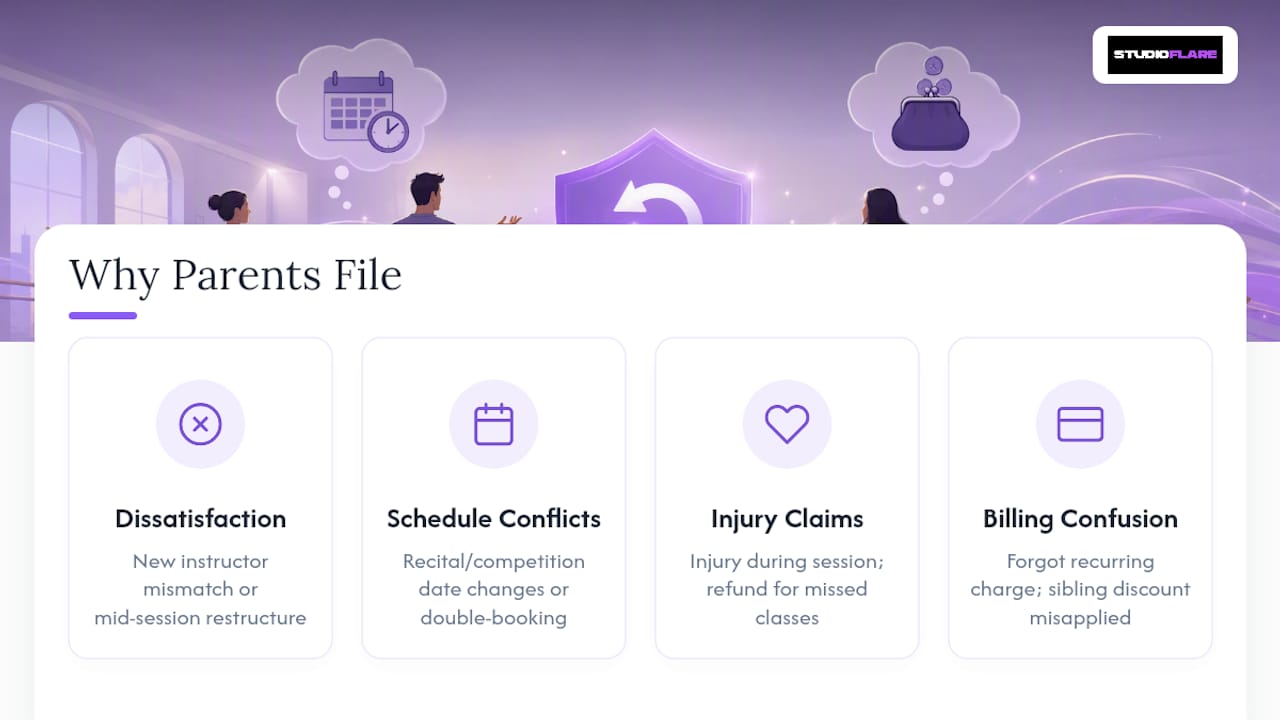
Dissatisfaction with instruction is common, especially when a parent feels a new instructor doesn't match the one their child signed up for, or when a class gets restructured mid-session. Schedule conflicts show up constantly too: a recital date moves, a competition schedule changes, or a family simply double-books, and rather than emailing the studio, the parent disputes the charge with their bank because it feels faster.
Injury claims are trickier and often legitimate on some level. A dancer sprains an ankle in week two of an eight-week session, and the parent feels they shouldn't pay for classes their child can't attend. Your refund policy should address this directly rather than leaving it to interpretation during a dispute.
Then there's plain billing confusion, a recurring charge the parent forgot they authorized, or a sibling discount that didn't apply the way they expected. This category is the most preventable of all, and it's usually where a clear checkout acknowledgment and a pre-charge reminder email make the biggest difference.
Recognizing which bucket a dispute falls into changes your response. A schedule conflict dispute calls for a policy citation and maybe a partial credit. An injury claim calls for empathy first, policy second. A billing confusion dispute calls for a fast, friendly phone call before it ever reaches Stripe's dispute queue.
Chargeback Strategies Built for How Dance Studios Actually Operate
Dance studios run on a business model that's structurally more dispute prone than a typical retailer: recurring tuition, seasonal enrollment, and a service that's consumed over weeks or months rather than delivered in a single transaction. That shapes what prevention actually looks like here.
Build your enrollment terms around the recital and competition calendar, not a generic monthly cycle, since most parent frustration clusters around schedule changes tied to those events. Treat sibling and multi-class discounts as a documentation risk, not just a pricing perk. Discount errors are a leading cause of billing-confusion disputes, so confirm the discount in writing at signup.
Segment your triage by season. Chargebacks tend to spike right after registration periods and again near recital fee collection, so staff should expect a heavier billing-support load at those two points and plan coverage accordingly. Finally, treat your cancellation window as a communication tool, not just a legal shield. A studio that reminds families of the cancellation deadline a week before it closes gets far fewer disputes than one that only mentions it once, buried in a signup form months earlier.
Chargebacks industry-wide are projected to climb roughly 24% globally from 2025 to 2028, which makes building these habits now cheaper than fixing a bad dispute rate later.
Does a Chargeback Hurt Your Stripe Account Standing?
Yes, and the effect compounds if you ignore it. Stripe tracks your dispute rate as a percentage of total transactions, and a rate that climbs too high can trigger closer account monitoring or, in more serious cases, restrictions on your ability to process payments. This isn't about one angry parent disputing a $45 late fee. It's about a pattern.
A studio with a handful of disputes across thousands of transactions barely registers. A studio with a cluster of disputes in a short window, especially disputes it never responded to, looks like risk to both Stripe and the card networks watching in the background. That's the quiet cost most studio owners miss: it's not just the $15 dispute fee and the lost tuition. It's the account health score sitting behind your ability to keep processing payments smoothly during your busiest enrollment season.
Responding promptly and winning a reasonable share of disputes keeps that rate low. Ignoring notices, or treating every chargeback as unwinnable and not bothering to respond, is the fastest way to end up flagged.
When to Fight a Chargeback and When to Let It Go
We think the smartest triage question isn't "can I win this?" It's "is this worth the staff hour it'll take to assemble evidence?" Small, one-off disputes with thin documentation and no history of repeat problems from that family often aren't worth fighting. Repeat disputes, or anything backed by solid attendance and signed terms, should be contested every time, both for the dollar amount and to keep your dispute rate from drawing scrutiny. The real goal is making these triage calls rare in the first place by fixing the checkout and communication gaps that create disputes.
— StudioFlare Team
Cut Chargeback Risk With Built-In Evidence Tools
StudioFlare gives studios a way to have the paperwork ready before a parent ever calls their bank. Checkout requires an acknowledgment of your refund and billing terms, receipts generate automatically with timestamps, and attendance logs build themselves as families check in for class.

When a dispute does show up, you're not digging through email threads or asking a front desk staffer to remember what happened three months ago. You export a complete evidence bundle, cover letter format included, in a few clicks. That's the practical difference between a studio that treats every chargeback as a fire drill and one that treats it as routine paperwork. See how the billing and attendance tools work together on the StudioFlare product page, or create your studio account to start building that evidence trail from your very next enrollment.
Where to Go for the Official Rules and Deadlines
Bookmark Stripe's disputes documentation and the guide to responding to disputes for reason codes and deadlines that change occasionally. Keep the studio-specific chargeback prevention guide handy too, alongside your Dashboard's dispute view, for every case going forward.
Sources
- Stripe docs — disputes
- Stripe guide — introduction to payment disputes
- Stripe support — disputes
- Chargeback prevention for studios: policies and documentation that win disputes — Zatrovo