

Pull up your prioritized substitute list and start contacting names in order until someone confirms. If the class starts in under two hours, skip straight to your emergency contacts and expect to pay a premium for the fast turnaround. Update your schedule the moment you have a confirmed sub, then notify parents. Log the substitution before you do anything else that day.
Here's the 30-minute version:
- 0 to 5 minutes: Text or message your top three subs for that class type at once, not one at a time.
- 5 to 20 minutes: First to confirm gets it. Send them the class folder immediately.
- 20 to 25 minutes: Update the roster in your scheduling system and flag the substitution.
- 25 to 30 minutes: Notify affected families with the sub's name and a one-line note on who they are.
Anything less than 90 minutes before class time counts as a critical window. Below four hours, you're in emergency territory, and that usually means emergency-response pay of 25 to 50% above your standard rate. Substitute teacher scheduling only feels chaotic when there's no ranked list and no time threshold. Both are fixable this afternoon.
Key Takeaways
Reliable substitute coverage comes down to a ranked sub pool, a timed 4-step protocol, transparent pay, and documentation stored where staff can actually find it.
| Point | Details |
|---|---|
| Rank your sub pool | List subs in priority order with genre tags, contact info, and response history, not a flat contact list. |
| Follow the 4-step protocol | Cancel notice, outreach, confirmation, then client notification, each with a set time target. |
| Pay a fair emergency premium | Set a published base rate and add 25 to 50% for short-notice or same-day coverage. |
| Require insurance and vetting | Confirm certificates of insurance and background checks before any assignment, and store expiration dates centrally. |
| Automate the record-keeping | A platform like StudioFlare tracks certifications, outreach responses, and parent notifications in one place. |
Primary sources behind the guidance
- Emergency substitute pay increase — KENS5
- Substitute instructor insurance policies — BarreDiary
- Substitute teacher policies for dance studios — Dance Studio Journal
Table of Contents
- Building a substitute pool you can actually rely on
- A 4-step fast coverage protocol you can adopt today
- Setting pay rates that actually keep subs answering
- Vetting, documentation, and insurance to reduce liability
- How to brief a substitute in five minutes flat
- What your cancellation and response data are trying to tell you
- How StudioFlare cuts the admin time out of substitute scheduling
- A copy-ready SOP for your operations manual
- What most studios get backwards about substitute planning
- Why StudioFlare fits studios tired of scrambling for coverage
- Frequently Asked Questions
- Sources
Building a substitute pool you can actually rely on
A substitute pool is a ranked, living list of people qualified to teach your classes on short notice, not a group text you scroll through in a panic. The strongest studios build theirs in layers, starting closest to home and expanding outward only when needed.
- Current staff who teach adjacent styles or age groups.
- Former instructors who left on good terms and still live nearby.
- Studio alumni now in college or working locally who trained in your syllabus.
- Dance programs at nearby colleges, where students often want paid teaching hours.
- Advanced students or adult class participants, for lower-stakes coverage like open studio or drop-in classes.
- Vetted contacts from local dance networks and social groups, used sparingly and only after background checks clear.
For each person, record their genre tags, phone and email, certification status, background check date, insurance expiration, typical availability windows, and how often they've actually said yes when asked. That last field matters more than most studios realize. A 3 to 5 sub minimum per class type is a smart target, since specialty fitness studios that track this closely report chronic shortages when they run thinner than that.
Pro Tip: Recruit before you need to, not after. Send a "who's available this summer" message to your whole pool in April, before competition season and vacation gaps hit at the same time.
A 4-step fast coverage protocol you can adopt today
Coverage falls apart when there's no shared process. A documented 4-step protocol of cancellation, outreach, confirmation, and client notification resolves most gaps before they ever become cancellations.
- Cancellation notice. Instructors should give 24 or more hours' notice when possible, with a 4-hour minimum outside true emergencies.
- Outreach. Message your top-ranked subs simultaneously through a group message or scheduling platform request, aiming to fill the slot in 20 to 30 minutes.
- Confirmation. Update the schedule, assign the class folder, and confirm start time, location, and any equipment the sub needs to bring.
- Client notification. Tell parents once a sub is locked in, not before, so you're not sending a correction ten minutes later.
Set a hard cancellation threshold, too:
- If no sub is confirmed 60 to 90 minutes before class start, cancel the class and notify families immediately.
- Never leave families guessing until the class was supposed to start. That's when trust erodes.
Setting pay rates that actually keep subs answering
Publish a base substitute rate, whether it's per hour or per class, so every booking is transparent and nobody negotiates in a panic text at 4 p.m. Ambiguity around pay is one of the fastest ways to lose a sub pool's trust.
- Post the standard rate somewhere your staff can reference it without asking.
- Pay an emergency premium for short-notice or same-day coverage.
- Offer small response-rate bonuses to your most reliable subs to encourage timely responses.
- Process payment within the same pay cycle, not "whenever."
Emergency pay in practice: Boerne ISD raised its emergency substitute pay specifically to get faster yeses on short notice, landing in that same 25 to 50% premium range studios use for last-minute coverage.
Vetting, documentation, and insurance to reduce liability
Every substitute in your pool needs a paper trail before they ever step into a classroom. This isn't bureaucracy for its own sake. It's what protects you if something goes wrong during someone else's class.
- Run a background check before adding anyone to the active roster, no exceptions for "just this once."
- Confirm relevant certifications for the age group and style they'll teach, plus CPR or first aid where your studio requires it for staff generally.
- Require a certificate of insurance showing active professional liability coverage, and check the expiration date before every assignment, not just at onboarding.
- Watch for the transition month between policy renewals. That's when coverage gaps most often slip through unnoticed.
- Store scanned copies and expiration dates centrally so only compliant subs appear as bookable options.
How to brief a substitute in five minutes flat
A sub who walks in blind can supervise a class. A sub who gets a real briefing can actually teach it. The difference shows up immediately in how the kids respond, and it's usually the gap parents notice when they complain about a substitute day.
Build a standing class folder for every regular class:
- The last four weeks of choreography or curriculum notes.
- A student roster with any injury flags, allergies, or behavioral notes.
- Playlist access or a link to the music being used.
- Equipment setup instructions, from mirrors to mats to sound systems.
- One sentence on the main goal for that specific class session.
Deliver it through a 5-minute call or a standardized digital briefing form the moment a sub confirms, not when they arrive at the door. Assign one person, usually the studio manager or lead teacher, as the briefing owner, and give the sub a direct number to text if something unexpected comes up mid-class, following guidance on what a swim instructor home visit includes for briefing substitutes effectively.
Pro Tip: Keep the class folder as a living document your regular teacher updates weekly. A folder that's three months stale is almost as useless as no folder at all.
What your cancellation and response data are trying to tell you
Two numbers reveal almost everything about your coverage health: how often a class needs a sub, and how often your pool actually says yes when asked.
- Cancellation frequency by class or instructor, tracked monthly.
- Sub response rate, meaning the share of outreach messages that get a fast yes.
Log every substitution with the reason, how much notice you got, and any client feedback, then review the pattern quarterly. If one Tuesday evening slot needs a sub four times in a semester, that's not bad luck, that's a scheduling problem.
| Metric | What to track | Review cadence |
|---|---|---|
| Cancellation frequency | Number of sub requests per instructor or class slot | Monthly |
| Sub response rate | Percentage of outreach messages answered within 30 minutes | Monthly |
| Participation compliance | Whether each pool member met minimum coverage commitments | Quarterly |
Require a minimum participation level, such as one covered shift per quarter, so the same two or three people aren't carrying your entire sub pool while everyone else stays listed but unavailable.
How StudioFlare cuts the admin time out of substitute scheduling
Most of the friction in substitute teacher scheduling isn't finding a warm body. It's the paperwork trail around them: certifications, availability, parent messages, payroll notes, all scattered across texts and spreadsheets. A studio management platform closes that gap by keeping every piece in one searchable place.
- Staff records store certifications, background check dates, and insurance expirations in one profile per substitute.
- Group outreach goes out to your ranked sub pool at once, with response tracking so you see who answered first.
- Parent notifications trigger automatically when a schedule change is logged, tied directly to the substitution record for payroll.
- Built-in livestreaming lets a class run even when no local sub is available that day.
- An AI assistant answers quick staff questions about who's on the roster or when a sub was last paid, without digging through old messages.
| Manual process | StudioFlare equivalent |
|---|---|
| Group text to find a sub | Automated outreach to a ranked sub list with response tracking |
| Spreadsheet of certifications | Centralized staff records with expiration alerts |
| Separate parent email after the fact | Automatic notification tied to the schedule update |
A copy-ready SOP for your operations manual
A short written policy prevents most last-minute scrambles, according to operational guidance for studio manuals. Paste this structure in and adjust the numbers to your studio.
- Instructors give 24+ hours' notice; 4-hour minimum outside emergencies.
- Outreach goes to the top three ranked subs simultaneously, 20 to 30 minute response window.
- Confirmed sub gets the class folder and a 5-minute briefing before class.
- Parents are notified once coverage is locked, never before.
- Emergency subs (under 4 hours) receive the published premium rate automatically.
Quarterly audit checklist:
- Which class slots needed a sub more than twice this quarter?
- Which pool members met their minimum participation requirement?
- Are all certificates of insurance current for active subs?
Studios that build this into an operations manual stop treating each cancellation as a crisis and start treating it as a checklist.
What most studios get backwards about substitute planning
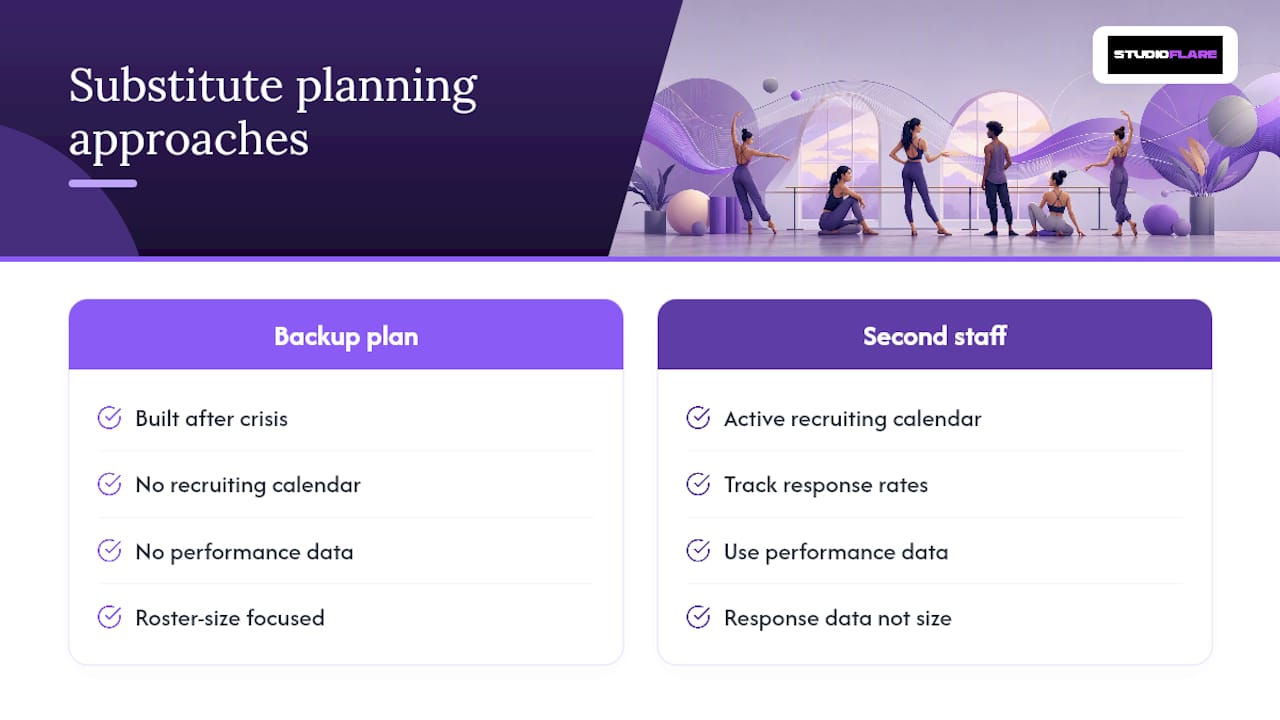
Most advice on this topic treats the substitute pool as a backup plan, something you build after the crisis to prevent the next one. That's backwards. The studios with the fewest cancellations treat their sub pool as a second staff roster with its own recruiting calendar, its own performance data, and its own minimum participation rules, the same way best practices for managing substitutes point out for any organization that leans on temporary coverage.
The overrated piece of conventional wisdom is the idea that more subs on paper equals better coverage. A list of fifteen names nobody's tracked response rates on is worse than five names you know will actually answer. Response data beats roster size every time.
If you do one thing after reading this, make it the participation requirement. Studios that let a handful of people carry the whole sub pool burn those people out fast, and burnout is exactly when a reliable sub stops answering your texts. Fix that incentive structure before you worry about anything else on this list.
Why StudioFlare fits studios tired of scrambling for coverage
Spreadsheets and group texts work until the day they don't, usually right when a sub cancellation collides with a packed recital week. StudioFlare replaces that patchwork with one system that stores every substitute's certifications and availability, sends outreach to your ranked pool automatically, and updates parents the moment a schedule changes.

It's built specifically for dance studios, which means the workflow already matches how your classes actually run: by style, by age group, by instructor specialty. If a sub search comes up empty, the platform's built-in livestreaming lets a class run anyway instead of canceling outright. Studios moving off older systems can compare the full feature set on the StudioFlare vs. Mindbody breakdown to see what changes day to day.
If your current setup still runs on text threads and memory, set up your studio on StudioFlare and see how much of this substitute chaos disappears in the first week.
Frequently Asked Questions
How far in advance should instructors give notice for planned absences? Twenty-four hours or more is the standard target, with a four-hour minimum outside true emergencies. Anything shorter should trigger your emergency outreach process automatically.
What counts as an emergency for substitute pay purposes?
Who should approve same-day substitute requests? One person, usually the studio manager, should own same-day approvals. Splitting that authority across multiple staff members is how double-bookings and mixed messages to parents happen.
Do substitute instructors need their own insurance? Yes. A current certificate of insurance showing professional liability coverage should be on file before any substitute is assigned to a class, with dates checked at each new assignment.
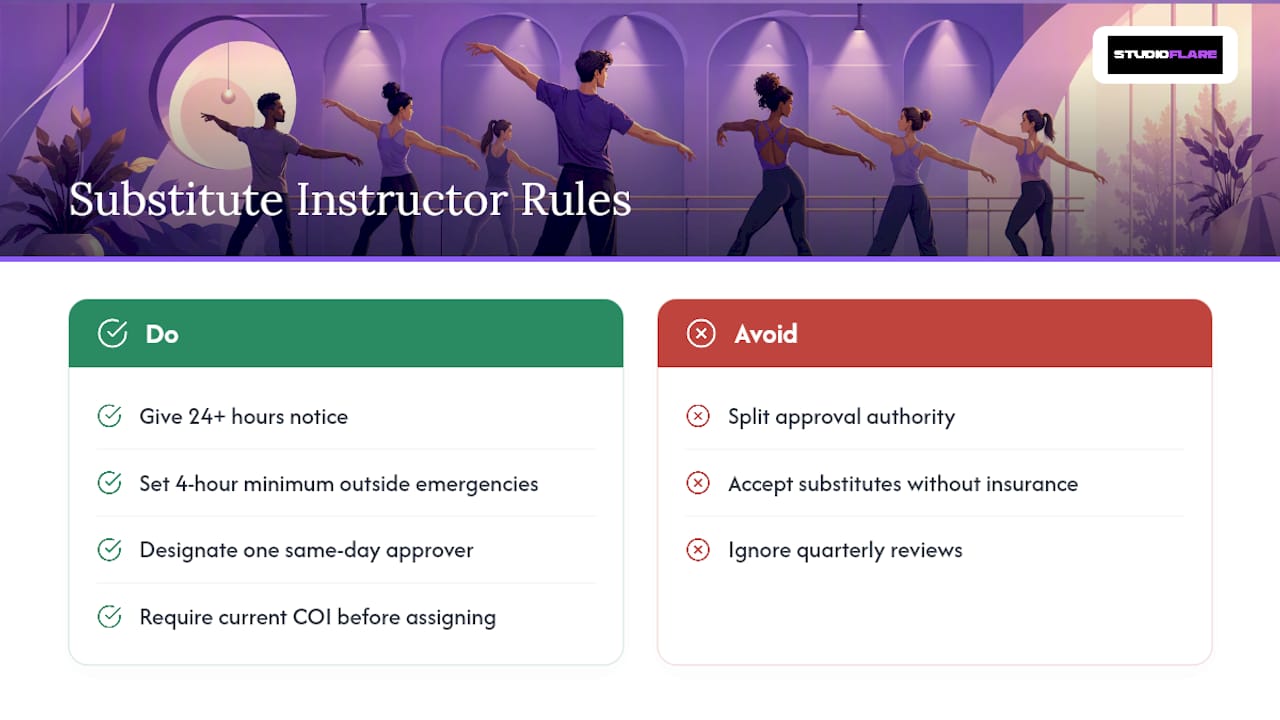
How often should a studio review its substitute scheduling data? Quarterly works well for most studios. Reviewing cancellation frequency and response rates every three months catches slots or instructors that need a scheduling change before the pattern becomes a bigger staffing problem.
Sources
- Boerne ISD more money emergency pay rate raise increase substitute teachers auxiliary employees — KENS5
- Substitute instructor policies every barre studio needs — BarreDiAry
- Substitute Teacher Policies for Dance Studios in 2026 — Dance Studio Journal