

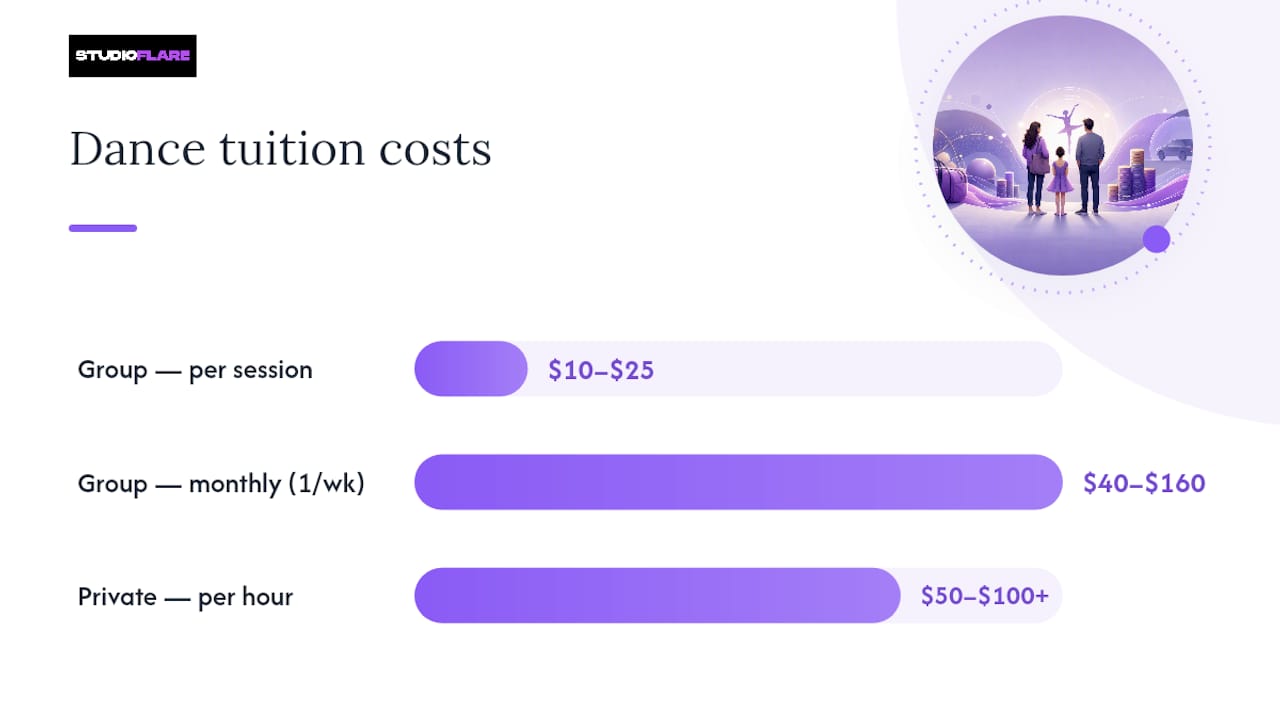
A typical tuition fee schedule dance families see runs $40 to $160 a month for one weekly group class, with private lessons priced $50 to $100 an hour. Studios usually convert an annual tuition figure into 9 or 10 equal monthly installments, then add registration, costume, and recital fees on top. The real number that matters isn't the per-class rate. It's the total season cost once billing cadence, auto-pay terms, and refund rules are factored in.
TL;DR:
- Most dance studios spread annual tuition into nine or ten monthly payments, with additional costs for costumes, recitals, and registration fees.
- Private lessons usually cost $50 to $100 or more per hour, significantly raising overall season expenses depending on the number of classes or lessons.
- Extra fees such as costume purchases, recital packages, insurance, and venue charges can add hundreds of dollars per student to the total cost.
- Family discounts, multi-class packages, and financial aid options are often available but typically require asking directly; they are not automatically included.
- Using studio management platforms with transparent, itemized billing reduces confusion and helps families understand the full financial commitment before enrolling.
Table of Contents
- How Much Does Dance Tuition Really Cost? Rates and Examples
- How Do Studios Turn Annual Tuition Into Monthly Bills?
- What Extra Fees Show Up Beyond Tuition?
- Are There Discounts or Financial Assistance for Dance Tuition?
- How Do You Read a Studio's Fee Schedule Before Enrolling?
- How Studio Software Clears Up Confusion Around Tuition Billing
- Budgeting for a Dance Season: A Practical Rule of Thumb
- A Clearer Way for Studios to Handle Tuition Billing
- Sources
How Much Does Dance Tuition Really Cost? Rates and Examples
Group class pricing in the U.S. generally falls between $10 and $25 per session, which translates to roughly $40 to $160 a month for a single weekly class. Private lessons run considerably higher, typically $50 to $100 or more per hour, since you're paying for one-on-one instructor time rather than sharing a room with a dozen other dancers.
Style and location move these numbers more than most parents expect. Ballet and competitive ballroom programs tend to sit at the top of the range because they demand smaller class sizes and often require pointe or technique training beyond the group hour. A studio in a major metro area will almost always price higher than a small-town studio offering the same curriculum.
Here's how per-class pricing scales into a monthly bill:
| Class frequency | Per-class rate | Estimated monthly tuition |
|---|---|---|
| 1 class/week | $15 | $40 to $160 |
| 2 classes/week | $15 | $40 to $160 |
| 1 private lesson/week | $75/hour | several hundred dollars |
| 2 classes/week (premium/ballet) | $10 to $25 | $40 to $160 |
A few things push these figures around in practice:
- Competitive teams and pre-professional tracks often bundle in extra rehearsal hours, raising the effective monthly rate well past the group-class average.
- Online or hybrid classes sometimes price below in-studio group rates, since studios save on space and staffing costs.
- Multi-class packages (three or more classes per week) usually come with a per-class discount baked into the total.
Monthly dance tuition rates for one class rarely tell the full story once you add a second style or a private coaching hour.
How Do Studios Turn Annual Tuition Into Monthly Bills?
Studios rarely bill tuition class by class. Instead, they calculate a full season's cost and spread it across a set number of payments. Understanding which model a studio uses is the first thing to check on any dance tuition payment plan.
- 9-pay or 10-pay plans. The most common approach: annual tuition divided into 9 or 10 equal monthly installments, usually running from August or September through May or June.
- 12-pay plans. Some studios spread tuition across a full calendar year to smooth out payments, even though classes don't run every month.
- Semester billing. Two-payment plans that bill once per semester, common at studios that split fall and spring sessions cleanly.
- Single annual payment. A smaller number of studios offer a one-time payment, often with a modest discount for paying in full upfront.
Registration typically happens before the first class, and many studios require a deposit or first month's tuition at signup, with prorating applied if you join mid-month. Billing language matters here: a studio might state that "tuition is posted to the family account on the 28th and processed on the 1st," which tells you exactly when to expect a charge.
Auto-pay is close to universal now. Most studios require a card on file and bill automatically each cycle, with late fees kicking in a few days after a missed or declined payment. Read the fine print on refund and non-transferable clauses before you sign, since most tuition agreements treat monthly payments as non-refundable once the billing cycle starts.
What Extra Fees Show Up Beyond Tuition?
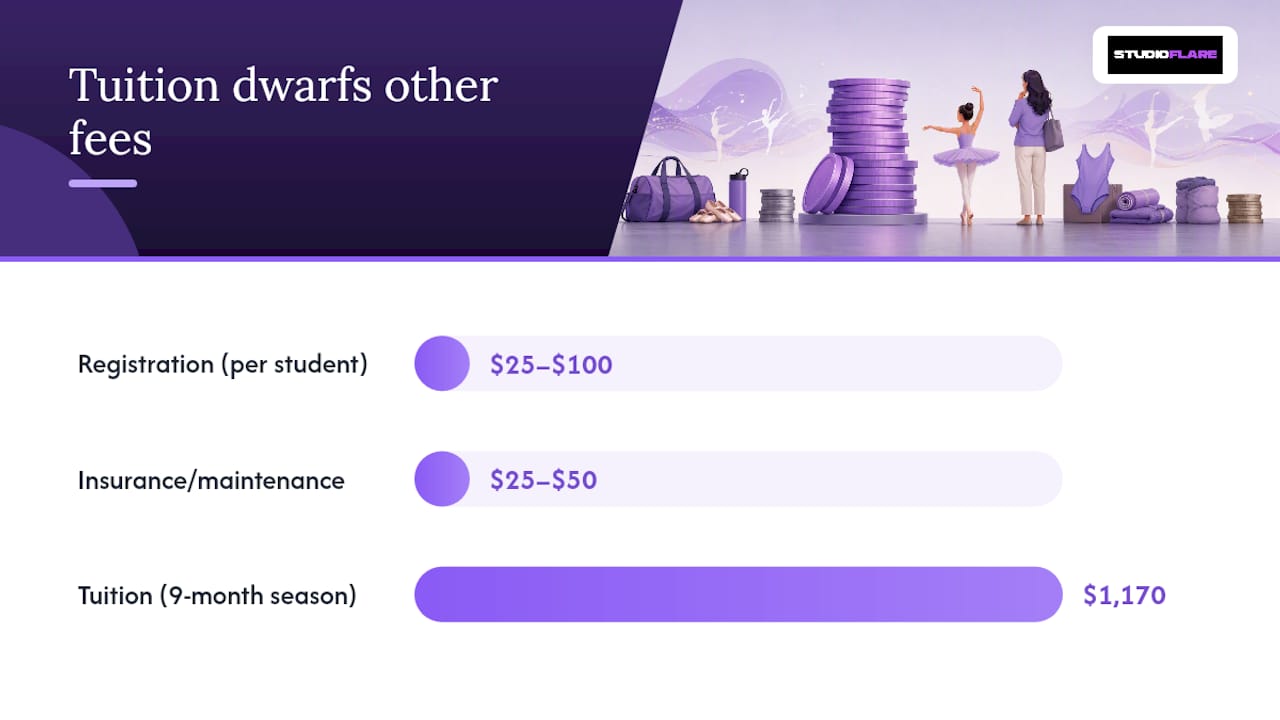
Registration fees are the first line item you'll hit, typically $25 to $100, and they're usually charged per student rather than per family, though some studios cap it at a family rate for three or more siblings.
Costume and recital costs are where budgets get surprised. Recital packages, which often bundle costume rental or purchase, a recital ticket allotment, and sometimes a program fee, can add several hundred dollars per student for the season. Many studios split this into two or three installments due in the fall and winter rather than one lump charge in the spring.
Other line items to watch for on a fee schedule:
- Insurance or facility maintenance fees, often a flat annual charge of $25 to $50.
- Recital ticket packages, sold separately from the recital fee itself, priced per seat.
- Costume alteration or fitting charges, sometimes billed separately if a costume needs tailoring.
- Convenience or processing fees tied to auto-pay or card transactions.
A quick gut check: if a family enrolls one child in two weekly classes at $130 a month, the tuition alone runs about $1,170 for a 9-month season.
Are There Discounts or Financial Assistance for Dance Tuition?
Multi-child households almost always have leverage. Sibling discounts commonly show up as either a flat dollar reduction (say, $10 off per additional child) or a percentage discount (5% to 15%) applied to the second and third enrolled student, a pattern documented across multiple studio billing pages.
Beyond siblings, a few other discount categories are worth asking about directly:
- Multi-class discounts for students taking three or more classes per week at the same studio.
- Military, student, or community-program discounts, along with class-pack or membership pricing aimed at adult dancers, which some community-focused studios offer alongside standard tuition.
- Scholarship or sliding-scale tuition for families who ask, since many studios don't advertise these openly.
- Acceptance of EBT, WIC, or similar assistance programs, which varies studio by studio and is rarely listed on a public rate sheet.
None of these show up automatically on a printed fee schedule. You generally have to ask the front desk or the studio owner directly, and it's worth asking before you commit to a plan, not after your first invoice.
How Do You Read a Studio's Fee Schedule Before Enrolling?
A published fee schedule tells you the sticker price. It rarely tells you the full story until you ask a few pointed questions.
Before signing anything, confirm these six items:
- What's the exact billing cadence, and which day of the month does the charge process?
- What's included in tuition, and what's billed separately (costumes, recital fees, insurance)?
- What's the make-up class policy for missed sessions?
- What are the refund and cancellation terms if my child needs to withdraw mid-season?
- Is auto-pay mandatory, and what happens if a card declines?
- When are costume and recital payments due, and can they be split into installments?
Pro Tip: Ask for the fee schedule in writing, and request a sample invoice showing a full month with all add-ons included. Compare total seasonal cost across studios instead of just the advertised per-class rate. A studio charging $15 per class can easily cost more per year than one charging $20 per class, once you add up registration, costumes, and recital fees.
How Studio Software Clears Up Confusion Around Tuition Billing
Most billing disputes between studios and families come down to unclear paperwork, not bad intentions. A missed prorating explanation or a costume installment that wasn't spelled out ahead of time turns into a frustrated phone call in October.
Studio management platforms address this by automating the parts that used to live in spreadsheets and group texts:
- Automated billing that charges the correct installment on the same date every month, with no manual invoicing.
- Card-on-file processing that enforces the studio's own late-fee and refund policy consistently, rather than case by case.
- A parent billing portal where families can see exactly what's charged, when, and why, including costume and recital line items.
- Installment handling for recital packages and costumes, so families see a clear payment plan instead of one large surprise charge.
Pro Tip: Studios that publish invoices through a parent portal see fewer past-due balances, simply because families can check the exact charge breakdown instead of guessing. Studio owners looking to tighten this up can start with StudioFlare's guide on collecting dance studio payments online.
Budgeting for a Dance Season: A Practical Rule of Thumb
Plan for tuition plus 20% to 30% on top for registration, costumes, and recital costs. That buffer covers most of what a printed rate sheet leaves out.
The harder decision is often value versus ambition: more classes at an affordable studio builds skill and stage time, while fewer classes at a higher-cost, performance-driven program can open doors a general studio can't. Neither choice is wrong, but the budget math changes fast between them.
Get the fee schedule in writing and read the payment policy before you commit. A five-minute conversation now saves a frustrating invoice dispute in March.
— StudioFlare Team
A Clearer Way for Studios to Handle Tuition Billing
Families read every fee schedule looking for the catch, and studios that publish clean, itemized billing build more trust than ones relying on a printed handout from three years ago. There are software platforms that provide automated tuition billing through Stripe, parent portals where families can see charges before they are billed, and workflows for costume and recital installments to avoid tracking in separate spreadsheets.

Some studio management systems offer combined tools to handle registrations, revenue tracking, and communication in one place, helping studios reduce administrative burdens. If you're running a studio and want to see how automated billing compares to a traditional setup, check out the StudioFlare alternative to Mindbody or visit the StudioFlare homepage to request a demo and see the billing workflow firsthand.