

For most dance studios, the right setup is flat-rate 10-month or 12-month tuition billed through stored-payment autopay. That single combination eliminates most of the collections work that eats into a front-desk manager's week. Session packs and drop-in pricing have their place for trial programs, but they trade cash flow predictability for flexibility, and most studios can't afford to give up predictability.
Your next move: pick one billing cadence, require a card or bank account on file at registration, and turn on autopay before your next enrollment cycle opens.
- Flat-rate monthly billing smooths revenue across recital season and summer slowdowns
- Stored payment methods (credit card or ACH) remove manual invoicing almost entirely
- Autopay reduces the late-payment chase that consumes hours of admin time monthly
Key Takeaways
Predictable tuition revenue depends on choosing one flat-rate billing model, requiring stored payment at registration, and separating variable fees from recurring charges.
| Point | Details |
|---|---|
| Pick one billing model | Flat-rate 10 or 12-month tuition creates more predictable cash flow than by-session or drop-in pricing. |
| Require stored payment upfront | Make card or ACH entry mandatory at registration, not an optional follow-up step. |
| Separate variable and recurring charges | Bill costumes and recital fees on a different date than standard monthly tuition. |
| Document every override | Log scholarships or comp classes with a note and staff initials to prevent future confusion. |
| Automate through studio-specific software | Studioflare runs billing on Stripe with family accounts, proration, and decline alerts built in for dance studios. |
Table of Contents
- What Billing Models Do Dance Studios Actually Use?
- How Do You Set Up Autopay and Billing Dates Correctly?
- How Should Studios Handle Fees and Late Payments?
- What Should Automated Billing Actually Do for You?
- How Do You Reconcile Tuition Payments Each Month?
- How Should Studios Handle Payment Disputes and Refunds?
- How Do You Stay Compliant with Payment Processing Rules?
- What Do Studios Consistently Get Wrong on Tuition Billing?
- How Studioflare Puts This Playbook Into Practice
- Frequently Asked Questions
- Sources
What Billing Models Do Dance Studios Actually Use?
Nearly every studio operates on some version of four models: 10-month tuition, 12-month flat-rate, by-session packs, and monthly drop-in pricing. Host Merchant Services breaks these down as the "big four," and recommends flat-rate billing specifically because it stabilizes cash flow and simplifies autopay logistics.
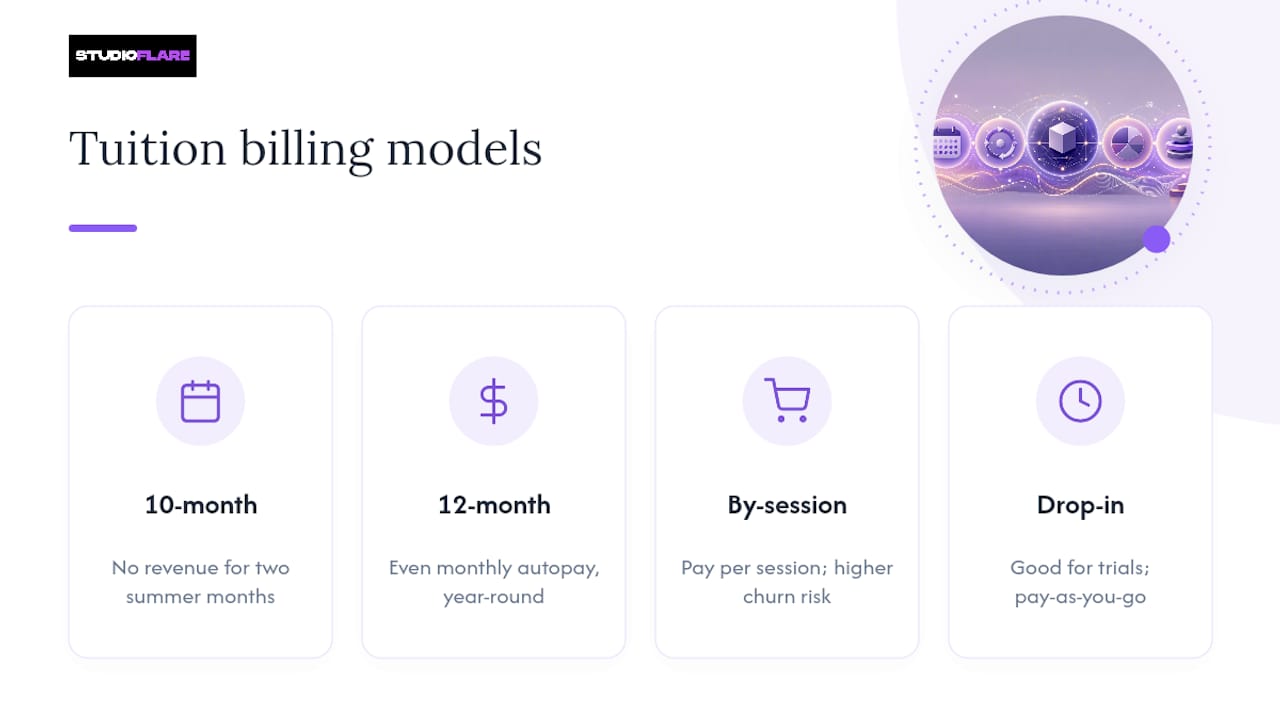
10-month tuition charges a flat rate across the traditional September to June season, then stops for summer. Parents like it because it maps to the school year they already understand. The downside: you get zero revenue for two months unless you run a separate summer program with its own billing.
12-month flat-rate billing takes annual tuition and divides it evenly across all twelve months, including summer, even though classes might pause for a few weeks. This is the model Host Merchant Services and most billing consultants push hardest, because it means the same autopay amount hits the same day every month, year-round. No revenue gaps, no re-enrollment scramble in September.
By-session packs and monthly drop-in pricing work well for trial classes, adult programs, or short-term intensives where families want to pay only for what they use. The tradeoff is real: every session-based transaction is a new decision point for a parent, and every decision point is a chance to churn.
Sibling discounts and family accounts change the math further. Linking siblings under one billing profile with an automatic discount tends to increase household retention, since canceling one child's enrollment now affects the whole family's pricing.
Pro Tip: If you're moving from by-session to flat-rate billing, run both models in parallel for one enrollment cycle before fully switching. It gives you real numbers on how many families would have churned under the old system versus the new one.
How Do You Set Up Autopay and Billing Dates Correctly?
Getting the mechanics right up front, as explained in How Swim Academies Accommodate Busy Families, saves you months of cleanup later. Follow these steps in order:
- Choose one billing cadence and one billing date. Most studios settle on the 1st of the month. Publish it on your enrollment form, your parent portal, and your welcome email so nobody claims surprise later.
- Write your proration rule before you need it. A simple, defensible method: divide monthly tuition by the average number of classes in that month (commonly four) to get a daily rate, then charge for classes remaining. A student joining halfway through a four-class month pays for two.
- Require a stored payment method at registration, not after. Make card or ACH entry a mandatory field on the enrollment form itself, not a follow-up task for your billing coordinator.
- Set your cancellation and late-fee rules in writing. A 30-day written notice for cancellation and a fixed late fee after a set grace period, say five days past the due date, gives both sides clear expectations. Dance Studio Advice recommends spelling this out in the enrollment contract itself, not just in a parent handbook nobody reads twice.
Studios that skip step three usually end up chasing paper checks and Venmo screenshots for years, wondering why their front desk is always behind.
How Should Studios Handle Fees and Late Payments?
Your enrollment paperwork should say, in plain language, what tuition covers and what it doesn't. Something like:
That one sentence prevents half the billing disputes studios deal with each spring. Dance Studio Advice outlines a workable framework built around a few firm rules:
- Require a card on file at registration, no exceptions
- Bill recurring tuition on a fixed date, typically the 1st
- Charge variable fees (costumes, recital, competition travel) on a separate date, ideally a week or two away from the tuition run
- Send an automated decline notice immediately, followed by a modest late fee (commonly around $10) after a short grace period
- Suspend class access after a defined arrears threshold, often 30 days past due
Keeping variable and recurring charges on different processing dates isn't just tidier bookkeeping. It also prevents a single card decline from failing two charges at once and doubling your follow-up work.
Exceptions happen: a scholarship student, a comp class for a staff member's kid, a one-time hardship waiver. Document every override with a short note and the staff initials who approved it. Six months later, when someone asks why an account looks different, that one line saves a long conversation.
What Should Automated Billing Actually Do for You?
Automation only earns its keep if it handles the parts of billing that create the most manual work: family-linked accounts, sibling discounts, scheduled autopay batches, decline alerts, proration, and exportable reports. Jackrabbit Pay lists faster processing, fewer manual errors, editable batches before they run, and settlement reports that match your bank deposits as the core payoffs of automating tuition collection.
Generic payment tools fall short here. A standalone Stripe subscription can charge a card reliably, but it has no concept of a family account, a sibling discount, or a mid-month prorated start. Studio-specific platforms build that logic in, which is why Host Merchant Services points studios toward dedicated software instead of assembling their own patchwork.
Studioflare runs billing through Stripe on the back end, so families get secure, familiar payment processing, while the platform layers on the studio-specific logic Stripe alone doesn't offer: family billing profiles, sibling discount rules, and automated proration for mid-month starts. Its AI assistant answers the routine "did my payment go through" and "when is tuition due" questions parents send, before they ever reach your front desk.

Before flipping the switch studio-wide, run a sandbox test on a handful of dummy accounts, then a pilot batch with a small group of real families. Watch how proration calculates, confirm decline notifications actually fire, and check that your settlement report lines up with what hit your bank account before you roll it out to every family on the roster.
How Do You Reconcile Tuition Payments Each Month?
A tight reconciliation habit keeps your books honest and catches problem accounts before they become write-offs. Run this routine at the same time every month:
- Pull your settlement report from your payment processor and match total deposits against what actually landed in your bank account.
- Cross-check that ledger against your studio management system's tuition report, flagging any mismatch immediately rather than at tax time.
- Export your decline list and follow up on every account still unresolved, prioritizing anything over 30 days past due for suspension review.
- Format your export for direct import into QuickBooks or your accounting software, so nobody is retyping numbers by hand.
Studios that reconcile weekly instead of monthly catch card declines and expired billing information while they're still a five-minute fix, not a 60-day collections problem.
How Should Studios Handle Payment Disputes and Refunds?
Most tuition disputes come from one of three places: a parent doesn't recognize a charge, a family believes they canceled before a billing date, or someone disputes a late fee they think wasn't earned. Handle all three the same way, with documentation first and conversation second.
Keep a timestamped log of every enrollment change, cancellation request, and policy acknowledgment. When a parent emails to cancel, reply confirming the effective date and reference your written 30-day notice policy. That single email exchange resolves most disputes before they escalate to a chargeback.
Refunds deserve a clear, written threshold: define what triggers a full refund (a studio-side scheduling error, a canceled class) versus a partial credit (a family leaving mid-month under your standard notice terms) versus no refund at all (a missed class due to illness, which most studios cover under general attendance policy rather than billing adjustments).
Chargebacks are the costliest outcome, both in fees and in the parent relationship. When a family disputes a charge directly with their card issuer instead of contacting you first, most processors give you a window to submit evidence: the signed enrollment agreement, the billing policy acknowledgment, and your communication log. Studios that keep that paperwork organized win the majority of these disputes. Studios that don't tend to eat the loss and the processing fee on top of it.
How Do You Stay Compliant with Payment Processing Rules?
Handling recurring card and bank payments puts you under real, not optional, security obligations. Any platform processing card data needs to meet PCI DSS standards, the security framework that governs how card information gets stored, transmitted, and protected. The practical upside for studio owners: you almost never need to think about this directly if your billing runs through a compliant processor like Stripe, since the processor carries most of the compliance burden rather than your studio storing raw card numbers itself.
A few habits matter regardless of which platform handles your billing:
- Never store card numbers in a spreadsheet, email thread, or paper enrollment form. Tokenized storage through your payment processor is the standard, not a nice-to-have.
- Restrict who on staff can view full payment details versus who just needs to see payment status (paid, declined, pending).
- Read your platform's data retention and privacy terms, including how family financial data is handled if a family leaves the studio, before you commit to a system.
- Confirm ACH payments run through a processor with proper bank-level authorization, since ACH fraud liability works differently than card fraud.
If you're evaluating a new billing platform, ask directly how it handles PCI compliance and where payment data actually lives. A vague answer is a red flag worth taking seriously.
What Do Studios Consistently Get Wrong on Tuition Billing?
The most common mistake is bundling variable fees into the recurring tuition charge, which turns every costume order or recital fee into a billing dispute nobody saw coming. The second is treating stored payment as optional. It isn't, if you want predictable revenue instead of a monthly collections project.
Standardize your billing date across every family, test your autopay batch on a small group first, and tell parents about changes before you make them, not after. Good billing software should support these habits, not replace the judgment behind them.
How Studioflare Puts This Playbook Into Practice
Everything in this checklist, flat-rate billing, mandatory stored payments, sibling discounts, proration, and decline handling, maps directly to features built into Studioflare. Billing runs on Stripe, so families get secure processing while you get family-linked accounts and automated proration without stitching together spreadsheets and reminder texts.

If you're currently running billing manually or through a generic subscription tool, the jump to studio-specific software usually pays for itself within the first missed payment it catches automatically. Studioflare's AI assistant fields the "when is my next payment" and "why was my card declined" questions directly, which means fewer interruptions for whoever runs your front desk. Studios coming from spreadsheet-and-text-message billing, or from a Mindbody-style setup, tend to notice the difference in the first billing cycle.
Ready to see it running against your own roster? Create your studio and set up a sandbox billing cycle before your next enrollment period opens.
Frequently Asked Questions
What is the best tuition payment plan for a small dance studio? Flat-rate 12-month billing tends to work best for small studios because it spreads revenue evenly across the year, including slower summer months, and simplifies autopay setup since the charge amount stays constant.
How do dance studios handle mid-month enrollment for tuition payment plans? Most studios prorate using a daily rate, calculated by dividing monthly tuition by an average class count (often four), then charging only for the classes remaining in that billing period.
Should dance studios require autopay for tuition payment plans? Yes, for nearly all recurring programs. Requiring a stored card or bank account at registration removes the manual invoicing and follow-up that consumes the most administrative time each month.
What late fee is standard for dance studio tuition payment plans? Many studios use a modest flat fee, often around $10, applied after a short grace period following the due date, paired with a written 30-day cancellation notice requirement.
Can Studioflare handle sibling discounts within tuition payment plans? Yes. Studioflare links family accounts so sibling discounts, combined billing, and proration apply automatically across a household's enrolled students.
Sources
- Dance Studio Auto-Pay: 4 Important Billing Models To Use
- Billing Policies For A Successful Dance Studio | Dance Studio Advice
- Automate Tuition Payments with Jackrabbit