

Yes. Prorating tuition for mid-season enrollments and specific withdrawals is standard practice and worth adopting formally. Frame tuition as a full-season commitment split into monthly installments, then prorate late starts by remaining-class ratio or a simple week-based rule. Turn on proration in your billing software, publish the exact formula in your policy, and you'll avoid most of the billing disputes that come from families guessing at what's fair.
TL;DR:
- Prorating tuition for mid-season enrollments is essential, using methods like class ratio, calendar days, or fixed-week models, with the chosen method consistently applied.
- Holiday closures and canceled classes due to weather or instructor illness are typically excluded from proration calculations to simplify billing and protect revenue.
- Most studio management platforms require toggling proration options and testing them with dummy enrollments before going live to ensure accurate billing.
- A clear, written policy should specify the proration calculation method, applicable scope, timing, deposit policies, and notice requirements to avoid disputes.
- Implementing season-based billing with automated proration and manual overrides reduces billing disputes and enhances transparency for families and staff.
Table of Contents
- What Tuition Proration Means for a Dance Studio
- Three Proration Methods, With the Math Worked Out
- Turning on Proration in Your Billing Software
- Building a Policy That's Fair and Predictable
- Where Proration Policies Break, and How to Fix It
- Ready-to-Use Policy Language and an Admin Checklist
- Why Season-Based Billing With Smart Proration Wins
- Automating Proration Without Losing Control Over Exceptions
- Policy Examples Worth Reading in Full
- Sources
What Tuition Proration Means for a Dance Studio
Tuition proration is the adjusted charge a studio applies when a student enrolls after a season starts or withdraws before it ends, instead of paying the full monthly or seasonal rate. A dancer who joins three weeks into a four-week block pays for the classes remaining, not the whole month.
Most studios don't bill per class. They treat the season as one commitment, split into equal installments regardless of how many classes fall in a given month, because it smooths cash flow for staffing and recital budgeting. Stage Door Dance's policy reflects this: tuition is based on the full season, prorated only for mid-season enrollments, with holiday closures and canceled classes excluded from any adjustment.
That exclusion matters. Common studio policy language typically covers:
- Tuition is calculated on a full-season basis, not a per-class basis.
- Studio closures for holidays are built into the season rate and are not deducted.
- Missed classes due to student absence are not refunded or prorated.
- Make-up classes, not tuition credits, are the standard remedy for canceled sessions.
That structure protects your revenue while still being fair to the family joining in October instead of September.
Three Proration Methods, With the Math Worked Out
There's no single correct formula. Pick one, apply it consistently, and put it in writing. Here are the three methods studios actually use.
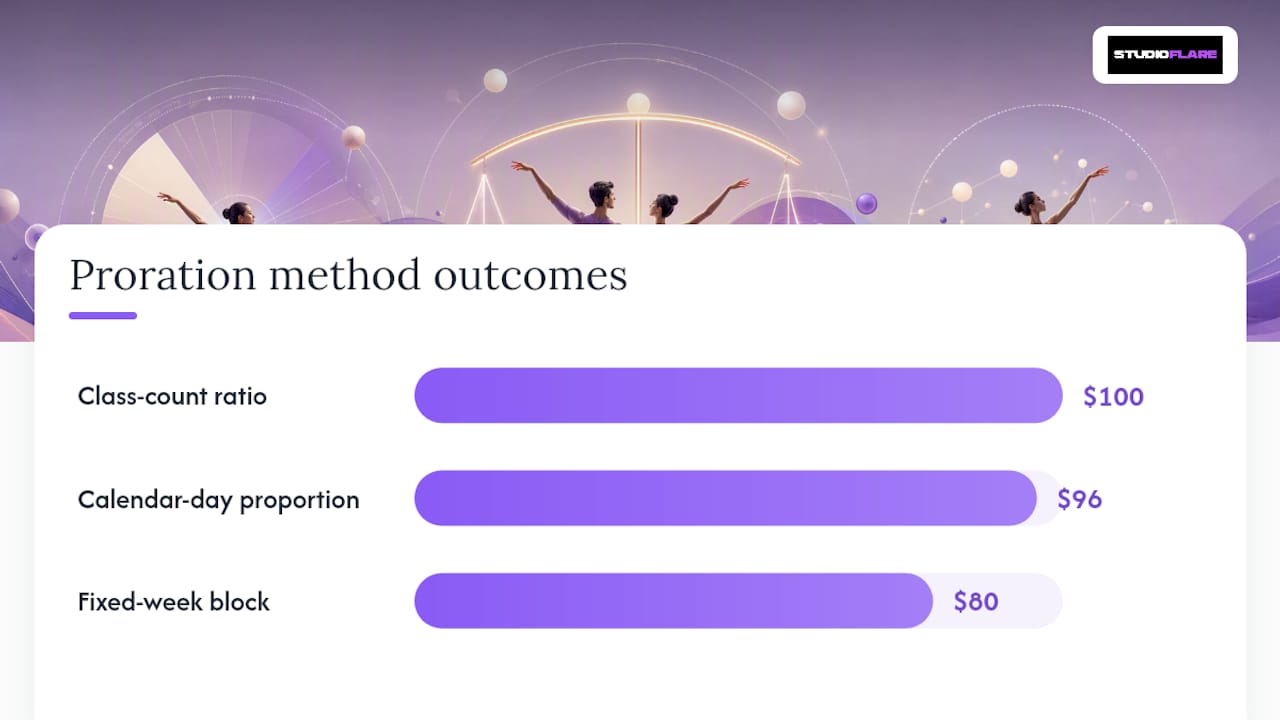
- Remaining-class-count ratio. Divide monthly tuition by total scheduled classes, then multiply by classes remaining. If tuition is $160 for eight classes in the month and a student joins after three have passed, they owe $160 × (5 ÷ 8) = $100.
- Calendar-day proportion. Divide tuition by total days in the billing period, then multiply by days remaining. On a 30-day billing month with 12 days already elapsed, an enrollee owes $160 × (18 ÷ 30) = $96.
- Fixed-week block model. Treat every month as exactly four weeks, regardless of the actual calendar, and prorate by week fraction. A student starting in week 3 of 4 owes half tuition: $160 × (2 ÷ 4) = $80.
Statistic Callout: Registrar-style academic proration models, like the week-based tables MIT publishes for fall tuition, use precise week and date cutoffs rather than rounded fractions. That level of precision reduces appeals but takes more admin time to maintain than a simpler class-ratio model.
Holidays and blackout dates should be stripped from the denominator in every method. If your studio observes a week off for Thanksgiving, that week doesn't count toward "total classes" or "total days" when you calculate what a late enrollee owes. Canceled classes due to weather or instructor illness are typically handled with make-ups, not recalculated proration, to keep the math simple for your front-desk staff.
Turning on Proration in Your Billing Software
Most studio management platforms bury proration settings a few menus deep. Before you go live with a policy, check for these toggles:
- Enable proration on enrollment and, separately, on withdrawal (some systems treat these as two different switches).
- Billing schedule type: season-based installments versus monthly recurring versus per-class.
- Blackout and holiday calendar: confirm these dates are excluded from proration math automatically.
- Autopay behavior on prorated invoices: verify the first charge reflects the prorated amount, not full price.
Run a short test before you trust the system with real families. Create a dummy student profile, enroll them mid-month, and confirm the invoice generated matches your hand calculation. Then simulate a withdrawal and check that the refund or final charge lands where your policy says it should. Pull the receipt and make sure the line-item description explains the proration, not just a raw dollar figure.
Pro Tip: Run your test enrollment on the same day of the week your studio typically processes new sign-ups. Some billing engines calculate proration based on the invoice generation date, not the enrollment date you enter, and that gap can throw off your numbers by several dollars.
Manual overrides exist for a reason. When a family requests an exception, whether it's a payment plan hardship or a mid-year transfer credit, document the override in a note attached to that student's billing record so your bookkeeper can reconcile it later without guessing why one invoice doesn't match the formula.
Building a Policy That's Fair and Predictable
A workable proration policy needs five components spelled out before a single family signs up:
- Scope: does proration apply to enrollment only, withdrawal only, or both?
- Calculation method: name the exact formula (class ratio, calendar days, or fixed week) so staff and parents can check the math themselves.
- Timing: when does the prorated rate kick in, and does it round to the nearest class or the nearest week?
- Deposits and registration fees: state clearly that these are non-refundable and non-prorated, since they cover administrative costs, not class time.
- Notice windows and exceptions: how many days' written notice is required for withdrawal, and how medical leaves or family emergencies get handled outside the standard rule.
Your choices here carry real trade-offs. A studio that refuses to prorate holiday closures, like Stage Door Dance's model, keeps revenue stable and staffing budgets predictable, but needs a strong make-up class system to keep parents satisfied. A studio that prorates on both enrollment and withdrawal offers more flexibility but takes on more cash-flow unpredictability, especially if several families withdraw in the same month.
That's Dancing!'s published policy splits the difference well: full-season tuition in installments, mid-season proration for new enrollments, required deposits, and explicit withdrawal terms. It's a model worth studying line by line if you're drafting your first policy from scratch.
Where Proration Policies Break, and How to Fix It
The most common failure point isn't enrollment math. It's withdrawals. A family gives notice on the 3rd of the month, another gives notice on the 27th, and if your system prorates both to the exact day, you're processing dozens of tiny, disputed refund calculations every month.
The fix that several studios have converged on: prorate refunds from the end of the month in which notice was given, not from the specific day. Ballet Caliente's tuition policy uses exactly this rule, and it does two things well. It gives families a full month of notice-period coverage, and it gives your bookkeeping a single, repeatable cutoff instead of a different math problem for every withdrawal date.
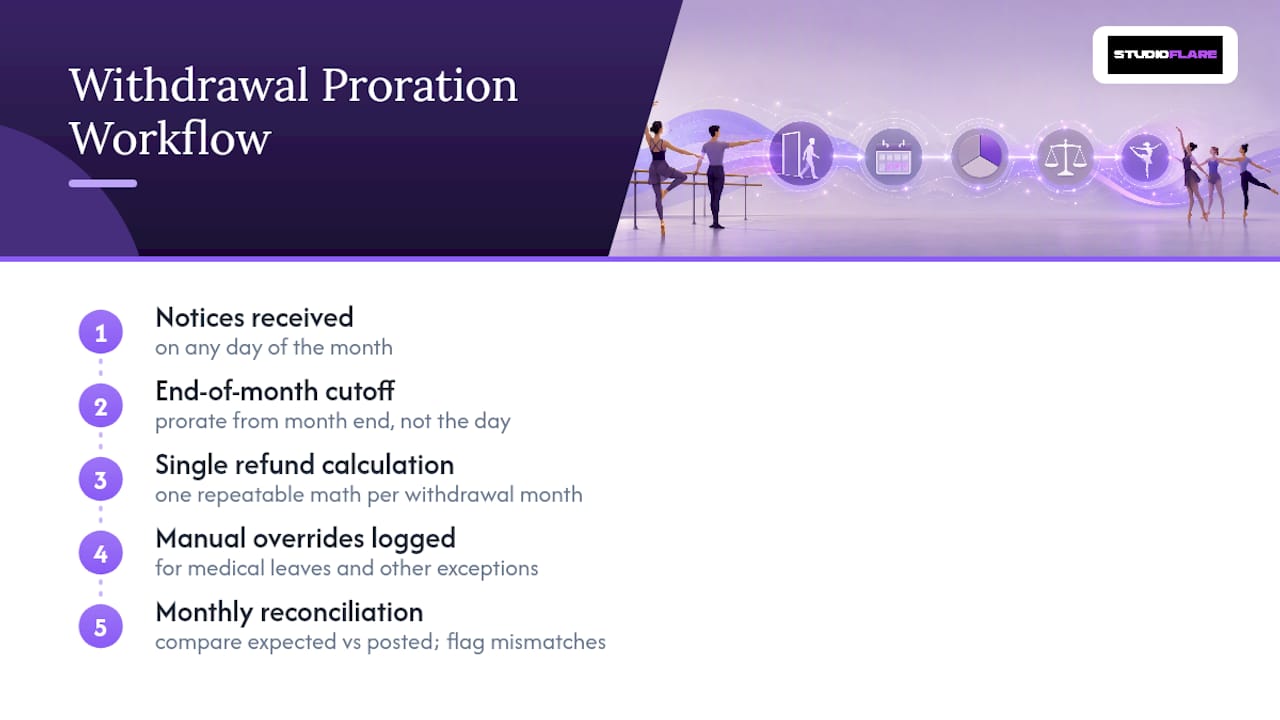
Keep a manual-override log for medical leaves and other exceptions, since automated systems handle standard cases well but struggle with anything that falls outside the calendar norm. Once a month, run a reconciliation report comparing expected prorated charges against what actually posted, and flag any mismatch before it compounds across dozens of accounts.
Pro Tip: Keep a two-sentence script on hand for the front desk: "Your tuition is prorated based on remaining classes this month, calculated at [X] per class. Your invoice reflects [Y] classes remaining, which comes to [Z]." Reading the formula out loud stops most disputes before they start.
Ready-to-Use Policy Language and an Admin Checklist
Paste these directly into your registration page and adjust the numbers to match your season:
- Season-based clause: "Tuition is calculated on the full season and split into equal monthly installments. Enrollments after the season start date are prorated based on remaining classes."
- Monthly billing clause: "Monthly tuition is billed at a fixed rate regardless of the number of classes in a given month, except for prorated charges applied to enrollments starting after the 1st."
- Withdrawal clause: "Written withdrawal notice must be submitted in advance, with timing specified in your studio's policy. Refunds are prorated to the end of the month in which notice is received. Medical or documented emergency withdrawals will be reviewed individually."
Admin checklist before launch: confirm your proration toggle and holiday calendar are set correctly, run a test enrollment and test withdrawal, verify the invoice and receipt language match your policy text, and publish the final policy on your registration form and parent portal, not buried in a separate PDF nobody opens.
Why Season-Based Billing With Smart Proration Wins
The studios that struggle with tuition disputes usually aren't undercharging. They're just inconsistent. One family gets a hand-calculated discount, another doesn't, and by month three nobody, including the front desk, can explain why.
A studio that switches from ad hoc adjustments to a season-installment model with a written prorate rule for late starts typically sees refund requests drop, simply because the math is transparent from day one. Automated billing handles the standard cases; a documented manual-override process handles the rest. That combination is what makes proration workable for a real studio, not just a spreadsheet exercise.
Test your proration rules with a dummy enrollment before you trust them with a real family's invoice.
— StudioFlare Team
Automating Proration Without Losing Control Over Exceptions
Studioflare gives you the exact combination this article recommends: season-based billing schedules, automated tuition billing through Stripe, a configurable holiday and blackout calendar, and manual adjustment tools for the medical-leave and hardship cases that no formula handles well. Reporting and reconciliation exports let you catch a misconfigured proration rule before it affects thirty invoices instead of one.

Before you commit to a system, run the same test outlined earlier inside it: simulate a late mid-month enrollment, simulate a withdrawal partway through a billing cycle, and pull a reconciliation report to see whether the numbers match your policy on paper. If your current spreadsheet-and-group-text setup can't survive that test, it's worth seeing how Studioflare handles it. Create your studio and run that exact scenario with your own tuition numbers before your next enrollment window opens.
Policy Examples Worth Reading in Full
For exact policy wording and proration tables, review Stage Door Dance's policies, That's Dancing!'s season policy PDF, The Dance Corner's tuition schedule, and MIT's registrar proration tables. Adapt the language to your season length, staffing model, and local regulations rather than copying it verbatim.
Sources
- Studio Door Dance — Policies
- That’s Dancing! studio policies (2025–26 PDF)
- MIT — Fall proration (example tables)
- The Dance Corner — Tuition rates & fees (2025–26)
- Ballet Caliente — Tuition & payment policies