

If your studio registers children under 13 online, collects their names and birthdates, posts their photos, or streams their classes, you should run those systems as if COPPA applies. COPPA is the Children's Online Privacy Protection Act, and the FTC's Rule under it covers any operator that knows it is collecting personal information from a child. The amended Rule has been fully enforceable since April 22, 2026. The practical answer is to get parental consent in writing before you collect, keep only what you need, delete it on a schedule, and use a single system for forms, billing and communication that you can explain to parents.
This guide is written for studio owners, directors and administrators, and for the parents who ask them hard questions. It is general information, not legal advice. For a specific situation, such as a data incident or a contract with an ad platform, talk to an attorney who handles privacy law.
TL;DR
- COPPA covers online services that are directed to children under 13 or that knowingly collect their personal information. A studio registration form for a 7-year-old fits that description in practice.
- Photos, video and audio of a child count as personal information, so posting recital clips or streaming classes needs parental notice and consent first.
- Consent must be verifiable, and the amended Rule requires a separate consent for sharing a child's data with third parties unless the sharing is integral to the service.
- You need a written security program, a written retention policy with a deletion timeframe, and assurances from every vendor that touches children's data.
- Civil penalties reach $53,088 per violation, and state attorneys general can enforce as well.
Table of Contents
- Does COPPA apply to a dance studio?
- What counts as a child's personal information
- Getting parental consent right
- Photos, video and livestreams
- Parent requests: review, refuse, delete
- Security and vendor management
- What changed in 2025 and 2026
- What a violation can cost
- Our view: privacy belongs in the registration flow
- Run registration, forms and billing in one place
- FAQ
- Sources
Does COPPA apply to a dance studio?
COPPA reaches two kinds of operators. The first runs a website or online service directed to children. The second runs any site or service, aimed at anyone, that has actual knowledge it is collecting or maintaining personal information from a child. That is the wording of 16 CFR § 312.3, the Rule's core prohibition.
A studio website that only lists class times and prices is mostly a general-audience site. The moment a parent enters a child's name, age and medical notes into your registration form, you hold a child's personal information and you know it. Your waiver forms, your email list, your livestream, your class photos on social media: all of these are places where a child's data lands.
The FTC's business guidance says the Rule covers operators of commercial sites directed to children under 13, general-audience sites that knowingly collect children's information, and general-audience sites with separate children's areas. It also says a privacy policy must be posted on the home page and linked everywhere personal information is collected, including registration forms and email sign-up boxes. The Texas Attorney General summarizes the duties in plain terms: a clear privacy policy, verifiable parental consent, parent access and deletion rights, reasonable security, and keeping data only as long as necessary.
The careful reading for a studio is simple. If you collect data about children under 13 online, run the whole operation to the COPPA standard. It costs little more than doing it loosely, and it answers the questions parents increasingly ask.
What about teens?
COPPA stops at 13. Teen dancers fall under other rules, including state laws that vary. If you work with older students, the way parents' consent rules for teens change after age 13 is worth understanding, because your registration form will mix both groups. The simplest policy is to apply one standard to every minor in your studio, so staff never have to guess which rule applies to which student.
What counts as a child's personal information
More than most owners expect. The Rule's definition includes:
- first and last name
- home address
- online contact information, such as an email address
- a telephone number
- government-issued identifiers
- persistent identifiers, such as cookies, IP addresses and device IDs
- geolocation precise enough to identify a street and city
- biometric identifiers, such as voiceprints and facial templates
- any photograph, video or audio file that contains a child's image or voice
Map that to a normal studio week. The registration form holds names, birthdates and addresses. The parent portal holds contact details. The check-in tool may hold names and arrival times. The livestream captures faces and voices. A photo posted from the recital carries an image and possibly location metadata. Every one of those is in scope.
The amended Rule widened the definition. According to Mayer Brown's April 2025 analysis, it now names biometric identifiers such as fingerprints, handprints, gait patterns and facial templates, plus government-issued identifiers such as birth certificate and passport numbers. Mobile phone numbers also count as online contact information when used to text a parent for consent. If you ever scan a birth certificate to verify a child's age, or use face-matching check-in, treat that data with the most care of anything you hold.
Getting parental consent right
Under 16 CFR § 312.5, you need verifiable parental consent before you collect, use or disclose a child's personal information. Verifiable means you took a reasonable step to confirm the person consenting is the parent. The listed methods include:
- a signed consent form returned by mail, fax or electronic scan
- a credit or debit card transaction that notifies the primary account holder
- a toll-free phone call or video conference with trained personnel
- government ID verification, with prompt deletion of the ID
- facial recognition matching of a government photo ID to a webcam photo, with prompt deletion
Three further methods were added in the amendments, per Kirkland & Ellis: knowledge-based multiple-choice questions, facial recognition with a government photo ID, and "Text Plus," a text message to the parent plus an extra confirming step.
The FTC's FAQ adds a distinction that matters for studios. When you use a child's information only internally, you may use the "email plus" method: ask for consent in a return message, then add a confirming step such as a follow-up call or letter. Disclosure to third parties needs a stronger method.
Step 1: Decide what you actually need
Start from the registration form. Name, age or birthdate, a parent contact and emergency information are reasonable for a class. A child's own email address, school, or a government ID number usually is not. Every field you remove is a field you never have to protect, report on, or delete. Our guide to what to collect on online consent forms walks through a field-by-field review.
Step 2: Give the parent a direct notice
The notice under 16 CFR § 312.4 must say that consent is required and nothing will be collected without it. It must list the items collected and how they will be used, and name the third parties or categories that receive the data and why. It must tell parents they can consent to collection without consenting to third-party disclosure, except where the disclosure is integral to the service. A prominent link to your online notice has to appear on your home page and wherever children's information is collected. The California Lawyers Association's July 2026 summary adds that the notice must say what happens if the parent never responds: you delete the parent's and the child's contact information.
Where it goes wrong: a generic waiver with a privacy sentence buried at the bottom. Keep the privacy notice separate from the liability waiver, written plainly, and linked from the form itself.
Step 3: Collect consent in a record you can find later
A signed electronic form is the cleanest option for a studio, because it is both the consent and your proof. StudioFlare includes digital waivers and forms and a parent portal, so registration, forms and parent communication sit in one place instead of across spreadsheets and group texts. That makes it far easier to answer the question "did we get consent for this child, and when?"
Step 4: Ask separately for anything beyond the service
The amended Rule requires separate verifiable consent to disclose a child's data to third parties when the disclosure is not integral to the service. According to Finnegan, bundled consent is no longer enough, and targeted advertising and AI model training are outside what counts as integral. So if you ever share student lists with an ad platform for a lookalike audience, that needs its own checkbox and its own consent, not a line inside the enrollment agreement.
Photos, video and livestreams
This is where studios most often step into trouble, because posting is so routine. The FTC's FAQ states that photos, videos and audio recordings that contain a child's image or voice are personal information. Before you post them, you must either prescreen and delete children's images, including geolocation metadata, or first give parents notice and obtain consent.
For a studio, the workable approach is a short media policy with an opt-in, collected at registration and revisited each season. It should say where images appear (website, social, recital program), who may post them, whether names are ever attached, and how a parent withdraws permission. Our photo and video policy guide gives wording you can adapt.
Livestreams add a second layer: the stream shows faces and may capture voices, and viewers need access. StudioFlare's built-in livestreaming is integrated with class registration and access control, so the people who can watch a class are tied to the registrations you manage. Pricing for livestreaming is not published, so ask us for it. Write the rules for who may watch, who may record and how long recordings stay up in a livestream class policy, and put it in front of parents before the first stream.
Summer camps are the same issue in a compressed window, with new families and many forms at once. See our guide to camp registration that gets COPPA and ADA right.

Parent requests: review, refuse, delete
Parents hold ongoing rights. Under 16 CFR § 312.6, when a parent asks, you must describe the categories of information you collected from the child. You must also let the parent refuse further use or future collection, direct you to delete the data, and review the child's information through a means that verifies the requester is the parent without being unduly burdensome. If a parent directs deletion, you may end service to that child.
A studio can handle this with a short routine:
- Name one person who receives these requests and publish their email in your privacy notice.
- Confirm the requester is the parent or guardian on the account.
- Send the parent a readable export of what you hold.
- Delete on request, including from exports, spreadsheets and old email threads.
- Log the date and what was done.
The weak point is almost always the stray copy: a roster in someone's downloads folder, a screenshot in a group text. That is the practical reason to move off spreadsheets. When data lives in one platform, a deletion request is one action rather than a hunt.
How long you may keep records
The long-standing rule in 16 CFR 312.10 says to keep a child's information only as long as reasonably necessary for the purpose it was collected, and to delete it with reasonable measures against unauthorized access. The amended Rule goes further: operators need a written retention policy, posted on the site, stating the purposes, the business need and the deletion timeframes. Indefinite retention of children's data is prohibited, per the current eCFR text.
A sensible studio schedule might read: active student records are kept while the student is enrolled; after withdrawal, keep only what tax and accounting require; delete everything else on a fixed date, such as the end of the next season. Pick the timeframes with your accountant and attorney, then publish them. This is also where per-student pricing helps: StudioFlare charges for active students, not historical records, so clearing out old profiles does not cost you anything extra to maintain.
Security and vendor management
The Rule has always required reasonable procedures to protect the confidentiality, security and integrity of children's information. It also requires you to release data only to service providers that can maintain that security and that give assurances to that effect, per the 2018 CFR text.
The amended Rule makes this concrete. Operators must keep a written information security program with designated coordinators, annual risk assessments, safeguards, ongoing testing and an annual evaluation. Finnegan's summary adds written assurances from vendors before you share children's data.
For a studio, a workable program is a two-page document that names who is responsible, lists the systems that hold student data, and records a yearly review. Include:
- your registration and billing platform
- your email and texting tools
- your livestream and video tools
- your website analytics and any ad pixels
- payroll and accounting software
Each vendor should be able to tell you in writing how it protects data and what it does with it. Fewer vendors means fewer assurances to chase. Studios that replace a patchwork with one platform shrink this list considerably. StudioFlare combines registration, Stripe-based billing, messaging, waivers, attendance and livestreaming, and publishes its own privacy policy. Our broader data privacy guide for dance studio owners covers the day-to-day habits: staff access, password hygiene and what to do when a laptop goes missing.
Watch two common leaks. Marketing pixels on a registration page can pass children's data to an ad network, which is a third-party disclosure. And bulk texting to parents is fine, but keep the lists limited to the parent contacts, not children's own numbers.
What changed in 2025 and 2026
The FTC published its amendments on April 22, 2025, and they took effect on June 23, 2025. Entities had until April 22, 2026 to comply, apart from a few provisions with later dates, per the FTC's rule record. Hunton Andrews Kurth summarizes the headline changes: separate consent for third-party disclosures, new retention limits and a broader definition of personal information.

The amendments also add a definition of "mixed audience" services, which are directed to children but not primarily so. Such services may collect limited information before they know a visitor's age, only to give parents notice, respond to a child's specific request or protect a child's safety, per Mayer Brown. A studio website with a kids' camp page and an adult fitness page may fit that pattern.
Since the deadline has passed, nothing here is "coming soon." A studio that registered children last fall without a written retention policy or security program should fix that before the next enrollment season.
What a violation can cost
The FTC can seek civil penalties of up to $53,088 per violation, as reported by Reed Smith in 2025. The figure is adjusted periodically, so check the FTC's current number. The FTC's own FAQ lists factors such as egregiousness, prior violations, the number of children affected and the type of data. The best-known cases involve giant companies, but the same law and the same factors apply to a small operator. State attorneys general have parallel authority too, so a complaint from a parent can come from more than one direction.
The lesson for a studio is less about fines than about trust. A parent who asks "what do you do with my daughter's video?" should get a clear, quick answer.
Our view: privacy belongs in the registration flow
We built StudioFlare for dance studios only, and that shapes how we think about children's privacy. A dance studio is a small business that holds a large amount of information about children: names, birthdates, emergency contacts, medical notes, photos, and sometimes live video of their classes.
The studios we hear about that struggle are usually running on spreadsheets, group texts and a handful of unrelated tools. Each one is another place a child's name can sit with no deletion date. Our approach is one place for registration, waivers and forms, tuition billing through Stripe, parent communication and livestreaming, so a studio has fewer systems to document and fewer copies to chase when a parent asks for deletion.
We also price in a way that fits good data habits: you pay for active students, not for the historical records you should be cleaning up anyway. There is no setup fee and no contract.
Our advice is to treat consent as part of registration, not a separate chore. Ask once, plainly, record it, and make it easy for a parent to change their mind.
StudioFlare Team
Run registration, forms and billing in one place
If you are replacing spreadsheets, or moving from another studio management system, StudioFlare gives you online registration, digital waivers and forms, a parent portal, bulk messaging, attendance and check-in, and automated tuition billing through Stripe. The Starter plan is $29 per month and Pro is $49 per month, plus $1 per month for each active student. There is no setup fee and no contract.
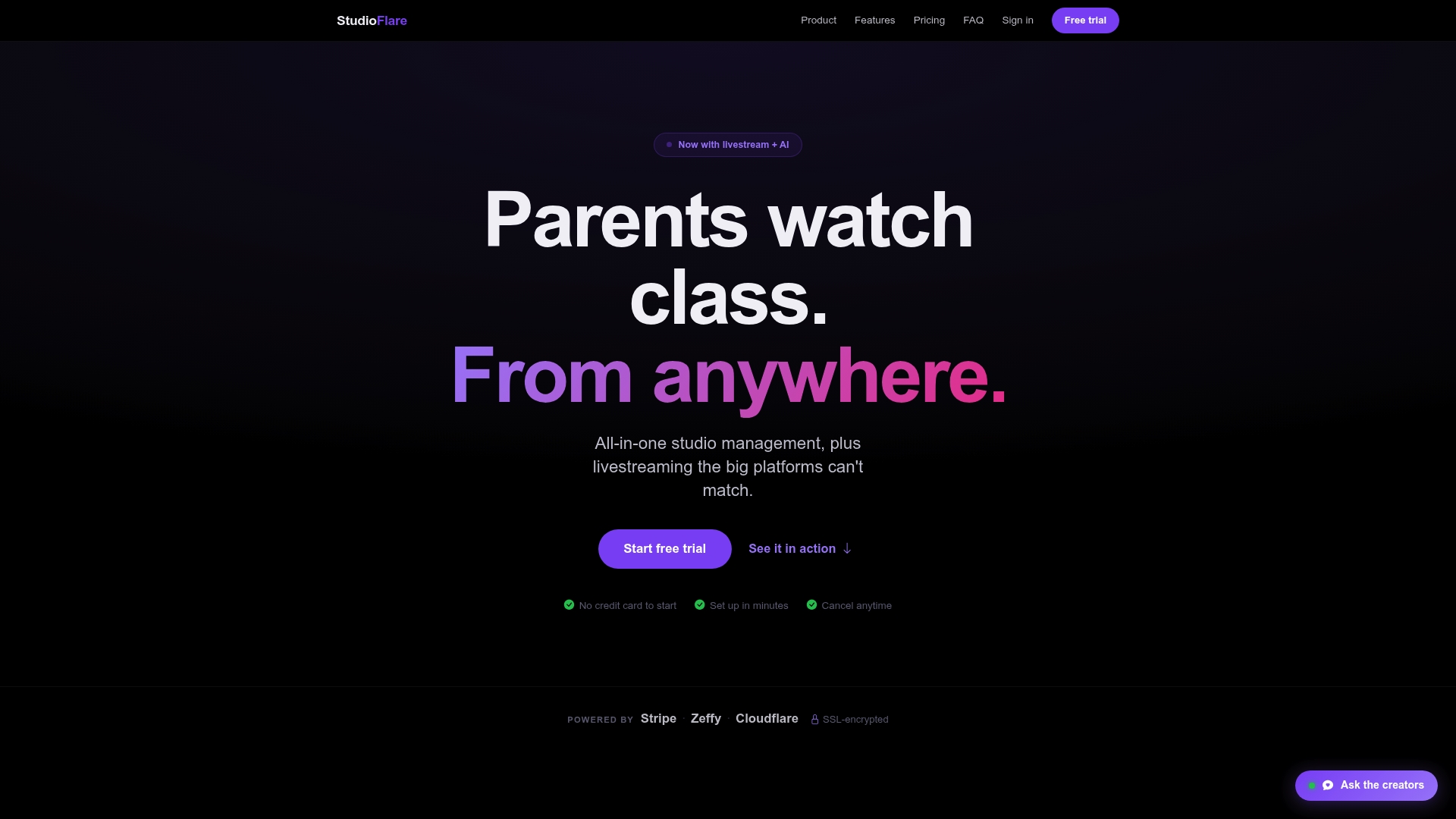
Livestreaming is built in and tied to registration and access control. Its pricing is not published, so ask us. You can also see how we compare with the Dance Studio Pro alternative if you are migrating.
FAQ
Does COPPA apply to my small dance studio?
It applies to any operator with actual knowledge that it collects personal information from a child under 13 online, regardless of size. A registration form that asks for a child's name and birthdate meets that test in practice. Run your forms, photos and streams to the COPPA standard and you are covered either way.
Can I post recital photos and videos of students?
Yes, with the right steps. Photos and video with a child's image or voice are personal information, so you either prescreen and remove children's images or first notify parents and get consent. A media opt-in at registration, renewed each season, is the simplest route.
How long can I keep a former student's records?
Only as long as reasonably necessary for the purpose you collected them, and the amended Rule requires a written, posted retention policy with a deletion timeframe. Keep what tax and accounting rules require and delete the rest on a schedule. Settle the exact periods with your accountant and attorney.
Is there a COPPA certification I need?
No certification is required of a studio to operate. What the Rule asks for is concrete practice: a privacy notice, verifiable parental consent, parent access and deletion, reasonable security and a written retention policy. Document each and review them yearly.
Sources
- 16 CFR § 312.3, eCFR
- 16 CFR Part 312, eCFR
- 16 CFR § 312.4, eCFR
- 16 CFR § 312.5, eCFR
- 16 CFR § 312.6, eCFR
- Part 312, 2018 CFR text, govinfo.gov
- You, Your Privacy Policy and COPPA, FTC guidance
- Children's Online Privacy Protection Act, Texas Attorney General
- Complying with COPPA: Frequently Asked Questions, FTC
- FTC COPPA FAQ exhibit on photos, video and penalties
- FTC rule record, reginfo.gov
- FTC Announces Significant Amendments to COPPA, Mayer Brown
- FTC Publishes COPPA Rule Amendments, Kirkland & Ellis
- Children's Privacy and Safety Online, California Lawyers Association
- COPPA's Amended Rule Is Now in Full Effect, Finnegan
- COPPA Rule Amendment Compliance Deadline Approaches, Hunton Andrews Kurth
- The FTC's latest round of COPPA enforcement, Reed Smith