
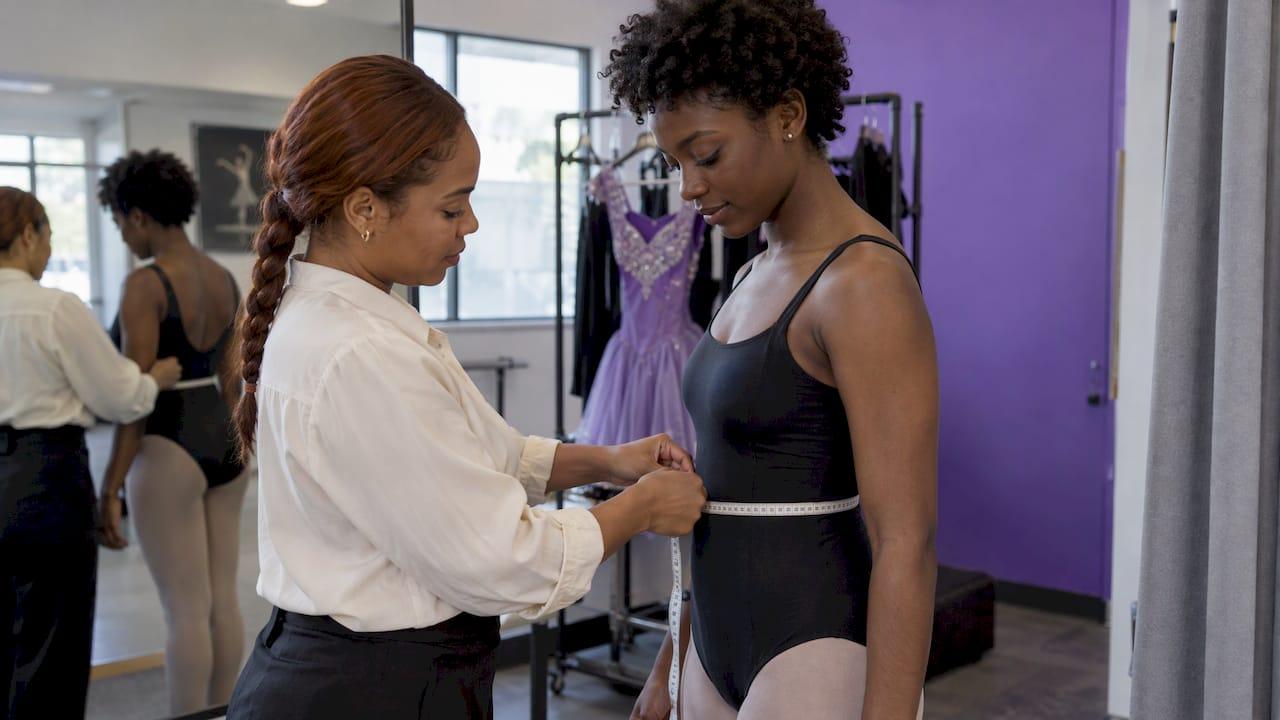
The most reliable way to track costume measurements is to have one trained person take them, have a second person type them straight into one shared record, and review each entry on the spot. Then re-check only the dancers who are still growing before you order. Do that and you avoid most reorders, rush fees and awkward conversations at the recital fitting.
This guide covers what to measure, how to take each measurement, where to keep the numbers, how to read a size chart when a dancer falls between sizes, and how to run a try-on day that catches problems before the order goes out.
TL;DR
- Collect bust or chest, waist, hips, girth and inseam at a minimum, taken over a leotard or other fitted clothing, in inches, with no extra inches added.
- Use a measurement buddy: one person measures, the other records. Type the numbers instead of handwriting them, and skim each entry right away for errors.
- Keep one record per dancer, in one place, with the date it was taken. Costumes get altered and kids grow, so a note on a tag goes stale quickly.
- When a dancer falls between sizes, size up, and follow the chart of the specific manufacturer you are ordering from.
- Measure in the fall, order early, and add growing room only for dancers who are still growing.
Table of Contents
- Which measurements to collect
- Who should measure, and how to keep it consistent
- Where to keep the numbers
- When to measure, and how to handle growth
- Reading a size chart when a dancer falls between sizes
- A try-on process that catches problems early
- Our perspective: measurements belong with the roster
- Put it into practice with StudioFlare
- FAQ
- Sources
Which measurements to collect
Start with the core set that nearly every costume company asks for. Weissmans' sizing guide lists bust or chest, waist, hips, girth and inseam, and Images Costumes names chest or bust, waist, hip and girth as the core measurements, with inside leg, under arm, back length and skirt length as optional extras depending on the design.
Some suppliers ask for more. Phoenix Dance Apparel's list runs to twelve measurement types, including cup size, sleeve length, bicep, wrist, back length, height and weight. You do not need all twelve for every dancer, but a record that can hold them saves you from calling parents back mid-season.
| Measurement | How to take it | Typically used for |
|---|---|---|
| Bust/chest | Around the fullest part of the chest, tape horizontal, arms at the sides | Tops, separates |
| Waist | At the natural waistline, found by bending to one side | Bottoms, separates |
| Hips | Around the fullest part of the buttocks, feet together | Bottoms, skirts |
| Girth | From the top of one shoulder, over the fullest part of the chest, down the torso, through the legs and back to the same shoulder | One-piece costumes |
| Inseam | From the inner leg to the floor | Pants, unitards |
The descriptions above follow Weissmans' size chart instructions. The same page tells you which number drives the decision: girth for one-piece garments, bust or chest for tops, and hips for bottoms.
How to take them properly
A few habits matter more than any single measurement:
- Clothing. Dancers should wear a leotard or other fitted clothing. Phoenix Dance Apparel adds that undergarments should be similar to what they will wear under the costume.
- Posture. Dancers stand straight, look forward and breathe naturally. Revolution Dancewear suggests feet hip-width apart and parallel, arms relaxed, no slouching.
- Order. Revolution's guide measures girth first, then bust on the exhale after a deep breath, then natural waist, then hips with the tape flat to the body.
- Tape. Use a flexible dressmaker's tape, not a metal one. Images Costumes says to keep it firm but not tight and to measure in inches. Phoenix recommends a tape longer than 60 inches, which matters for girth.
- Start point. The Line Up advises starting at 0 on the tape and keeping it snug without pulling.
- No padding. Do not add extra inches for comfort or growing room at this stage. Record the true number and apply any allowance later, at the ordering step.
One warning from Images Costumes is worth remembering if you have international families or suppliers: converting centimeters to inches can lead to inaccuracies, so measure in the unit the chart uses from the start.
Who should measure, and how to keep it consistent
Consistency beats precision. Two careful people with different habits will produce different numbers for the same dancer. Hedy Perna, quoted in Dance Teacher, describes having her office manager measure every child herself, and says she likes the consistency of one person. The Line Up gives the same advice: have the same person measure the entire group.
In practice:
- Pick one trained measurer for the whole studio, or one per age division at a large studio, and have them practice on a few staff members first.
- Pair them with a recorder. Revolution Dancewear describes a two-person process in which one person measures while the other enters the numbers into studio software on a laptop or tablet, with paper as a fallback.
- Type, do not handwrite. Phoenix Dance Apparel notes that typing cuts down on errors, and asks you to record first and last names, with no nicknames, so the order matches the roster.
- Review right away. Skim each student's numbers immediately after recording. A 24-inch waist next to a 31-inch hip on a young child is easy to catch while the dancer is still standing in front of you.
- Never let dancers or parents self-measure on the day. Phoenix's tips include not measuring yourself. Parents can measure at home for later growth checks, but the order should rest on the studio's own numbers.
Protect privacy
Measuring in front of the whole class can make dancers self-conscious. Revolution Dancewear recommends measuring a few feet away from other dancers so no one overhears the numbers. Say the numbers quietly to the recorder, and keep the record visible only to staff and the family it belongs to.

Where to keep the numbers
The paper binder, the spreadsheet and the text thread are where measurements go missing. A tag sewn into a costume is no better: one costume forum thread on the topic points out that costumes are usually taken in or let out over time, so a laminated tag will not show current measurements.
What a good record has:
- One row or profile per dancer, tied to the same name as the class roster
- Every measurement in inches, with the date taken and the initials of the measurer
- A field for notes, such as torso length, a cup-size note, or "re-measure in January"
- A place for the size ordered per costume, so you can compare it with the body measurement later
- Access for the people who need it (the costume coordinator, the front desk) and nobody else
If you use a spreadsheet, The Line Up offers a downloadable measurement form you can adapt, and Costume Gallery provides a class sizing chart for group orders. Weissmans adds a smart habit: if you use class management software, make sure you have downloaded the most current size charts before you add measurements, because charts change. Costume Gallery also notes that new styles may follow a different size chart than earlier ones during a transition period.
Weissmans also suggests taking a photo of the whole group of dancers to help with size comparisons. It is a quick way to spot an outlier, such as a dancer who was measured wrongly and looks two sizes off the rest of the line.

The point of a studio system is that measurements live next to the things they affect: the roster, the costume fees and the order. Our guides on costume ordering workflow and costume inventory show how to connect them.
When to measure, and how to handle growth
Measure once, early, and order once. Limelight Teamwear recommends measuring all dancers in the fall, September to October, finalizing orders by December or early January, ordering six to nine months before the recital, and naming a costume coordinator to track orders and distribution.
Growth is the complication. Weissmans' guidance is specific: when ordering a few months ahead, add 1.5 to 2 inches to girth, and only for dancers who are still growing. Not every dancer needs it, and Images Costumes cautions against adding extra inches as a blanket habit. Keep the raw measurement in your record and note the allowance separately, so you can tell later whether a costume was sized to the body or to the forecast.
A simple calendar:
| When | What to do |
|---|---|
| Early fall | Choose your measurer and recorder, load current size charts, run measuring day |
| Within a week | Review every entry, fix gaps, chase absent dancers |
| Before ordering | Flag growing dancers, apply the allowance, confirm sizes with families if you wish |
| On delivery | Run try-ons and note any alterations in the record |
| After the recital | Update the record if you will reuse it for next season |
For the bigger picture of milestones, see our recital planning checklist.
Reading a size chart when a dancer falls between sizes
There is no universal dance costume size. Nelson of Satin Stitches, quoted in Dance Teacher, makes the point that each company develops its own chart, so follow what the manufacturer recommends for the costume you are ordering. Images Costumes adds that each product has a chart for that design, which says which measurements are needed and whether the numbers refer to the body or to the finished garment.
Rules that hold across the suppliers we reviewed:
- Between two sizes, order the larger. Weissmans says so, and Kellé Dance Costumes agrees. The Line Up explains why: alterations are harder when a garment is too small than when it is too large.
- Use the right measurement for the garment. Kellé states that girth is the most important number unless you order separates, in which case use bust for the top and waist and hips for the bottom.
- Check torso and waist notes. The Line Up suggests considering a long torso when measurements run 2 inches or more over the size, and a wide waist when the waist is 2 inches or more over.
- Expect different numbers from streetwear. Costumes are meant to be form-fitting, so a dancer's chart size often differs from the size they buy at a store. Parents ask about this constantly, so tell them in advance.
- Children are shaped differently. The Line Up notes that child body types tend to be more square, with similar bust and waist and a shorter torso girth than adults.
To see how charts are laid out, Kellé's chart lists a small adult at bust 32½ to 34, waist 24 to 26, hips 34 to 36, girth 55 to 58 and inseam 31¾. A Wish Come True gives a child medium at girth 44 to 46, bust 25 to 27, waist 22 to 24, hips 26 to 29 and inseam 22. Compare the same dancer across two charts and you will often land in different sizes, which is exactly why you record raw measurements, not just the size you ordered last year.
A try-on process that catches problems early
Measurements get you close. A try-on confirms it. A workable process:
- Request sizing sets. Zimmerman of Curtain Call, quoted in Dance Teacher, notes that some suppliers lend sample leotards in various sizes for up to two weeks so dancers can try on a specific size. Ask your supplier whether it offers this.
- Hold a sizing event. Revolution Dancewear suggests using an open house or registration day, or booking sizing appointments through a scheduling tool. That makes measuring part of enrollment rather than a separate chore.
- Teach parents to measure. A short demonstration helps them handle growth spurts later in the year, with the same tape rules your measurer uses.
- Compare measurement to the size chart for that costume. Flag anyone who sits at the edge of a range, and anyone whose numbers look inconsistent.
- Think about alterations. Zimmerman advises considering whether a garment is easy to alter if it is too big in the bust, or whether the girth will stretch in that fabric. Fabric type and silhouette affect fit, as Weissmans notes.
- Record the outcome. After the try-on, write the final size and any alteration beside the measurements. Next year's order starts from that note.
Build in time. A costume that arrives wrong with two weeks to go is a crisis, while one that arrives wrong with two months to go is a return. Our article on why dance studios need time for costume fittings lays out a working timeline.
Our perspective: measurements belong with the roster
We built StudioFlare for dance studios, and the costume season is where we see disorganized records cost the most. The measurements sit in a binder, the roster lives somewhere else, and the fees are tracked in a third place. Every handoff is a chance for a wrong size or a missed payment.
Our view is that a dancer's costume details should sit alongside the things they depend on: who is enrolled, which classes they are in, what the family owes and how you reach the parent. StudioFlare includes costume management, a parent portal and bulk messaging, so a coordinator can work from one system rather than from group texts and spreadsheets.
We also think the measuring day should be simple for the staff running it. A recorder with a tablet, one measurer, and a clean record per dancer is a process any studio can run in an afternoon. The tools should make that easier, not add steps.
Our pricing follows the same idea. We charge for active students, not for historical records, so a studio that keeps years of past dancers on file is not paying for them.
StudioFlare Team
Put it into practice with StudioFlare
If you are still collecting costume details across paper forms and spreadsheets, StudioFlare gives you one place for registrations, costume management, billing and parent communication. Plans start with Starter at $29 per month and Pro at $49 per month, plus $1 per active student per month, with no setup fee and no contract. You can see the details on our pricing page or create your studio to try it.

Once measurements are in order, the next questions are usually money and inventory. Our guides to costume fee billing and costume inventory templates pick up where this article stops.
FAQ
What is the minimum set of measurements for dance costumes?
Bust or chest, waist, hips, girth and inseam cover most suppliers' charts. Images Costumes lists chest, waist, hip and girth as the core set, with extras such as back length or skirt length depending on the design. Always check the size chart for the specific costume before measuring.
Should I add extra inches for growing dancers?
Only for dancers who are still growing, and only when ordering a few months ahead. Weissmans suggests adding 1.5 to 2 inches to girth in that case. Record the true measurement first and note the allowance separately.
What if a dancer's measurements fall between two sizes?
Order the larger size. Suppliers including Weissmans, The Line Up and Kellé give this advice, since a garment that is too large is easier to alter than one that is too small. For one-piece costumes go by girth, and for separates use bust for the top and waist and hips for the bottom.
Who should take the measurements?
One experienced person, ideally for the whole studio, working with a recorder who types the numbers in as they are called. Consistency between dancers matters more than any single reading. Review each entry right after it is taken to catch slips.
How often should I re-measure?
Measure everyone once in the fall before ordering, then re-check only growing dancers if a long gap passes before the order is placed. Limelight Teamwear recommends measuring in September or October and finalizing orders by December or early January. Update the record after try-ons so alterations are not lost.
Sources
- Sizing, Weissmans
- How to Measure Dancers for the Perfect Fit Every Time, Revolution Dancewear
- Measurements, Phoenix Dance Apparel
- How to take accurate measurements for dance costumes, Images Costumes
- Dance Costume Sizing, The Line Up
- Sizing Charts and Measuring Guide, Costume Gallery
- Size Chart and Measuring, Kellé Dance Costumes
- Sizing Information, A Wish Come True
- Dance Studio Recital Timeline, Limelight Teamwear
- Everything You Wanted to Know About Costumes, Dance Teacher
- What Costume Will Look Good on All My Dancers, Dance Teacher
- Costume measurement discussion, r/Costuming