
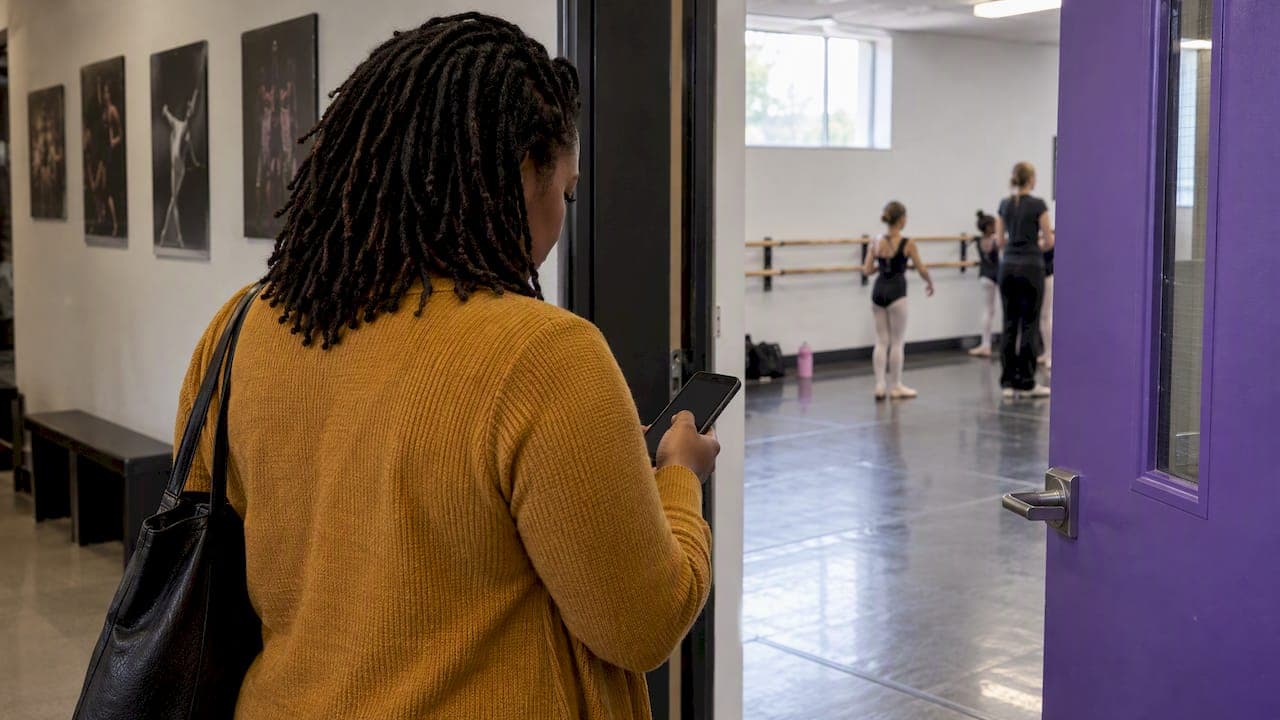
Use text messages for anything a parent must act on today: a class change, a weather closure, a payment that is about to fail. Use email for anything a parent will want to read twice or save: the recital packet, the season calendar, the costume order form. For anything important, send both. The rest of this article shows how to apply that rule to a real studio week, what to put in a text reminder, and which U.S. consent rules apply before you hit send.
TL;DR
- SMS wins on speed and attention. Email wins on length, attachments and anything a parent needs to find again later.
- Match the channel to the message: how urgent is it, does it need a reply, does it include images or documents, and will the parent need it next month?
- Parents are buried in email, so a single important detail in a long newsletter is easy to miss. Pair a short text with the full email.
- In the U.S., texts fall under the TCPA, so collect consent at registration, keep a record, and honor opt-outs right away.
- Keep the volume low. A few useful messages beat daily noise on either channel.
Table of Contents
- How email and SMS differ for studio parents
- What parents actually notice
- Which channel for which message
- How to write an SMS class reminder
- U.S. consent and opt-out rules
- Our perspective: one inbox for parents, one dashboard for you
- Run both channels from one place
- A simple communication plan for your studio
- FAQ
- Sources
How email and SMS differ for studio parents
The two channels are built for different jobs. Email gives you room: a full schedule, photos of costumes, a PDF of the recital rules, a link to the registration page. Text messaging gives you immediacy: one or two sentences that arrive on the screen a parent is already holding. Twilio's guidance on choosing a channel puts it simply: email suits longer, richer messages that people may save for later, and SMS suits concise, time-sensitive information.
For a dance studio, that translates into a few practical differences.
| SMS | ||
|---|---|---|
| Best length | Paragraphs, lists, attachments | One to three short sentences |
| Speed of attention | Hours or days | Minutes |
| Searchable later | Yes, easy to file and find | Hard to find in a long thread |
| Rich content | Images, PDFs, forms, links | Short link, at most |
| Two-way replies | Possible but slow | Natural, "Running 10 min late" |
| Consent rules | Lighter (CAN-SPAM) | Stricter (TCPA) |
| Cost to you | Usually included in software | Often usage-based per message |
Neither channel is better in the abstract. A parent who is already in the car needs the text. A parent planning a recital weekend needs the email.
What parents actually notice
The case for adding SMS rests mostly on one problem: crowded inboxes. Research by Yahoo and Censuswide, reported by MediaPost in August 2024, found parents received an average of 80 child-related emails per month, 62% said they had missed a key event or detail in email, and 56% felt they received too many. Your studio newsletter is competing with school, sports, camps and the pediatrician.
That does not mean email is dead. A report on nearly 5,000 U.S. parents from Finalsite found preference depends on the message and the tool: 82% called email effective for general information, while younger parents showed growing comfort with texting. A separate CampusESP survey of more than 6,400 parents found 36% named SMS among their top preferred channels, and it reports SMS open rates of up to 98%.
Two cautions on those numbers. They come from school and education settings, not dance studios, and open rates published by messaging vendors describe how often a text is opened, not how often it is acted on. Treat them as a direction, not a promise. The useful takeaway is the Finalsite one: families differ, so offer a choice instead of assuming one channel fits everyone. Your studio probably has a mix of parents who live in their inbox and parents who never open anything but texts.

Which channel for which message
Here is a working guide for the messages a dance studio sends most often. Twilio's four questions are a good filter: how time-sensitive is it, does it need a reply, does it contain rich media, and will the parent need it later?
| Message | Channel | Why |
|---|---|---|
| Class canceled or moved today | SMS first, email follow-up | Time-critical; email backs it up with details |
| Weather or facility closure | SMS and email | Reaches people on the move and leaves a record |
| Tuition reminder before the due date | SMS or email | Short and routine; a text gets noticed |
| Failed payment | SMS plus email | Needs action soon and a link to fix it |
| Recital schedule, ticket and costume details | Email, with a short text pointing to it | Long, reference material |
| Waivers, forms and policies | Parents need to read, sign and keep them | |
| Monthly newsletter | Photos, features, calendar | |
| Registration opening | Email, then a text nudge | Detail first, urgency second |
| Absence or late arrival | Two-way SMS | Quick replies in both directions |
| Class photo day reminder | SMS the day before | Short and easy to forget |
The "both" rows matter most. A text says "look now." The email says "here is everything." Parents who miss one usually catch the other.
When email should lead
Email is the right home for documents. Enrollment agreements, photo releases and medical forms need to be read, signed and stored, and parents will search for them months later. If you collect signatures, electronic signature tools for education show how enrollment paperwork can move out of paper folders and into a trail you can find. Our own guide on what to collect in online consent forms covers the fields a studio usually needs. A newsletter also belongs in email; if you need ideas, see these dance studio newsletter examples.
When SMS should lead
Text when the clock is running. Missed-appointment and no-show problems are the same in any appointment business, and text templates for missed appointments show how short a good nudge can be. In a studio, the equivalents are a private lesson that starts in an hour, a class moved to another room, or a tuition payment that did not go through. For the full cadence of reminders before a class, see our guide to three automated reminders that cut no-shows.
How to write an SMS class reminder
A good reminder does one job in a few seconds. It tells the parent who, what, when and where, and what to do if plans change. Put the studio name first, because many parents will not have saved your number.
What every reminder should include
- Studio name, so the text is recognizable.
- Dancer's name or class name, so it applies to the right child in multi-kid families.
- Date, start time and room or location.
- One action, if any: reply to confirm, tap a link, or bring something.
- A way out: an opt-out instruction such as "Reply STOP to unsubscribe," which carriers and good practice expect on recurring messages.
Templates you can adapt
- Class reminder: "Studio Name: Mia's Ballet 2 is tomorrow at 4:30 PM in Studio B. Reply Y to confirm or N if she'll miss. Reply STOP to opt out."
- Last-minute change: "Studio Name: Tonight's 6:00 Hip Hop class is moving to Studio A. Same time. Questions? Reply here."
- Tuition nudge: "Studio Name: Your October tuition is due Friday. Pay or update your card here: [link]. Reply with questions."
- Recital pointer: "Studio Name: The recital details email just went out. Please read it by Sunday: [link]."
Keep each under about 160 characters when you can, so it does not split into several messages. Send reminders at reasonable hours, usually the day before and again a few hours ahead for private lessons. For wording and timing on money messages, our tuition reminder templates go deeper, and the absence message guide covers the replies you will get back.
Two-way texting changes the workload. Parents will answer, so someone has to read the replies, and the studio needs a clear rule for what counts as an official absence notice. We walk through that in two-way texting for dance studios.
U.S. consent and opt-out rules
This is where SMS differs most from email, and where a studio can get into trouble if it improvises. The rules below summarize official guidance. They are not legal advice, and a studio with a large list or a marketing-heavy plan should ask an attorney who handles telecommunications or consumer-protection law.
Texts count as calls. The FCC treats text messages to wireless numbers as calls, with the same consent-based protections as voice calls, as stated in its 2015 announcement. Under the TCPA, autodialed texts to cell phones require prior express consent unless an exception applies, per the FCC's 2016 public notice.
Consent type depends on the message. The FCC's consumer guide on robocalls and texts says commercial texts need written consent, while informational texts may rely on oral consent, and recipients may opt out. For a studio, a class reminder is informational. A text promoting a sale on dancewear or a new session is closer to commercial. The safest habit is to collect written consent for everything at registration, with a plain checkbox that names the kinds of texts parents will get.

Opt-outs must be honored. Consent can be revoked by any reasonable method, and after that you may not keep sending autodialed texts, according to the FCC's recent rulemaking document. That means "STOP," "please stop texting me" and similar replies all count. Process them promptly and do not make a parent hunt for a form. For an example of how consent text and audit records are handled on another messaging channel, see this guide to opt-in consent records.
Email has lighter rules, not none. Under the FTC's CAN-SPAM compliance guide, messages that confirm a transaction a person already agreed to, or give account or membership status, are transactional or relationship messages, exempt from most requirements. Promotional emails must honor opt-out requests for at least 30 days after sending. A tuition receipt is transactional. A summer camp promotion is not.
Two extra points for studios. First, you are texting parents about their children, so collect the parent's number, not the child's. Second, if you run camps or serve young dancers directly, review the privacy angle in our guide to COPPA and ADA for summer camp registration. Keep a record of when and how each parent opted in.
Our perspective: one inbox for parents, one dashboard for you
We build software only for dance studios, and the same pattern shows up in how studios talk to families. Owners start with spreadsheets and group texts, then add email, then a separate texting app, and soon the front desk is answering the same question in three places. The problem is rarely the channel. It is that nobody knows who got what.
Our view is that the channel should follow the message, and the message should come from the same system that already knows the class roster, the tuition status and the consent record. When a text about a failed payment goes to the right parent, and a long recital email goes to the whole company, nobody has to copy and paste lists. It also means opt-outs and consent live next to the student record instead of in someone's phone.
We also think in terms of less noise. If every message is urgent, none is. Texts should be rare enough that parents still pay attention. Use the newsletter for the story, and the text for the time and the room.
— StudioFlare Team
Run both channels from one place
StudioFlare combines bulk SMS and messaging, a parent portal, automated tuition billing through Stripe, digital waivers and attendance in a single studio platform, so your reminders go to the right families without exporting lists. Plans start at $29 per month for Starter and $49 per month for Pro, plus $1 per month for each active student. There is no setup fee and no contract. SMS and some other add-ons carry optional usage-based fees. Compare the options on our pricing section or create your studio account.
If you are moving off older software, our pages on switching from another dance studio platform explain what changes.
A simple communication plan for your studio
You do not need a complicated system. Start with a short written plan and put it in your parent handbook.
- Ask for preferences at registration. One field for email, one for mobile number, and a checkbox for text consent. Let parents choose texts, email or both.
- Set the defaults. Urgent and day-of messages go by text. Everything long goes by email. Important dates go by both.
- Limit frequency. Twilio's guidance recommends avoiding too-frequent messaging. Many studios aim for no more than a couple of texts a week per family outside of emergencies, and a weekly or monthly email.
- Write the text first, the email second. If you cannot say the key point in one sentence, the message belongs in email.
- Repeat important deadlines. A registration deadline can go out by email first, then a reminder text. Our registration reminder guide shows a 72-hour pattern.
- Plan for closures. Decide ahead of time who sends a closure notice, on which channels and how soon. See our closure message plan.
- Review quarterly. Check which messages get replies, which get ignored, and which prompt opt-outs. Opt-outs are a signal you are sending too much or the wrong thing.
One more idea: tailor the approach to each family instead of forcing a single style. Some guides on adapting communication to each family make the same point for caregivers: a quick log or note works when it matches how the other person likes to receive information.
FAQ
Is SMS better than email for parents?
Neither wins every time. Text messages are better for short, urgent notes because they are seen quickly, and email is better for detail, attachments and anything parents will refer back to. Most studios do best using both, matched to the message.
Do I need permission to text parents?
Yes. In the U.S., texts are treated like calls under the TCPA, and the FCC says autodialed texts to cell phones generally require prior consent. Commercial texts call for written consent, so collect it at registration and keep the record. If your studio sends promotional texts at volume, ask an attorney to review your consent wording.
What should a dance class reminder text say?
Include the studio name, the dancer or class, the date, time and room, and one clear action such as replying to confirm. Add opt-out wording on recurring messages. Keep it short enough to fit in a single message.
How often should we message parents?
As rarely as the job allows. Reserve texts for time-sensitive items and send email for everything else, with a regular but not daily rhythm. If opt-outs or unread emails climb, you are likely sending too much.
What happens if a parent replies STOP?
Stop texting that number right away. The FCC says consent can be revoked by any reasonable method, so treat any clear request to stop as an opt-out. Keep sending essential messages such as billing receipts by email.
Sources
- Twilio: Email vs. SMS, how to choose the right channel
- MediaPost: Parents are swamped by email volume
- Finalsite: Parent communication preferences
- CampusESP: Parent engagement SMS module
- FCC: 2015 announcement on unwanted calls and texts
- FCC: 2016 public notice on the TCPA
- FCC: Stop unwanted robocalls and texts
- FCC: Rules implementing the TCPA
- FTC: CAN-SPAM Act compliance guide for business
- Missed appointment text templates
- Electronic signatures for education
- Opt-in consent records guide
- Parent and caregiver communication templates