
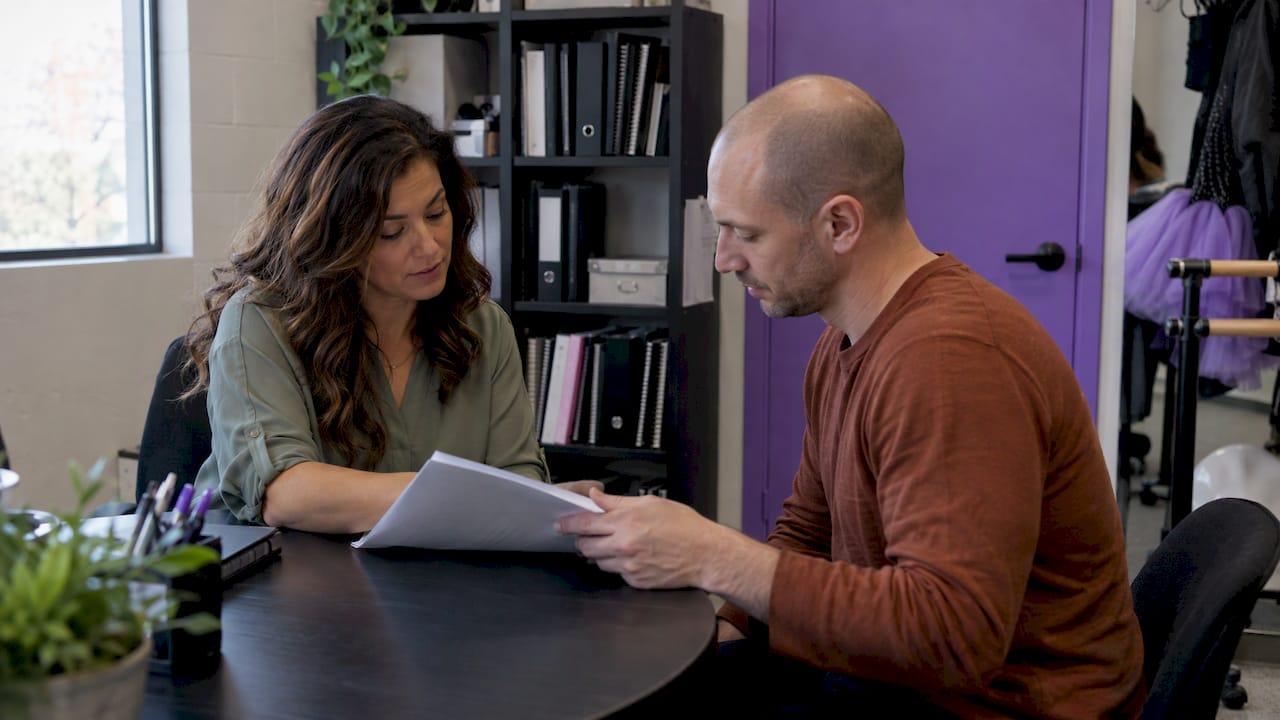
A dance studio social media policy is a short, signed document that says who may post what about your dancers, how staff talk to students and families, and what happens when someone breaks the rules. The strongest versions cover eight things: official channels, photo and video consent, recording limits, staff boundaries, respectful conduct, credit for choreography, removal requests and consequences. Put it in your handbook, have every family acknowledge it at enrollment, and collect the consent that backs it up in the same place you collect registrations.
Most studio owners write this policy after something goes wrong: a parent posts another family's child, a teacher gets a friend request from a 13-year-old, or a rehearsal clip goes viral without permission. This guide gives you the structure to write it before that happens.
TL;DR
- Route studio communication through official channels (studio email, main phone line, a designated group page or app) and keep staff off personal social accounts with minors.
- Get written parent or guardian consent before posting any dancer's photo or video, and remove identifying details such as full names for featured minors.
- Ban unauthorized recording of classes, rehearsals and recitals unless the studio approves it in advance.
- State consequences in steps (warning, suspension, dismissal) and have families acknowledge the policy every year.
- Keep consent, waivers and parent messaging in one system so the policy is easy to enforce.
Table of Contents
- Why a studio needs its own social media policy
- The eight sections every policy needs
- Laws and rules that sit behind your policy
- How to roll the policy out
- Where the policy usually breaks down
- Putting the policy to work with StudioFlare
- Our perspective
- FAQ
- Sources
Why a studio needs its own social media policy
A generic handbook line like "be kind online" does not help when you must decide whether a parent can post a group recital number with 20 other children in it. Dance is visual, children are the performers, and families want to share everything. That mix is why a written policy matters.
There is also a safeguarding reason. Dance Data Project, a nonprofit that publishes research on dance, recommends that studios route correspondence through the organization's email or main phone line, keep staff and students from interacting on social media, require annual signed conduct codes and publish clear reporting protocols in the handbook, on the website and at the studio. Treat your social media policy as part of that safeguarding framework, not just as brand control.
The eight sections every policy needs
Studio policies that are public show a consistent pattern. Dance Collective's 2026–27 social media policy, for example, covers professionalism, respect and inclusion, privacy, copyright, official communications, sponsorship disclosures, public-content review, enforcement and family acknowledgement. You can borrow that skeleton and adapt it to your size.
1. Scope: who the policy covers
Name everyone: students, parents and guardians, instructors, front-desk staff, volunteers and competition team chaperones. Dance Collective's structure applies expectations to students, parents, staff and volunteers alike, and it separates official school communications from personal opinions. That second distinction matters. A parent is free to have opinions about casting, but nobody should post them as if they speak for the studio.
2. Official channels
List exactly where the studio speaks: the studio account handles, the email address, the main phone number, and the parent portal or messaging tool. Then say that anything urgent or administrative goes there. One Northern California studio's policies and fees handbook bars families from contacting teachers or staff through personal social media pages and points them to a designated group channel or email instead. That is a simple rule that takes pressure off teachers.
3. Photo and video consent
This is the section families care about most. Your policy should say:
- The studio posts photos and videos of dancers only with a signed release on file.
- Names of minors are not paired with their images.
- A family can withdraw consent at any time and the studio will stop using new images going forward.
A sample release in a studio-owner webinar deck authorizes promotional use of photos and videos, states that student names will not be disclosed, and requires the director's express written permission before publication. Bri's Dance Place goes a step further for families: its privacy policy says rehearsal and performance images may not be posted without permission, that images of other dancers require proven parent or guardian consent, and that identifying details of featured minors should be removed.
For a deeper template, see our guide to a photo and video policy for dance studios and the list of online consent forms to collect.
4. Recording and posting by families
Parents will film. Decide in advance where that is welcome. Menlo Park Academy of Dance's social media policy prohibits students and parents from recording classes, recitals, performances, intensives or rehearsals without the studio's advance consent. It also requires documented consent from another dancer's parent and studio approval before anyone posts an image featuring that dancer.
A workable middle ground for many studios:
- No recording in classes or rehearsals, which protects other families' children and your teachers.
- Recording allowed at designated recital moments, for personal use only.
- Posting limited to your own child, or to images where other dancers cannot be identified.
Recording-consent rules also differ by state, so it helps to see how one state frames them. This overview of recording consent in Massachusetts shows why a studio policy should state its own permission rule instead of relying on what parents assume is allowed.
If you stream classes or recitals, that needs its own rules about who can watch and whether links may be shared. We cover that in what to write in a livestream class policy.
5. Staff and instructor boundaries
This is the section that protects your dancers and your teachers. Put these points in writing:
- Staff do not connect with minor students through personal social media accounts.
- Digital communication with students is professional, tied to studio activities and open to a parent or another adult.
- Group messages through official channels replace private one-to-one messages.
These points follow established youth-sport guidance. The U.S. Center for SafeSport's 2025 gymnastics policy requires electronic communication between adults and minors to be professional, activity-related and transparent, generally including a parent, another adult family member or another adult participant. It also prohibits adults from connecting with minor athletes through personal social media accounts, subject to stated exceptions, while allowing an official organization or team page. That document is written for gymnastics, not dance, but it is a clear model for the boundary you want. WGI, the indoor performance circuit organization, makes a similar recommendation in its 2025 draft guide on electronic communications: avoid private messages aimed at individual minors and use official group communications.
There is a practical side too. Your teachers should not need to give out personal numbers to run a competition team. Our guide to parent communication for dance studios covers how to set up group messaging so that rule is easy to follow.
6. Conduct: what can and cannot be posted
Spell out the behavior you will not accept. Steps on Broadway Academy's 2024–25 handbook says participants may face discipline for posts it considers obscene, defamatory, threatening, harassing, discriminatory or hateful toward academy staff, students or families. A good studio version adds three practical items:
- No posts that criticize a named student, teacher or family.
- No sharing of competition scores, casting or class lists that identify children.
- No use of the studio's name or logo for private sales or fundraising without approval.
7. Credit for choreography and photography
Choreography is creative work, and studios are often unclear about who owns what. The same Steps on Broadway handbook asks that intellectual property such as photography and choreography be credited when posted online, and Menlo Park's policy requires credit for choreography. Add a line that says: when you post choreography or a photographer's image, tag the choreographer or photographer. If you hire a photographer, settle in the contract whether families may repost the proofs.
8. Removal requests and consequences
Families need a fast path to say "please take that down," and you need the authority to ask others to do the same. Ignite Your Flare's handbook says the studio may request removal of improper social media content and that failure to remove it or continued problems may result in dismissal. Dance Collective's policy ties violations to warnings, suspension or dismissal depending on severity, and treats enrollment as acknowledgement of the policy.
A sample enforcement ladder:
- Informal conversation and a request to remove the content.
- Written warning if the post stays up or the behavior repeats.
- Suspension from classes or events for serious or repeated violations.
- Dismissal, with tuition handled according to your refund policy.
Proportionate steps are easier to defend than a single "we may dismiss you for any violation" clause.
Laws and rules that sit behind your policy
Your policy is a contract between you and families. It is not the law, and the law around children online is moving. Two points are worth knowing.
Child-influencer laws. A 2024 law review article reports that Illinois's child-influencer law took effect July 1, 2024, and Minnesota's took effect July 1, 2025. Both address qualifying content in which minors appear. The article also says Minnesota gives people the right to ask for deletion of content that featured them as minors. If your studio runs a family-style account where children are the draw, check how your state treats this kind of content and ask a local attorney if you are unsure whether it applies.
Data privacy. Names, birthdates, photos and health details in your files are personal data about children. Our dance studio data privacy guide walks through what to collect and how to limit access. Policies that mention "we will not publish names of minors" are only as good as your internal handling of those names.
Sport-specific rules such as SafeSport's apply to the organizations they cover. Use them as a model, not as a statement of what every dance studio must do.

How to roll the policy out
A policy nobody has read protects nobody. A simple rollout looks like this:
- Draft it in plain language. Dance Data Project recommends making the policy understandable to students, so write the teen version in short sentences.
- Put it in three places. The handbook, the website and the studio wall. Dance Data Project recommends publishing reporting protocols in all three.
- Collect acknowledgement at registration. Make agreement to the policy and the photo release part of enrollment, so no family reaches the first class without a signature on file.
- Name a contact. Say who receives complaints and removal requests, by title and email.
- Review it every year. Update it each season for new platforms and any state law changes, and ask families to re-acknowledge it.
- Brief your staff first. Run a 15-minute session at the start of each season. Teachers should hear the rules before parents do.
Staff access matters too. Decide who can see rosters, contact details and livestreams. Our guide to dance studio staff access levels shows how to split billing, check-in and livestream permissions.
Where the policy usually breaks down
The wording is rarely the problem. Enforcement is. Three patterns come up again and again:
- Consent lives in a binder or a spreadsheet. When a family withdraws permission, nobody checks the list before the next post goes up. Keep consent status where your social media manager can see it.
- Communication is scattered. If announcements go out by group text, personal email and direct messages, you cannot say which channel is official. Pick one place for each type of message.
- Changes are not recorded. A policy updated in August is useless if families signed the old version in 2023. Keep dated acknowledgements.
Putting the policy to work with StudioFlare
StudioFlare is a studio management platform built for dance studios. It includes digital waivers and forms, bulk SMS and messaging, a parent portal and built-in livestreaming that is integrated with class registration and access control. That means the policy acknowledgement, the photo release and your official parent communication can sit alongside registration and billing, instead of in separate folders and group chats.
Plans are Starter at $29 per month and Pro at $49 per month, plus $1 per active student per month. There is no setup fee and no contract. You can see the details on the StudioFlare site, and if you are moving from another studio system, our Dance Studio Pro alternative page explains the switch.
When you are ready to try it with your own families, you can create your studio and set up your waivers and messaging in one place.
Our perspective
We built StudioFlare for dance studios because the problems studio owners describe are specific to dance: young dancers, parents who want to share every moment, and teachers who deserve a clear line between work and private life.
A social media policy works when it is easy to follow. That means families sign it when they register, not in a separate email they forget. It means consent is recorded where you can find it, and official messages go out from one place instead of from five personal phones.
That is why we put digital waivers, parent communication and livestreaming access control in the same platform as registration and billing. When a family enrolls, the policy acknowledgement and the photo release are part of the same flow, and your staff message families through studio channels instead of personal accounts.
We think the best policy is the one your front desk can apply on a busy Monday evening without opening a binder.
StudioFlare Team
FAQ
Should a dance studio ban staff from following students on social media?
Most safeguarding guidance says staff should not connect with minor students through personal accounts. Dance Data Project recommends that staff and students refrain from social media interaction, and SafeSport's youth-sport policy allows communication through an official organization page instead. A written ban is easy to enforce and protects teachers from awkward situations.
Do we need parent consent to post a recital photo?
Yes, as a studio policy, get written consent from the parent or guardian before you post any dancer's image. Example studio policies also remove identifying details such as full names for featured minors. Collect the release at registration so it is on file before the first recital.
Can parents film class or rehearsal?
That is your call, but you should state it. Some studios, like Menlo Park Academy of Dance, ban recording of classes, rehearsals and performances without advance consent. Others allow personal recording at set recital moments. Whatever you choose, write it down and apply it to everyone.
What happens if a parent posts something that breaks the policy?
Start with a request to remove the content. Dance Collective's policy uses warnings, suspension or dismissal depending on severity, which is a sensible ladder to copy. Put the steps in the policy so families know them before any problem arises.
How often should we update the policy?
Review it at least once a year, before registration opens. Dance Data Project recommends annual signed conduct codes, so refreshing the acknowledgement each season fits naturally with that practice.
Sources
- Dance Data Project: Best Practices and Guidelines for Ballet and Dance School Safety
- Dance Collective Social Media Policy 2026–2027
- Dance Studio Policies and Student Handbook webinar slides
- Bri's Dance Place Privacy Policy
- Menlo Park Academy of Dance Social Media Policy
- U.S. Center for SafeSport: 2025 Gymnastics MAAPP
- WGI: Best Practices, Electronic Communications (2025 draft)
- Ignite Your Flare Policies and Fees Handbook
- Steps on Broadway Academy First Steps Handbook 2024–25
- Social Media and Social Reform: Why States Should Consider Child-Influencer Laws (SMU Law Review)