
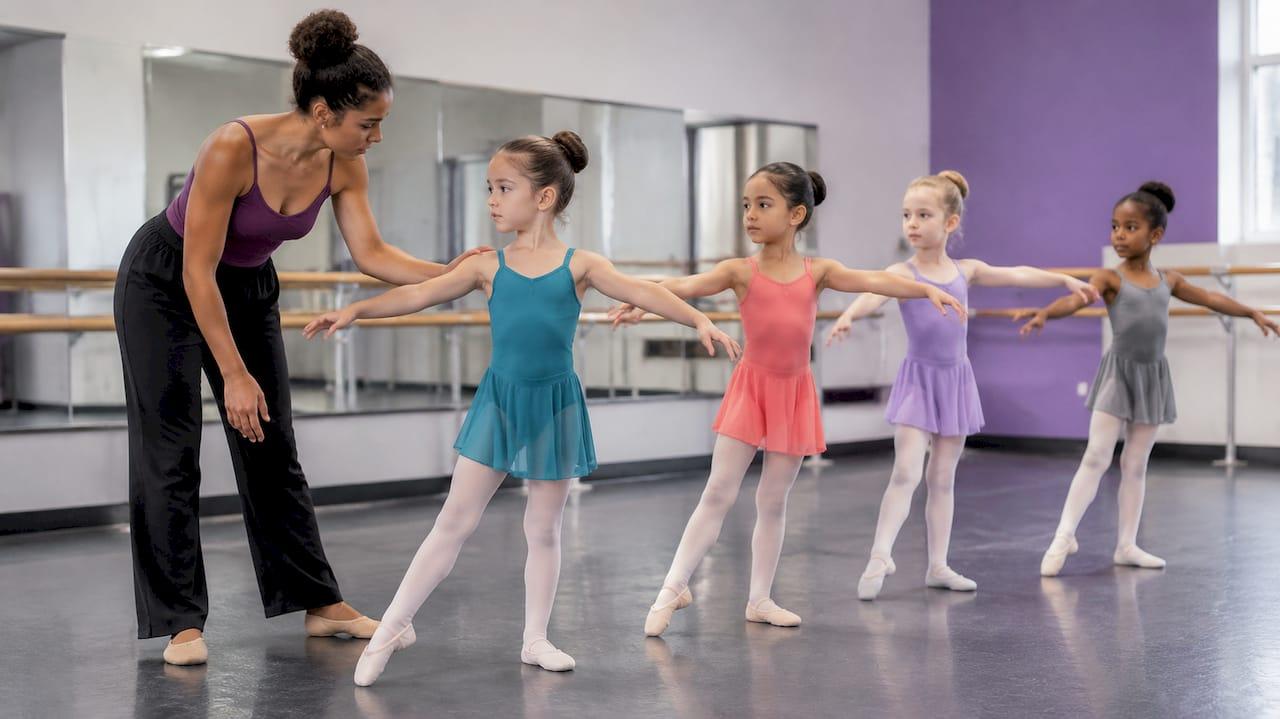
A good class size policy sets a cap for each age group, a minimum that keeps a class on the schedule, a teacher-to-student ratio, and a clear rule for what happens when a class fills up. Most studios land between 6 and 8 students for toddlers and 12 to 15 for school-age recreational classes, with teen and adult classes running larger. This guide gives you those ranges, wording you can adapt, and the utilization numbers that tell you when to add or cut a section.
TL;DR
- Set a maximum by age and level, not one number for the whole studio. Younger dancers need smaller caps and more adult help.
- Pair every cap with a minimum enrollment, so you know when a class runs and when it gets combined or cancelled.
- Write the waitlist rule into the policy: what happens at capacity and how many waitlisted dancers justify a new section.
- Track utilization (attendance divided by capacity) and review it each term. Classes that stay very full call for another section; classes that stay empty call for a new time slot or format.
- Put the policy where parents see it at registration, and make the system enforce it so nobody has to say no by hand.
Table of Contents
- What a class size policy should cover
- How many kids are usually in a dance class
- Write the policy: wording you can adapt
- Class utilization rate: the number behind your policy
- Use attendance data to adjust schedules
- Safety, engagement and fairness
- Our perspective
- Put your policy to work with StudioFlare
- FAQ
- Sources
What a class size policy should cover
Parents read your policy to answer one question: will my child get attention? Your own team reads it to answer another: when do we add, merge or cancel a class? A complete policy answers both with five parts.
- Maximum enrollment by age group and level.
- Minimum enrollment needed to keep a class running.
- Staffing ratio, including when an assistant is added.
- Waitlist rules, including how spots are offered and when a new section opens.
- Placement and conduct rules that protect the room, such as lateness and attendance expectations.
Most of the top-ranking studio policy pages cover uniforms, attendance and dress code. Few say anything about how many dancers are in the room. That gap is useful for you: a clear cap is a selling point for parents who worry about individual attention.
How many kids are usually in a dance class

There is no single standard, and studio space, age and genre all change the answer. The most cited guidance comes from two Dance Teacher magazine experts, who recommend maximum class sizes of 6 to 8 for ages 2 to 3, 10 to 12 for ages 4 to 6, 12 to 15 for grade school children, and 20 for teen and adult classes. That piece dates from 2014, so treat it as a baseline and compare it with what working studios publish today.
Here is how several US studios state their own numbers:
| Studio | Younger dancers | Older recreational dancers | Other rules |
|---|---|---|---|
| Fantasy Dance School | About 8 for ages 3 to 5 | About 12 for ages 6+ | Minimum of six students to stay on the schedule |
| Dance Tech Studios | 10 or fewer with a teacher and an assistant | Never more than 15 | Over 10 students adds a second assistant; 5:1 ratio |
| DDA Dance Academy | About 5 to 12 for ages 2½ to 5, with instructor and assistant | About 6 to 15 for ages 6+ | Varies with the room used |
| Tiny Dancers | 6 to 7 for the youngest classes; 10 to 11 for drop-off classes at age 3+ | Not stated | Cap depends on the studio location |
The pattern is consistent. Under age 6, expect single digits to low teens. School-age recreational classes sit around 12 to 15. Teens and adults can go higher, because they need less hands-on supervision.
Pick numbers that match your room and your teachers
Your caps should come from three things, in this order:
- Floor space. The cap has to leave every dancer room to travel across the floor. We cover the square footage math in our guide to setting dance class capacity, which works from 20 to 25 square feet per dancer.
- Genre. A ballet barre class, a tap class where dancers need arm and foot room, and a hip-hop class moving across the floor all use space differently.
- Teacher experience. Larger classes work when the teacher has the background to manage them. The Dance Teacher experts also suggest assigning a trained assistant to large classes so the lead teacher can focus attention where it is needed.
Occupancy is a separate legal limit. Your local building and fire officials set the maximum number of people allowed in a space, so confirm that figure for each room before you publish caps that could exceed it.
Write the policy: wording you can adapt
Short, plain sentences work best. Below are template lines. Replace the numbers with your own.
Maximum enrollment. "To protect individual attention, each class has an enrollment limit. Limits are set by age and level, and are listed on every class page."
This mirrors the reasoning studios publish. Fantasy Dance School, for example, says it limits each class to provide quality instruction and individualized attention. Scenic City Dance ties its smaller technique classes to individualized corrections and detailed technical education.
Minimum enrollment. "Classes need at least [number] registered dancers to run. If a class falls below the minimum, we may combine it with another level, move the time, or cancel it and notify families with at least [number] days' notice."
Fantasy Dance School uses a minimum of six students. Pick a number that covers your teacher's pay and room cost, then state it. Our guide to dance teacher pay models can help you find the break-even point.
Staffing ratio. "Preschool classes are taught by a lead teacher with an assistant. When a class passes [number] dancers, we add a second assistant." Dance Tech Studios uses exactly this kind of tiered rule.
Waitlist. "When a class is full, dancers join the waitlist in the order they sign up. We offer spots by email and text, and hold each offer for [number] hours." Then add the trigger for growth. Scenic City Dance requires a waitlist of at least 10 dancers before it considers an additional section. A trigger like that stops you from opening a half-empty class on a hunch. For a deeper look, see our waitlist playbook.
Placement. "Placement is decided by the faculty. Attendance, punctuality and participation may affect class placement." Fantasy Dance School ties lateness of more than 15 minutes to safety and disruption, and links excessive absences and repeated tardiness to placement and eligibility. If you want a stricter rule, our article on drop-in and lateness policies has examples.

Explain the "why" in one paragraph
Parents accept a cap more readily when they understand it. Prestige Dance Studio says small classes for children aged 5 and younger help teachers spot and fix improper technique and make sure fundamentals aren't missed. Use your own version of that idea. Keep it to two or three sentences and put it above the numbers.
Also expect different views from your own faculty. The Dance Teacher experts note that many parents worry a crowded class means less personal instruction and a higher chance of injury, while some teachers like larger classes for their energy. Your policy settles the question so each teacher and parent hears the same answer.
Class utilization rate: the number behind your policy
A cap is only half the story. Utilization tells you whether the cap is right.
Utilization rate = students who attended (or were enrolled) in a class, divided by that class's capacity, times 100.
A tap class with a cap of 12 and 9 dancers on the roll has a 75% utilization rate. You can measure it two ways:
- Enrollment utilization: registered dancers divided by capacity. Use it to decide on adding or merging sections.
- Attendance utilization: dancers who showed up divided by capacity. Use it to spot classes with strong enrollment but weak attendance.
Calculate it per class, then average by day, time slot and age group. Studio-Deck cautions that an average hides the story: a 64% average is usually a few sold-out peaks and a tail of near-empty experiments. Look at classes one by one.
Targets to start with
These benchmarks come from fitness and boutique studio content, not dance-specific research, so use them as starting points and adjust to your own history:
- Studio-Deck says healthy boutique studios generally sit in a 70 to 85% band, with peak slots at 90% or more and off-peak slots targeted lower.
- US Tech Automations suggests that classes consistently below 40% are candidates for a new time slot, a format change or removal, while classes above 85% are candidates for an added section.
- Studio-Deck also warns that chasing 100% is a mistake, because a studio with every class full has no room for new families, trial classes or waitlist conversions.
A dance studio has a wrinkle that gym classes do not: the cap protects instruction quality. An 85% class with a cap of 12 means about 10 dancers, which is still comfortable. The same percentage in a toddler class capped at 6 means five children and little spare room for a new enrollment.
A worked example
Say you run a Tuesday 4:30 pm ballet class for ages 6 to 8 with a cap of 12.
- Enrollment is 12 for three terms in a row, and 7 dancers are on the waitlist.
- Utilization is 100%, and the waitlist is close to the 10-dancer trigger from your policy.
- You hold off on a second section this term, and offer waitlisted families a Thursday slot that is only half full.
- If the waitlist reaches your trigger, you open a Tuesday 5:30 pm section.
Now take the Friday 11 am jazz class at 3 of 15, or 20%. Your policy's minimum is not met, so you notify families, offer a move to a better time and merge or cancel as the policy says.
Use attendance data to adjust schedules
Review utilization at the end of each term, and again before you publish the next schedule. A short routine works well:
- Export enrollment and attendance by class.
- Flag classes above 85% and below 40%.
- Check the waitlist for each flagged full class.
- Look at the time slot. Convenient times matter: a 2023 consumer report cited by FitVision found that convenient, flexible times are the top reason people choose boutique studios over big-box gyms. That is a gym finding, but families juggling school and work respond the same way.
- Decide per class: add a section, move it, change the level mix, merge or cancel.
- Update the policy numbers if the same patterns repeat.
The same newsletter cites an IHRSA figure that members who struggle to book their preferred time are 42% more likely to churn within 90 days. It is a fitness-industry statistic, but it makes the point: families who cannot get a spot often drift away, which is why a waitlist and a clear path to a new section matter.
Good attendance records make this work. If you still use a clipboard, our guide to managing dance studio attendance shows a faster way. Room conflicts also limit how many sections you can add, so check double-booking controls before you promise a new class.
Safety, engagement and fairness
A class size policy supports safe instruction in a practical way. With fewer dancers per teacher, the teacher can reach each dancer to correct alignment. Dance WAMI notes that ideally twelve or fewer beginners per instructor allows hands-on alignment correction that helps prevent injury. Treat it as one publication's view, and set your own numbers with your faculty's experience in mind.
Fairness matters as much as safety. Apply the policy the same way to every family. Spell out how you handle siblings, returning dancers and requests for a spot over the cap. Say that exceptions are decided by the studio director, and document each one. If you offer private lessons for dancers who need extra attention, link to your private lesson policy from the class policy, and mention how deposits or late fees apply in your late fee policy.
Our perspective
We built StudioFlare for dance studios only, and the first thing we hear from owners is that class size rules live in three places: the policy PDF, a spreadsheet and somebody's memory. That is how a 12-dancer cap becomes 14 in October.
Our view is that a cap should be set once and enforced by the registration system. When enrollment closes at capacity and the next family joins a waitlist automatically, nobody has to deliver bad news at the front desk.
We also think utilization should be easy to see. Our platform is designed to put registrations, attendance and revenue in one place, and our AI assistant is built to answer questions about classes and payments from your own data, so reviewing a term takes minutes instead of an evening.
And because we charge only for active students, not historical records, your costs follow the dancers who are actually in your classes.
StudioFlare Team
Put your policy to work with StudioFlare
A policy only helps if it is applied the same way every time. StudioFlare handles online class registration, attendance and check-in, parent messaging, digital waivers and automated tuition billing through Stripe, so the caps and waitlist rules you write are the ones your families meet at sign-up. Plans start at $29 per month for Starter, with Pro at $49 per month, plus $1 per active student per month. There is no setup fee and no contract.
You can see the plans on our pricing page or create your studio and set up your first class caps. If you are moving from another system, we have a page on switching from Dance Studio Pro.
FAQ
What is a good maximum class size for a dance class?
It depends on age. Dance Teacher magazine's experts suggest 6 to 8 for ages 2 to 3, 10 to 12 for ages 4 to 6, 12 to 15 for grade school and about 20 for teens and adults. Adjust for your floor space, genre and the number of assistants you have.
How many students do you need to keep a dance class running?
Studios set their own minimum. Fantasy Dance School, for example, generally requires six students for a class to stay on the schedule. Choose a number that covers teacher pay and room cost, and state it in your policy with a notice period for families.
When should I add a second section of a class?
Look at utilization and the waitlist together. Classes that stay above about 85% are common candidates for an added section, and some studios require a waitlist of 10 dancers before opening one. Use the same trigger every term so the decision is consistent.
What is the class utilization rate in dance?
It is the number of dancers in a class divided by the class capacity, shown as a percentage. A class of 9 in a room capped at 12 is at 75%. Track it per class rather than as one studio-wide average.
Sources
- Ask the Experts: Student-to-Teacher Ratio, Dance Teacher
- Policy, Fantasy Dance School
- FAQ, Dance Tech Studios
- FAQs, DDA Dance Academy
- FAQ, Tiny Dancers
- Scenic City Dance guide, 2026 to 2027
- Why class size is important for a dance class, Prestige Dance
- Class Capacity and Utilization, Studio-Deck
- Automate class attendance reports, US Tech Automations
- The Hidden Danger of a Busy Studio, FitVision
- Beyond the Barre, Dance WAMI