
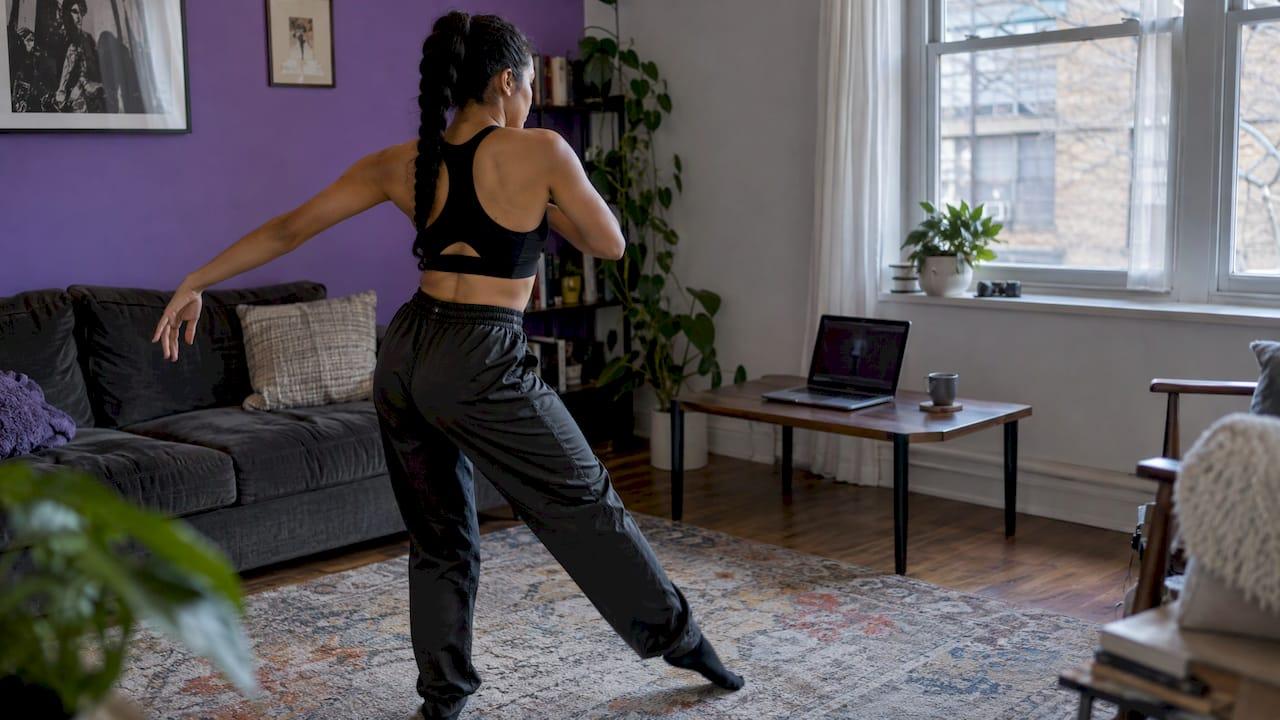
Dancers stay engaged online when the class gives them something to do every few minutes, a way to be seen, and a reason to come back next week. Class structure, feedback, community and the systems around the class (registration, access, reminders) all carry part of that load. This guide covers each one, with what the research and working studios have found, and shows how a studio platform can take the administrative work off your plate so your teachers can focus on the dancers.
TL;DR
- Passive watching kills attention fast: one Emory dance professor puts the limit at about eight minutes of talking head without an interactive activity.
- A predictable class shape (check-in, warm-up, one new skill, community time) keeps dancers oriented and returning.
- Small groups, rotating partners and spoken check-ins replace the eye contact and body language a studio gives you for free.
- Feedback works best when it is specific, spoken and aimed at one dancer, even in a gallery of 25 squares.
- Registration, access, reminders and attendance should run in one place so engagement work is not lost to admin.
Table of Contents
- Why dancers drift away from virtual classes
- Build a class shape dancers can rely on
- Create interaction and community on purpose
- Give feedback through a screen
- Adapt for ages, home spaces and technology
- Measure whether it is working
- Let the systems run so teachers can teach
- Try StudioFlare for your virtual classes
- Our perspective
- FAQ
- Sources
Why dancers drift away from virtual classes
A studio room is a shared space. Dancers feel the energy of the group, copy the person next to them and get corrected by a teacher who walks over. A screen removes most of that. Emory's Lori Teague describes dance as a form where bodies share energy, space and time, which is exactly what a video call strips out. Her colleague Sally Radell says students tend to zone out when they watch a talking head for more than about eight minutes without an interactive activity.
Researchers see the same pattern in several settings:
- A 2025 literature analysis in Frontiers in Education found that engagement and retention remain a concern in online dance because the immersive, embodied feel of in-person training is missing, and that technology access and digital literacy affect how well classes work.
- A 2024 study of hybrid movement training found teachers struggled to read online participants' non-verbal cues, and that online dancers sometimes faked their way through when lost. Verbal check-ins became essential.
- A 2022 study of a Zoom-based dance course found that a no-camera policy meant instructors could no longer see students' responses. Students who kept cameras on earned better final grades, and self-reported self-efficacy dropped slightly over the course.
- In a PLOS One study of home-based dance for older adults, the benefits were no travel and flexible timing, while the drawbacks were less social interaction and lower motivation once the routine of going to class disappeared.
The lesson is not that online dance fails. The same studies found real gains in collaboration, creativity and mood. It is that engagement has to be designed in, because the room no longer does it for you.
Build a class shape dancers can rely on
A predictable structure lowers the effort of joining and keeps attention on movement instead of logistics. Two documented examples show what that looks like.
A repeating weekly rhythm. New River Moving Arts kept weekly classes similar, with a set floor warm-up, at least one repeated standing technique combination and only one new combination per week. Instructors alternated individual improvisation with group exercises directed toward the screen. The study of that program found that class enjoyment was linked to better mood: average enjoyment was 8.4 out of 10, and higher enjoyment went with a bigger rise in positive affect.
A studio-wide template. Pam Simpson of Forte Arts Center trained her faculty for an hour and a half each day over spring break, then built every class around the same arc: a five-minute welcome and student talk, a warm-up, one big skill and community time. The studio added weekly themes, scavenger hunts, Jeopardy-style games and a virtual skill wheel, and only four students withdrew. Her takeaway was that being prepared mattered most: predicting where teaching would stick before it did.
A template you can copy for a 45-minute class:
- Minutes 0 to 5: Greet dancers by name, ask a quick question everyone can answer in the chat or aloud.
- Minutes 5 to 15: Warm-up that is the same every week.
- Minutes 15 to 35: One new skill, broken into pieces of eight minutes or less, each ending in something dancers do rather than watch.
- Minutes 35 to 45: Combination run-through, then turns witnessing each other.
Avoid choreography that makes dancers turn their backs to the camera. New River's guidelines note that students struggle to mirror or follow the teacher in those moments. Design phrases that face the screen, or cue the turn aloud.
Create interaction and community on purpose
Community is the main reason dancers return, and online it has to be scheduled.
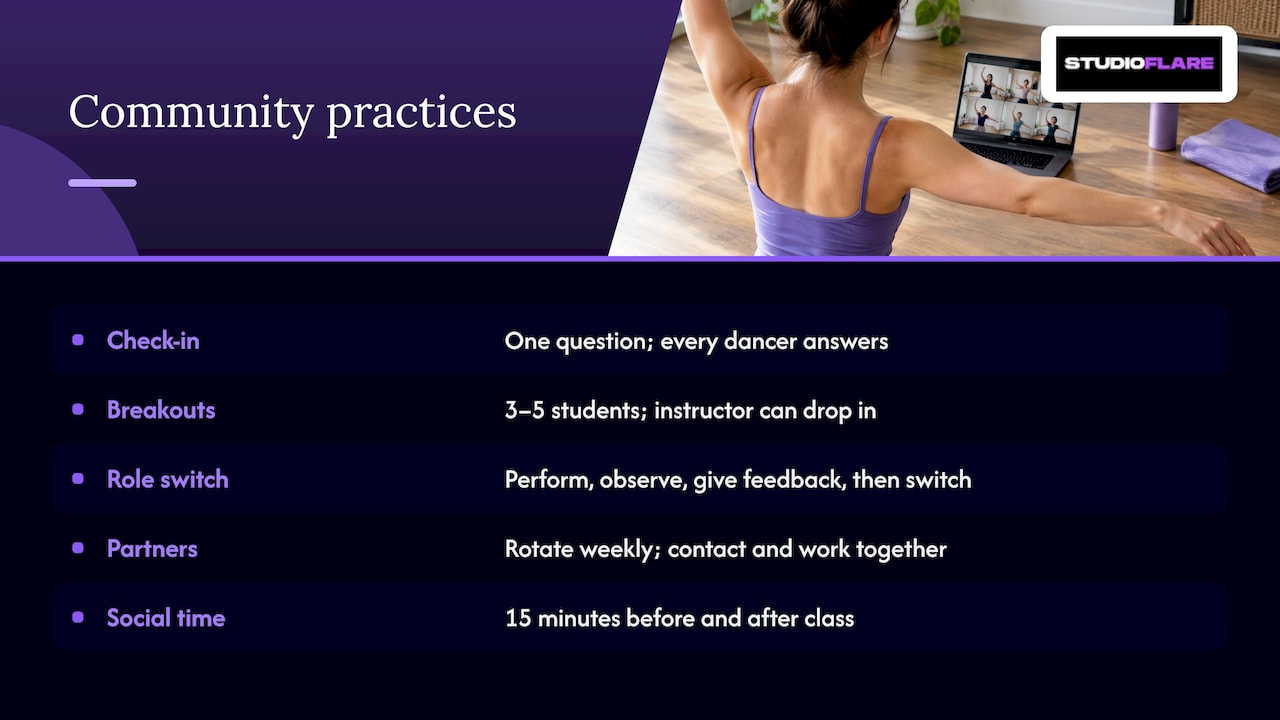
Open with a check-in. Emory's Lori Teague spent the first 15 minutes of her virtual classes on a group check-in, using prompts such as which concert changed a student's life. She found it revealed who her students were and tied their situations to the material. For a recreational studio, a shorter version works: one question, one minute, every dancer answers.
Use small groups. The Zoom dance course study found that breakout rooms of three to five students, with the instructor free to drop into any room, worked well for collaboration and creativity. Text chat helped shy students participate more comfortably than speaking up.
Split the class into performers and observers. At UC Berkeley, Katie Faulkner put students in two groups: one performed while the other watched and gave feedback, then they switched. She also paired students to pin each other's video for movement conversations, as described by Berkeley Letters & Science.
Assign accountability partners. A college instructor rotated weekly partners who contacted each other and worked on assignments together. She said it brought a different kind of humanity to the class. The same teacher asked hip hop students for weekly freestyle video submissions so they could practice vocabulary at home.
Leave time at the end. In the study of older adults in online dance, 15 minutes of socializing before and after each session supported participation, and that conversation often moved into group chats or breakout rooms afterward, according to the Taylor & Francis study.
General principles of keeping learners involved online carry over too. A primer on engaging students in online learning covers the same ideas of short activities, clear expectations and frequent participation.
Give feedback through a screen
Dancers stay when they feel seen. The hardest part of teaching online is that the teacher sees a small, flat image and the dancer gets little information back.
A 2026 ACM study of video-mediated dance learning documented several habits that work, as summarized on the ACM Digital Library:
- Using gallery view to monitor up to 25 students.
- Visual call-and-response checks such as asking for a thumbs-up.
- Pinning several dancers at once so they can compare.
- Sending short correction clips after class.
The authors also argue that corrections are something teacher and dancer work out together: what counts as correct, when to step in and how to say it.
A 2023 study of teacher-AI cooperation found that students valued specific spoken comments such as "bend your right leg more" more than automated feedback, and that teachers give more positive feedback to beginners and often address common problems to the whole class. A student in that study said the teacher caught fluidity and groove that software missed.
Practical habits for teachers:
- Slow down and repeat. A 2025 review in Frontiers in Psychology says quality can be maintained digitally by slowing the pace and repeating instructions, and suggests small group classes with an assistant and question time after class.
- Spotlight one dancer at a time. Ask permission first: "Do you mind if we watch you do it?" One college teacher also turned her own video off so she could watch students perform the way she would watch groups in a studio.
- Say what you see. Because online dancers cannot feel the room, name what is working. Verbal description does the job that proximity does in person.
- Accept less volume, more detail. The same instructor noted you get less information per class on Zoom, which lets you focus on detail instead.
Adapt for ages, home spaces and technology
Engagement drops quickly when a dancer feels the class was not made for their situation.
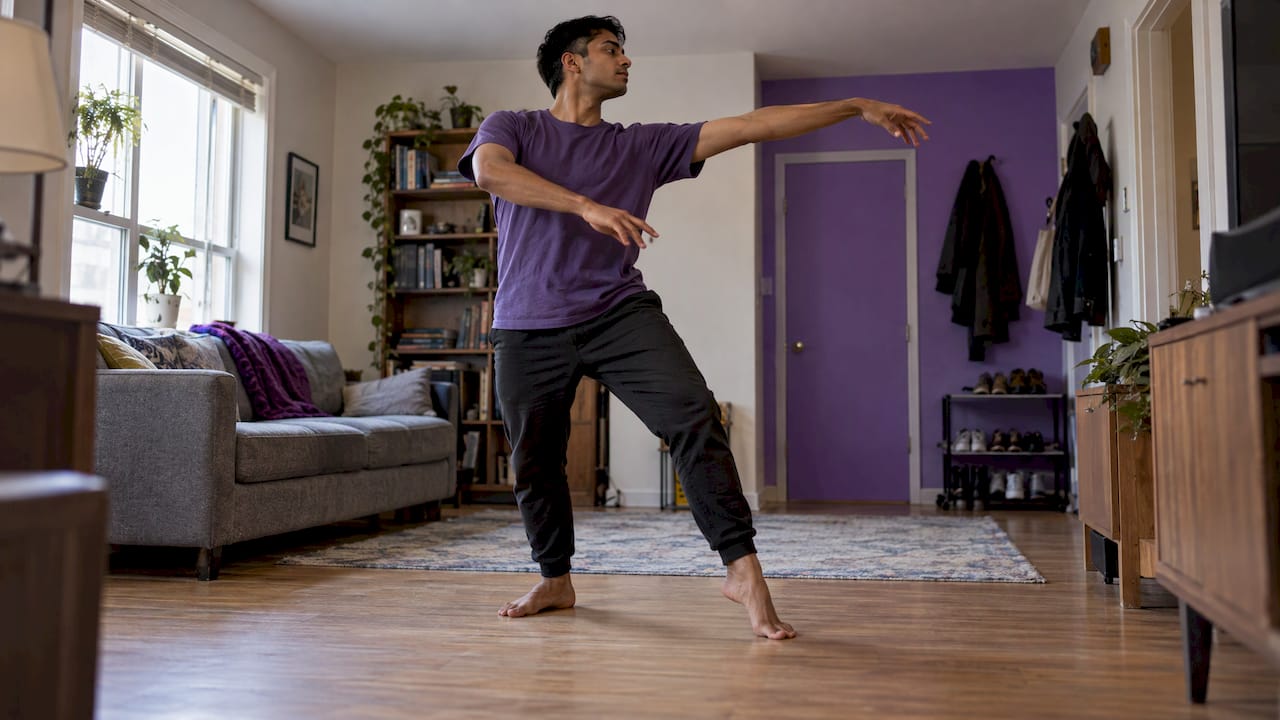
Space. Katie Faulkner alternated spatially demanding moves for students with room and restrained versions for those without, and let students build choreography from the space they had. For shy students, she noted, being at home and out from under a watchful eye can feel comforting.
Skill and age. Offer seated or standing options, as the older-adult program did, and give beginners frequent, concrete encouragement. For young dancers, parents are part of the setup, so give families a clear guide. Forte Arts Center gave families a sign-language guide so teachers could handle requests such as a hearing problem without interrupting class.
Technology. The older-adult study found the main barriers were access to laptops and internet and low confidence with technology. Participants asked for instructions on using the platform before the first class. A short "how to join" message sent in advance, with a plain list of what the teacher can help with, removes the biggest first-class hurdle.
Live or recorded. A study of Canada's National Ballet School program found that live streaming increased connectedness but was held back by technical issues, while recorded delivery was reliable but less social. Local facilitators who acted as the teachers' eyes and ears, with feedback forms, let teachers adjust choreography. Use live for community and feedback, and recordings for practice between classes.
Measure whether it is working
You do not need a research lab. You need a few signals you check every term.
- Attendance and retention. Who showed up, who stopped, and when? A drop after week three tells you something different from a drop after week one.
- Enjoyment. The New River study asked students to rate enjoyment on a 0 to 10 scale and found it tracked with improved mood. A one-question rating at the end of class is easy to copy.
- Perceived difficulty. In the same study, higher perceived difficulty went with more anxiety. If dancers rate a class as very hard, simplify the new material.
- Learning style. Visual learners, 42% of participants, showed the biggest gains in social connectedness, and tactile learners, 17%, showed the biggest mood improvements. A mix of demonstration, verbal cueing and movement-based tasks reaches both.
- Cameras on. In the Zoom dance course, students who kept cameras on earned better final grades. A gentle camera norm, explained as "so I can help you", is a useful engagement indicator in itself.
For more on reducing passive time, see our guide to cutting passive time to lift dance student engagement.
Let the systems run so teachers can teach
Every minute a teacher spends chasing a link, a payment or a waiver is a minute not spent on dancers. Engagement also starts before class: dancers who register easily, know where to join and get a reminder are more likely to show up.
StudioFlare is built for dance studios and puts the pieces in one place:
- Registration and tuition. Online class registration with automated tuition billing through Stripe. Our walkthrough on setting up online dance registration shows how to structure it.
- Livestreaming. Built-in livestreaming connected to class registration and access control, so the right dancers get into the right class. Read how to livestream your dance classes, and if you plan to offer hybrid options, the questions to ask before booking a hybrid dance class.
- Communication. Bulk SMS and parent portal tools for reminders and updates.
- Attendance and forms. Attendance and check-in tools plus digital waivers and forms.
- Insight. An AI assistant that answers common questions about classes and payments.
If you are coming from older studio software or spreadsheets, our pages on the iClassPro alternative and the Mindbody alternative for dance studios outline how StudioFlare compares for dance-specific work.
Try StudioFlare for your virtual classes
StudioFlare has two plans: Starter at $29 per month and Pro at $49 per month, plus $1 per month for each active student. You pay for active students, not for historical records. There is no setup fee and no contract. Livestreaming is available as a feature, and SMS and some add-ons carry usage-based fees. See the plans and features to find the fit for your studio.
That means a studio running a small online program can start on month-to-month pricing and pay for the dancers it actually has this month.
Our perspective
Engagement in virtual dance is a teaching problem first, and our job is to keep everything else out of the teacher's way. Studies from Emory, Berkeley and New River Moving Arts agree on the core: short interactive blocks, small groups, spoken feedback and a predictable rhythm.
We built StudioFlare specifically for dance studios, not generic fitness centers, because a dance studio's week is made of recitals, costumes, parent questions and tuition, all of which compete with class planning. When registration, billing, attendance, messaging and livestreaming sit in one platform, an owner can spend that time on the things the research says matter: training teachers, designing the class arc and checking in with dancers.
Our livestreaming is integrated with registration and access control, so a dancer who registers for a class gets in without a manual handoff. Our pricing is month-to-month with no annual contract, and we charge only for active students. We think a studio should be able to try a new format without signing up for a year of software.
StudioFlare Team
FAQ
How long can a virtual dance class go before students lose focus?
Emory's Sally Radell puts the limit at roughly eight minutes of a talking head without an interactive activity. Break instruction into short pieces, and end each with a task such as a repeat, a partner share or a spoken response.
Should dancers keep their cameras on?
In a study of a Zoom-based dance course, students who kept cameras on earned better final grades, and a no-camera policy left instructors unable to see responses. Explain that cameras let you give corrections, and offer positioning tips so dancers can be seen with limited space.
How do I build community when dancers never meet in person?
Schedule it. Open with a short check-in question, use breakout rooms of three to five dancers, rotate accountability partners and end class with turns witnessing each other. Leave time before and after class for conversation.
What is the best way to give corrections online?
Be specific and spoken, aimed at one dancer by name, and ask permission before spotlighting them. Studies found students value comments like "bend your right leg more" over generic feedback. Slow down, repeat instructions and offer short correction clips after class.
Is live or recorded better for engagement?
Live classes build connection and allow feedback, while recordings are reliable for practice between sessions. Many studios use live classes as the core and recordings as support.
Sources
- Distanced dance: Making the move to remote learning, Emory News
- Moving in a New Space: Dance During the Pandemic, Berkeley Letters & Science
- Moving online: Experiences and potential benefits of home-based dance, PLOS One
- Dance in Zoom: Using video conferencing tools to develop students' 4C skills
- The clash between physical and digital realm: hybrid movement training, Springer
- Evolution and trends in online dance education, Frontiers in Education
- Healing minds, moving bodies: measuring the mental health benefits of online dance, PMC
- Training Staff to Teach Online Dance Classes Well, Dance Teacher
- Here's What Worked and Didn't When College Dance Classes Went Online, Dance Teacher
- Full article: We're still seeing people on the screen, Taylor & Francis
- From Talking Heads to Moving Bodies, ACM Digital Library
- Dancing on the inside: A qualitative study on online dance learning, PMC
- Digital dance programs for Parkinson's disease, Frontiers in Psychology
- Dance Wherever You Are: The Evolution of Multimodal Delivery, PMC
- How to Get Students Engaged in Online Learning?