

A costume deposit is a partial payment collected before costumes are ordered, and most studios set it between $50 and $125 per costume, due in the fall. The money is not the hard part. The hard part is the policy around it: what the deposit covers, when it is due, what happens if a dancer drops, and how you keep track of every family's balance for months. Studios that get those four things in writing, and bill the deposit automatically, spend far less of the season chasing payments and explaining themselves. This guide gives you real numbers from working studios, wording you can adapt, and a tracking routine that fits in StudioFlare.
TL;DR
- Most studios in the examples below charge a deposit of $50 to $125 per costume, collected between September and January, with the balance billed once the final cost is known.
- Deposits are usually non-refundable once costumes are ordered, because custom-fitted costumes generally cannot be returned or resold. Say so in writing before you collect.
- Put the deadline, the refund rule, the balance date and the late consequence on the registration form, with a signature line.
- Track each deposit per dancer and per costume, so a withdrawal, a late payment or a refund never depends on memory.
- StudioFlare's automated Stripe billing and costume management keep deposits, balances and reminders in one place.
Table of Contents
- What a costume deposit actually covers
- What dance studios charge
- When to collect the deposit
- Refund rules: applied, refunded or forfeited
- Policy wording that prevents disputes
- Making the deadline clear to parents
- Tracking deposits, balances and refunds
- Common mistakes to avoid
- Put your costume deposits on autopilot
- FAQ
- Sources
What a costume deposit actually covers
A deposit is a down payment on a costume order, not the full price. The studio has to commit money to a costume company months before the recital or competition brings in any revenue, so the deposit makes sure families have a stake before the order goes in.
Some studios define the deposit more broadly than the garment. One studio's 2026-2027 handbook states that costume payments are deposits only, and that its fees cover the costume itself, planning, artistic direction, measurement classes, a database of dancers, sizes and payments, and placing orders and reorders. Once the costumes are ordered, that studio reconciles balances and tells families about any amount owed or refund due.
That last step is the one many studios skip. A deposit is an estimate. The final price depends on the order, so every deposit should end in a reconciliation: either a balance bill or a refund of the difference. Families accept this easily when the policy says it up front.
What dance studios charge
There is no single standard. Dance Studio Journal reports that costume costs typically run $75 to $150, with most studios landing between $95 and $120, and describes three common collection models: a $45 deposit per class at registration, three equal installments from September through November, or full payment by the first class in November.
Here is what published 2026-2027 policies from individual studios look like:
| Studio | Deposit | Due | Balance |
|---|---|---|---|
| Machita Dance Company | $85 per costume, rising to $95 after October 5 and $115 after October 31 | August and September | Difference plus sales tax billed in January |
| Vibe Performing Arts | $95 per competition costume per routine; $75 per recital costume | October 15 (competition), December 5 (recital) | Reconciled after ordering |
| Studio 531 | $55 per class, non-refundable | Third week of November | Due the week of February 1 |
| CenterStage Performing Arts Academy | $50 per costume | September 15 | Posted October 1, due November 3 |
| Karyn Kelly Dance Center | From $75 (youngest levels), $80 (recreational), $90 (competitive) | November 15 | Charged in March once cost is set |
| LPDC | $75 per class, non-refundable | November 1 | Processed February 1 |
| Sunnyvale Dance | $125 initial deposit, up to 3 costumes | January | Final fees billed first week of April |
| THE NEWMAN Dance Center | $50 per costume plus 6% Maryland sales tax | With November 1 tuition | Due December 1, costumes capped at $100 |
Three patterns stand out. First, the deposit is usually 40 to 80 percent of a typical costume price, so the balance is small and easier to collect. Second, the deposit date sits well ahead of the order date, which gives the studio a buffer. Third, the best-run policies set a rising price or a late fee for missed deadlines, so the deadline means something. Studio E Dance & Acro, for instance, charges a $5 late fee per costume when a deposit is more than 10 days late, and a $25 restocking fee for classes dropped after November 1.
How to set your own amount
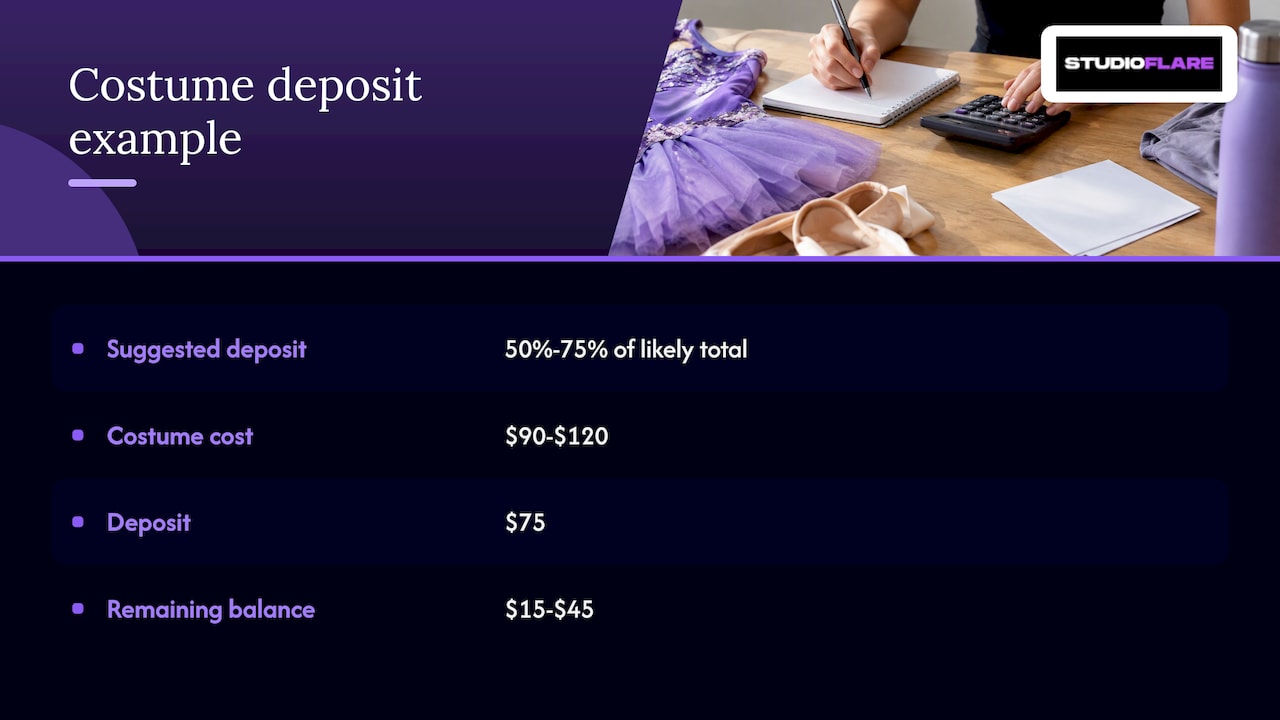
Start from your costume cost, not from a neighbor's policy. Take your typical per-costume price by age group, add tights, accessories or shipping if you include them, and set the deposit at roughly half to three quarters of the likely total. If your costumes cost $90 to $120, a $75 deposit leaves a small, predictable balance. If you serve very young dancers whose costumes are cheaper, a lower deposit tier, like the tiered amounts above, keeps the policy fair.
Decide whether sales tax is included or added. Two of the studios above state it explicitly, and it removes a common source of "why was I charged more" emails.
When to collect the deposit
Timing should work backward from your costume company's order deadline and your fitting schedule. Count back from the date costumes must be ordered, leave time for late payers, and set the deposit due date at least a few weeks before that. Our guide to costume ordering and fittings walks through why the order workflow needs about two weeks for fittings.
There are three practical models:
- At registration. The deposit is part of enrollment. Collection is easiest because families are already paying, but you carry more refund risk if a dancer drops before costumes are ordered.
- A fixed fall date. Most studios in the table above use one date in September, October or November. It gives families time to budget and gives you a clean deadline.
- Installments. Three equal payments from September through November spread the cost. It suits families who struggle with a lump sum and works well with automatic billing.
Whichever you choose, give one date, not a range. "Due October 15" gets paid. "Sometime in the fall" does not.
Refund rules: applied, refunded or forfeited
The question families ask most is what happens to the deposit if their dancer stops. The answer depends on one fact: whether the costume has been ordered.
The pattern across studios is consistent:
- Before the order is placed, many studios refund or credit the deposit, or reassign the costume to another dancer. One handbook says payments are non-refundable unless the costume has not been ordered or another dancer can use it.
- After the order is placed, the deposit is typically non-refundable. Dance Expressions states costume deposits are non-refundable once costumes have been ordered. Another studio's policies say the costume then becomes studio property if a recital class is dropped after orders are placed.
- The full price may still be owed. One 2025-26 handbook states the total costume price is payable even if the student withdraws. Dance Studio Journal recommends policy language under which students withdrawing after October 1 stay responsible for all costume payments, and charges are non-refundable once ordered.
The reasoning is the same everywhere. A custom-fitted costume cannot be resold, and costume companies generally do not accept returns. One Maryland studio puts it plainly in its handbook: costume fees are non-refundable because costume companies do not allow returns. If you want a broader view of why deposits in many industries become non-refundable at a certain point, this explainer on how deposit refund rules work is a helpful comparison.
Tie the refund rule to a trigger date, not a feeling. "Refundable until costumes are ordered on November 15" is clear. "Refundable if we haven't ordered yet" invites a daily check-in from worried parents.
Policy wording that prevents disputes
A good costume policy fits in a short paragraph. It needs five elements, and each one answers a question a parent will otherwise email you about.
- Amount and what it covers. "A $75 deposit per costume is due October 15 and is applied to the final cost of your dancer's costume."
- Balance timing. "Any balance is billed in February once final costs are confirmed, and any overpayment is refunded or credited."
- Order trigger. "Costumes are ordered once deposits are received. Unpaid costumes are not ordered." Several studios state this outright, and one adds that a dancer cannot take part in the recital until costumes are paid for.
- Withdrawal rule. State the date after which deposits become non-refundable, and whether the full price is still owed.
- Late consequences. A late fee or a price increase, stated in advance. Our guide to writing and enforcing a fair late fee policy covers how to keep it reasonable.
Also state who receives the costume. Studios that let families keep costumes say "yours to keep" in the recital fee section. Studios that keep ownership should say so, because ownership disputes are among the most common costume conflicts.
If you are rebuilding your enrollment paperwork around this, see our registration form templates and policies, and our walkthrough on separating deposits from other recital fees so families see each charge clearly.
Making the deadline clear to parents
A policy parents never read protects no one. Dance Studio Journal's editorial advice is to explain costume economics face to face at registration and to get written acknowledgment of the non-refundable deadlines, and it argues that studios doing so report fewer withdrawal conflicts. It suggests scripting a 30-second explanation and adding a signature line to the enrollment form.
A workable script covers three points: what the deposit is, the date it is due, and the date after which it cannot be refunded. For example: "Costumes are custom ordered in November. Your deposit is due October 15. Up to the order date we can refund it if your dancer drops, and after that it is non-refundable because the costume cannot be returned."
Then reinforce it in writing at three moments: at registration, a few weeks before the deadline, and a few days before. A text or portal message with the amount and the date does more than a paragraph in a handbook. Some studios also email the exact balance before charging the card on file, so no one is surprised by the amount, which is the approach Studio 5-6-7-8 describes in its 2026-2027 policies.
Tracking deposits, balances and refunds
The deposit itself is easy to collect. What goes wrong is the record keeping that follows. A single dancer might have three costumes across ballet, jazz and hip hop, each with its own deposit date, a balance that depends on the final price, and a withdrawal that happens in the middle of it all. Spreadsheets and group texts can hold that for a dozen families. At a hundred families, they leak.
Here is the routine, step by step, and where it tends to break.
- Create one record per dancer per costume. Not per family. A withdrawal from one class should change one costume line, not the whole account. This is where spreadsheets fail first, because a family-level row cannot show which costume was ordered. In StudioFlare, costume management sits alongside registrations, so costume charges attach to the dancer's enrollment rather than to a separate file.
- Bill the deposit automatically on a fixed date. Manual invoicing is where deadlines slip. StudioFlare automates tuition billing through Stripe, so a deposit can go out on schedule rather than depending on someone remembering. Our guide to costume fee billing covers how to structure the charges.
- Message families before and after the deadline. StudioFlare includes bulk SMS and parent portal communication, so a reminder reaches every family without a hand-built group text. SMS carries optional usage-based fees.
- Freeze the order list. On your order date, pull a report of paid deposits. Costumes with no deposit are not ordered, as your policy states. Reports and exports let you hand the costume company a clean list.
- Reconcile when the final price arrives. Compare each dancer's deposit with the actual cost, then bill the balance or refund the difference. This is the step families remember, so it deserves the same care as the deposit.
- Record withdrawals against the policy date. If a dancer drops before the order date, release or reassign the costume. After it, the record should show the deposit as non-refundable and the balance as owed, so your answer to the parent is a fact from the account, not a recollection.
StudioFlare also includes an AI assistant that answers common questions about classes and payments, which helps with the repeated "how much do I owe" messages that arrive near every deadline. For a broader look at structuring payments, see our guide to collecting dance studio payments online and our piece on tuition payment plans.
Common mistakes to avoid
- Collecting the deposit without a written refund rule. The dispute comes in April, when memory is worst.
- Setting the deposit at 100 percent of the estimate. When the final cost lands lower, every family needs a refund. A deposit slightly under the likely total keeps reconciliation to small balances.
- Ordering before deposits arrive. You absorb the loss if the family leaves. Several studios in the table above refuse to order until the deposit is paid.
- Burying the late consequence. If the rising price or late fee is not stated in advance, you cannot enforce it fairly.
- Mixing costume money with tuition. When a payment arrives, nobody knows which charge it was for. Keep costume deposits as a separate line.
What we believe about costume deposits
Costume season is where a studio's administration is tested. Tuition runs on a steady monthly rhythm, but costumes bring different amounts, different dates and different rules per dancer, all at once, all with families watching closely.
We built StudioFlare for dance studios specifically, so costume management, registration, Stripe billing, parent messaging and reports live in one place instead of across spreadsheets and group texts. A deposit then stops being a reminder on someone's to-do list and becomes a scheduled charge with a clear record behind it.
Our view is simple: the policy should be short and written, the deadline should be one date, and the record should be the same for every family. When the system holds the facts, the conversation with a parent about a refund or a balance becomes a calm, short one.
StudioFlare Team
Put your costume deposits on autopilot
If you are tracking costume deposits across spreadsheets and texts, or moving from older studio software, StudioFlare brings registrations, automated billing and parent communication into one platform built for dance studios. Plans start at $29 per month for Starter and $49 per month for Pro, plus $1 per active student per month, with no setup fee and no contract. Livestreaming is available as an add-on without a published price. You can see the plans on the StudioFlare site.

For studios coming from another system, our pages on switching from a larger booking platform and moving from iClassPro explain what changes.
FAQ
How much should a dance studio charge for a costume deposit?
Most studios in the 2026-2027 examples above charge between $50 and $125 per costume. A practical target is about half to three quarters of the expected total, which keeps the later balance small. Costume prices themselves typically run $75 to $150, according to Dance Studio Journal.
Are costume deposits refundable?
Usually only until the costume is ordered. After that, most studios treat the deposit as non-refundable because costume companies generally do not accept returns. Some studios, such as Machita Dance Company, set a fixed cutoff date after which deposits cannot be refunded. State the date in your policy and on the enrollment form.
When should a studio collect costume deposits?
Work backward from your costume order date. The studios above collect between August and January, with September through November the most common. Allow a few weeks between the due date and the order date so late payers can catch up.
What happens if a family does not pay the deposit?
The common rule is that the costume is not ordered. Studio 531 states that costumes are not ordered until all deposits are paid, and others add a late fee or rising price. Whatever you choose, publish it in advance and apply it the same way to every family.
Can software handle costume deposits and balances?
Yes. StudioFlare lists costume management, automated Stripe billing, bulk SMS and reports among its features, so deposits, reminders and balance lists sit in one system.
Sources
- Costume Fees for Dance Studios: Timing & Policies, Dance Studio Journal
- Vibe Performing Arts 2026-2027 Studio Handbook
- Tuition + Fees, Machita Dance Company
- Policies and Procedures, Studio 531
- Recital Costumes, CenterStage Performing Arts Academy
- Tuition & Other Costs, Sunnyvale Dance
- THE NEWMAN Dance Center Handbook
- Tuition & Fees, Karyn Kelly Dance Center
- Tuition, LPDC
- 2025-2026 Student Handbook, Studio E Dance & Acro
- CDPA Handbook 2025-26
- Policies & Procedures, Dance Expressions
- Studio Policies 2026-2027, Studio 5-6-7-8
- Are deposits refundable? The rules, by sector