
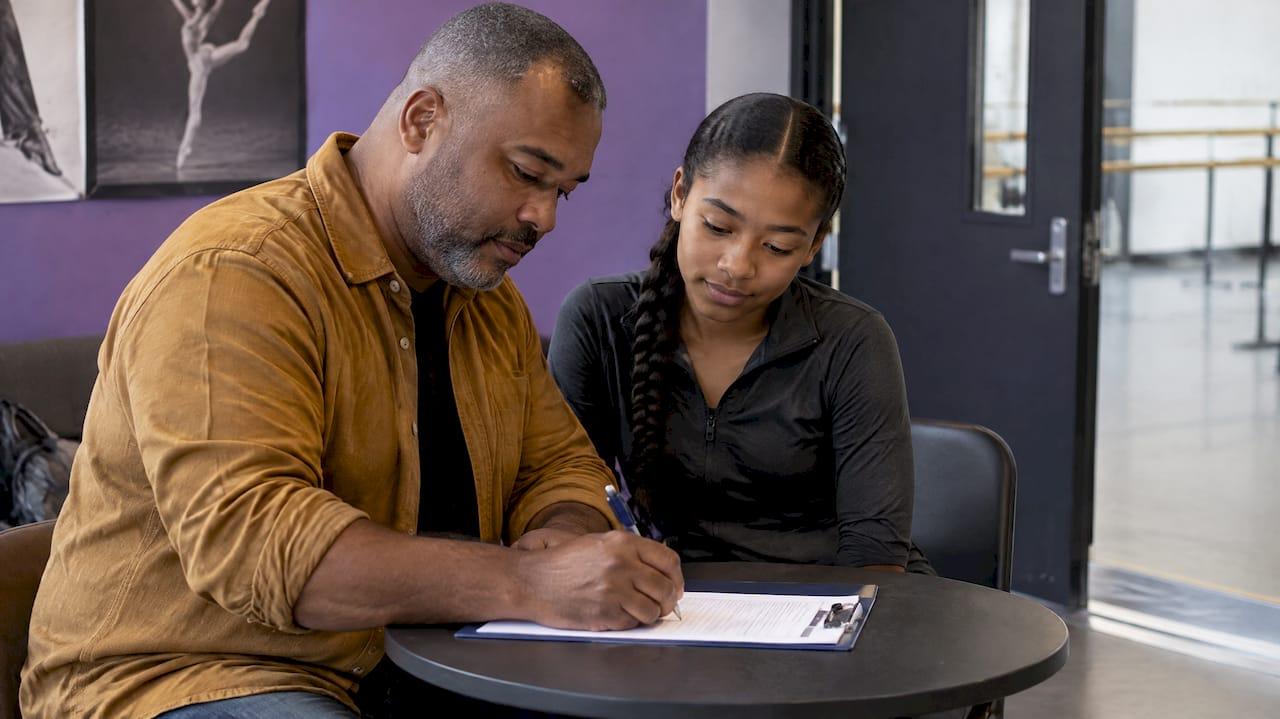
A dance student medical form is a short document, signed by a parent or guardian, that tells your studio who the dancer's doctor is, what allergies, conditions and medications matter, who to call in an emergency, and whether staff may give first aid. Collect it at registration, refresh it every season or school year, and keep it where staff can reach it in seconds.
Below you'll find the fields to include, how to word the consent section, how a medical form differs from a liability waiver, and how to store the data safely.
TL;DR
- Collect the basics on every dancer: physician, allergies, medications, conditions, insurance, and at least two emergency contacts.
- Pair the form with a separate emergency treatment authorization. Keep it distinct from your liability waiver.
- Refresh it at least once a year, and require families to report changes right away.
- Limit access to staff who need it, and make sure instructors can pull it up on a phone during class.
- Digital forms beat paper binders: they are searchable, always current, and tied to the student's registration.
Table of Contents
- What a dance student medical form is and when families complete it
- What to collect from the student and parent
- Recording allergies, medications and conditions
- Consent, authorization and the liability waiver
- Privacy and legal requirements in the U.S.
- Using the form when a dancer is hurt or ill
- What we believe about studio medical forms
- Moving your medical form online
- Keep medical forms with registration in StudioFlare
- FAQ
- Sources
What a dance student medical form is and when families complete it
The form is the studio's record of what it needs to know to keep a dancer safe. It is not a medical clearance. It is the information an instructor or front desk person reaches for when a dancer feels dizzy, rolls an ankle, or has an allergic reaction.
Most studios ask for it at registration. One studio, for example, requires its health information and medical waiver with every new student's registration. That is the cleanest rule: no form, no registration.
Timing after that varies, and you should set a policy and state it:
- Each season or session. One studio's health form is completed by a parent or guardian each session. This suits studios with changing summer, camp and fall rosters.
- Each school year. A large ballet academy in Chicago says forms only need to be submitted once per school year, and returning dancers submit a new medical waiver each fall.
- A minimum validity window. One studio's release stays in effect through the end of the following season, but never less than one year from signing.
- Whenever something changes. One academy asks parents to notify the studio immediately of pertinent changes and update medical information in its customer portal.
We recommend combining the last two: a full refresh every year, plus a duty to update whenever a diagnosis, medication or injury changes.
What to collect from the student and parent
Start with what real studio forms ask for, then trim to what your staff will actually use in an emergency. Collecting data you never use only adds privacy risk.
Core fields
One studio form collects the child's name, physician name and phone, medication allergies, history of asthma, seizures or loss of consciousness, heart problems, special medical problems, last tetanus-type vaccination date, whether ibuprofen or acetaminophen may be given, and insurance details. A strong baseline for your own form:
- Dancer's name, birthdate, age and class(es)
- Parent or guardian name, phone numbers and email
- Primary care physician: name, address, phone
- Health insurance company, policy and group number
- Allergies (food, medication, insect stings, latex) with the reaction
- Medical conditions (asthma, diabetes, epilepsy, heart conditions)
- Current medications: name, dose, frequency, reason
- Recent injuries and physical limitations
- Emergency contacts, with relationship and phone
- Consent signatures and date
Fields worth borrowing
A national dance organization's health sheet adds injuries in the last 12 months, a checklist of conditions such as asthma, epilepsy and diabetes, and an immunization section. Another form asks for major illnesses and major surgeries. An example allergy entry on that form, peanuts with hives, shows families the level of detail you want: the trigger and the reaction.

For emergency contacts, ask for more than one. A studio form from Pennsylvania collects up to four emergency contacts with their relationship and phone number, and another has a separate emergency contact section for when the parent or guardian can't be reached.
Adults and teens
Adult dancers and teen company members still need the form. Adjust the wording: adults sign for themselves, and teens' forms still carry a parent's signature while they are minors.
Recording allergies, medications and conditions
Vague answers cause the most trouble in practice. "Allergic to nuts" tells staff nothing about whether to call 911. Design the form so families have to be specific.
Ask for the reaction and the plan. Ask what happens, what the dancer takes for it, and where the medication is kept. One studio requires families to disclose allergies, conditions, medications, current injuries, physical limitations and other safety needs, and says any emergency medication such as an epinephrine auto-injector or rescue inhaler must be coordinated with the academy before the student participates.
Separate routine medication from emergency medication. A park district dance program asks about illnesses, conditions, allergies and current medication, and gives families a separate medication dispensing form if the dancer will bring medication to rehearsals or performances. A second form is cleaner than cramming dosing instructions into a checkbox.
Set storage rules for medication. One studio form tells families that medication goes in the student's backpack, no refrigeration is available, and a parent must arrange for someone the child knows to administer medication the child can't self-administer. Another says the parent is responsible for supplying any medication, special food or equipment and that additional medication needs a new form.
Spell out anaphylaxis and chronic conditions. One program requires students with allergies, asthma, diabetes or anaphylaxis to provide medications, emergency action plans and instructions before participating, including a labeled EpiPen and a current management plan for those at risk of anaphylaxis. Ask families to attach the doctor's action plan, not to summarize it.
Decide on over-the-counter medication up front. Many forms include checkboxes for whether staff may give ibuprofen, acetaminophen or an antihistamine. One form has separate permission lines for each medication, with dosage instructions and a parent signature. If your studio's policy is that staff never dispense medication, say so plainly on the form instead.

Consent, authorization and the liability waiver
These are three different documents with three different jobs, and families are best served when you keep them apart.
| Document | Purpose | Typical content |
|---|---|---|
| Medical information form | Tells staff what they need to know | Allergies, conditions, medications, physician, insurance |
| Emergency treatment authorization | Lets staff get care for a minor | Permission for first aid, calling emergency services, treatment if the parent can't be reached |
| Liability waiver | Acknowledges the risks of dance | Assumption of risk, release language, studio policies |
The emergency treatment authorization
One studio's form authorizes staff to give general first aid for minor injuries and to summon emergency personnel for life-threatening situations, with the parent responsible for the cost of care. Another has parents consent to the studio acting on their behalf in an emergency and authorize first aid or medical attention.
Authorization language can be tied to state law. A California camp form includes consent to emergency treatment of a minor under a section of the California Civil Code, effective for one week or until revoked in writing. Because state rules differ, have a local attorney review the wording before you publish it.
Emergency contacts are not legal guardians
One academy states that naming someone as an emergency contact does not make that person a legal guardian or give them authority over medical decisions. If grandparents or nannies drop dancers off, add a separate release line that says who may pick the child up. One studio form includes a student release authorization for listed persons when the parent can't be contacted.
Insurance and physical exams
Some studios ask families to confirm coverage. One form has parents declare that they carry adequate health insurance and that the studio can't assume financial responsibility for medical care. Others ask for a recent physical: one certifies the student had an exam by a licensed physician in the last twelve months. A pre-professional program may go further and require exam forms completed within twelve months of August 31, with students lacking the paperwork after two weeks unable to dance. Recreational studios usually don't need that level of requirement, so choose what fits your program.
For the waiver side, see our guide to an automated liability waiver for dance studios and our rundown of online consent forms and what to collect.
Privacy and legal requirements in the U.S.
There is no single federal rule that tells every dance studio how to handle student health forms. Here is what is useful to know.
HIPAA usually isn't the framework for studios. HIPAA applies to defined covered entities. Even for schools, generally HIPAA compliance does not apply because schools are not covered entities. A dance studio collecting forms from families is in a similar position, but that doesn't mean the data is unprotected by common sense or by state law. Ask your attorney how your state's privacy and data-breach laws apply to you.
Minor consent rules vary by state. State laws differ on when minors can consent to care, which is another reason to keep the authorization wording simple: a parent or guardian signs for minors.
Set your own confidentiality policy and say it on the form. One academy states that health information is handled confidentially and shared only on a need-to-know basis with authorized staff, emergency responders, healthcare professionals or others when reasonably necessary for safety or required by law. Adopt a similar rule.
Practical habits:
- Give access to instructors and front desk staff, not to every volunteer.
- Don't collect Social Security numbers or detailed medical histories you don't need.
- Never leave paper forms on a front desk or in an unlocked car.
- Remove records for dancers who left, according to your retention policy.
For more, read our practical guide to dance studio data privacy. If you run camps with young children, our post on summer camp registration, COPPA and ADA covers what changes.
Using the form when a dancer is hurt or ill
A form only helps if it's within reach. Build a short routine:
- Stay with the dancer and call emergency services for anything serious.
- Pull up the form: allergies, medications, conditions, physician.
- Give only what the authorization allows, such as first aid.
- Contact the parent, then the next emergency contact if needed.
- Document the incident the same day.
Studios write this into their policies. One academy says it will assist a student to urgent care or a hospital if emergency services are needed and will notify the parent or guardian. One studio's instructors are trained, for severe allergic reactions, to use an EpiPen on the outer thigh, call 911, and then call the parents. Another says all injuries and incidents are documented and parents are contacted using the emergency information on file, and that families must keep contacts current.
Two rules we'd add. First, a dancer who was out for injury or illness doesn't return until released by a physician is a policy you can adopt for a clear return-to-class standard. Second, keep a copy of the form with the first aid kit, as one studio does, or make sure it's reachable on staff phones.
What we believe about studio medical forms
Paper medical forms fail in a predictable way: they're collected in September, stuffed in a binder, and out of date by January. The binder is also in the wrong room when a dancer needs help.
We built StudioFlare for dance studios specifically, so the form lives with the student's registration. Parents complete it online while enrolling, and the studio has digital waivers and forms, attendance and check-in tools, and a parent portal in the same place. When a parent updates an allergy, the record is the current one.
Our view is simple: collect less, collect it once, collect it digitally, and make it reachable by the people who need it. That replaces spreadsheets and group texts with one place for your registrations, communication and records.
StudioFlare Team
Moving your medical form online
If you're ready to retire the paper binder, here's a sequence that works:
- Draft one master form using the fields above, and get it reviewed by an attorney in your state.
- Make it part of registration so no dancer is enrolled without it. Our guide to setting up online dance registration shows how to build that flow.
- Capture signatures digitally. See six steps to set up digital signatures for U.S. studios.
- Schedule your refresh each season or fall, and send reminders.
- Test your emergency routine by timing how fast a staff member can find a dancer's allergy info.
For a wider set of templates, see our collection of dance registration forms and policies.
Keep medical forms with registration in StudioFlare
StudioFlare handles online class registrations, digital waivers and forms, attendance and check-in, and parent portal communication in one platform for dance studios. Plans are published on our site: Starter at $29 per month and Pro at $49 per month, plus $1 per active student per month. There is no setup fee and no contract, and we charge for active students, not historical records.

If you're moving from spreadsheets or another studio system, you can create your studio and set up your registration and forms flow from there.
FAQ
Do all dance students need a medical form?
We recommend it for every student, including adults, because the form is what staff use in an emergency. For minors, a parent or guardian signs it. Whether you require a physician's exam on top of that is your choice and depends on your program.
How often should families update it?
At least once a year, and any time health information changes. Some studios ask each session, and others once per school year with a new waiver each fall. Pick one schedule and state it on the form.
Is a medical form the same as a liability waiver?
No. The medical form records health information and authorizes emergency care. A liability waiver covers the risks of dance and the studio's release language. Keeping them separate makes each easier to read and to update.
Does HIPAA apply to my studio?
HIPAA generally applies to covered entities such as healthcare providers and plans, and generally does not apply to schools. Your state's laws may still matter, so confirm with a local attorney.
Who should see a dancer's medical information?
Only the instructors and staff who need it to keep the dancer safe, plus emergency responders when necessary. Write that rule on the form so families know how their information is handled.
Sources
- Medical Release Form and Media Release Form, The Dance Studio
- Grainger Academy Medical Forms Submission
- Broadway South Dance Studio Medical Release Form
- Miller Street Acknowledgement and Release for Participation
- Miller Marley Health Form
- Miller Marley Emergency Contact Info
- Studio East Student Emergency Medical Form
- Fox Valley Dance Academy Dancer Information Form
- Ballet Attitude Academy Emergency Medical Authorization
- Island Dance Health Information Form
- MAD Medical Form
- In the Key of Dance Health and Safety
- El Dorado Dance Academy Summer Dance Camp Registration
- Grand Jete Studio of Dance Release of Liability Registration Form
- Does HIPAA Apply to Schools?, HIPAA Journal
- Minor Medical Consent Laws by State, Schoolhouse Connection